
X algorithm scoring weights, and what they teach you
August 21, 2026
TL;DR
X open-sourced its recommendation algorithm, including the scoring weights it uses to rank posts. It optimizes for predicted actions, not likes: a link copy is worth +20x and a reply or quote +5x, while a like is only +0.5x. Negative signals hit far harder, with a report at -234x. These are defaults that experiments can change, but they are a rare, concrete look inside a major feed, and the lesson transfers directly to LinkedIn.
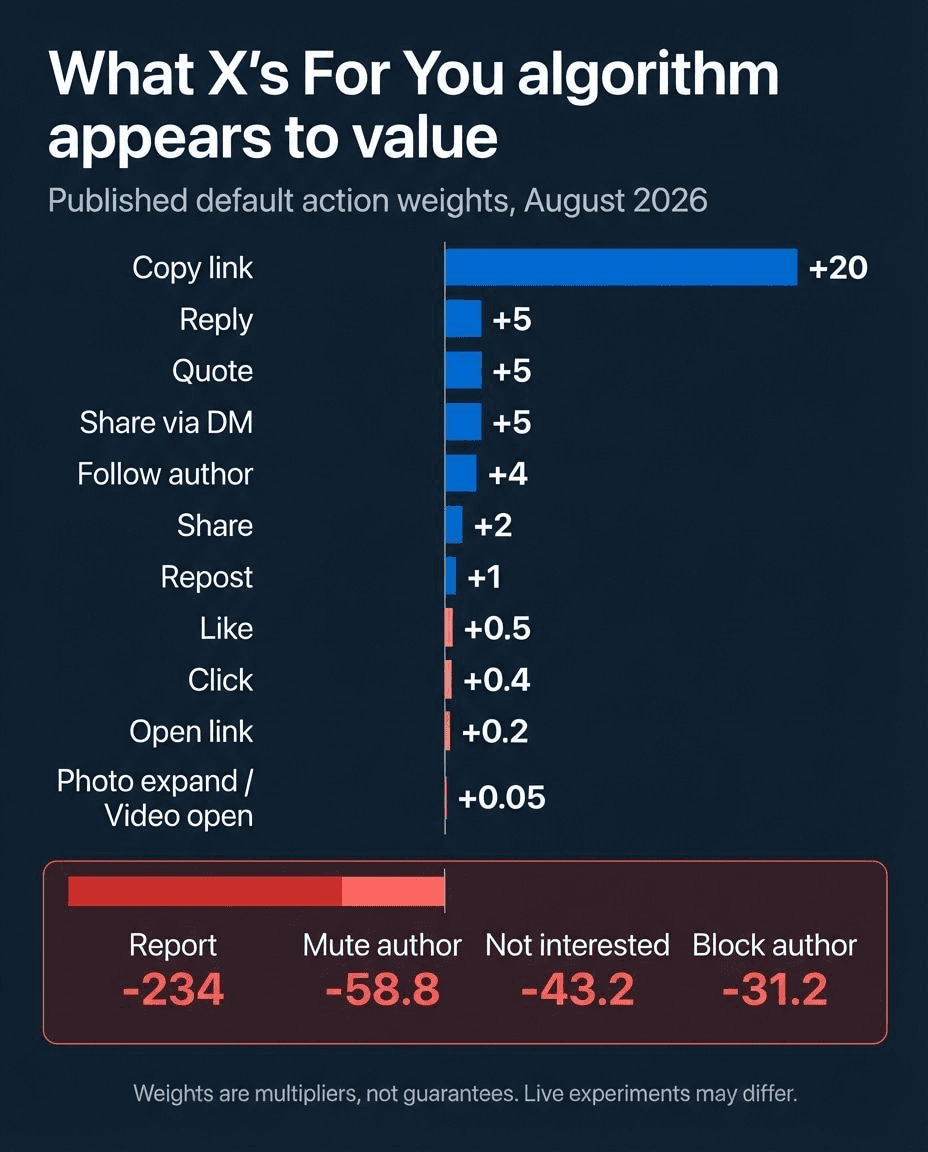 If you are searching for the X algorithm scoring weights, here is the short version: X open-sourced its recommendation system, and it does not optimize for likes. It optimizes for predicted actions, and it weights them very unevenly. Copying a link is worth roughly +20x, a reply or quote +5x, and a plain like only +0.5x. Negative signals hit far harder than positive ones. It is the first time a major platform has been this open about the exact math, and while the weights are defaults that experiments can override, they tell you a lot about how modern feeds actually think.
How the X algorithm works at a high level
The system is both simple and complex.
At the top level it is easy to describe. X gathers candidate posts, predicts what you are likely to do with each one, and then filters and ranks them by those predictions. The complexity lives inside that middle step, where a stack of models estimates the probability of each possible action and multiplies it by a weight.
The key idea is this: X ranks on predicted actions, not on the actions themselves. It is not counting likes after the fact. It is guessing, before it shows you a post, how likely you are to reply, reshare, copy the link, or hit report, and it scores the post accordingly.
That distinction matters because it means the feed is forward-looking. It is trying to serve you the thing you are about to act on, which is why chasing raw engagement counts is the wrong mental model.
The positive scoring weights
Here is how X values the actions it wants more of, based on the open-sourced defaults:
Swipe sideways to compare
| Action | Weight |
|---|---|
| Copy a link | +20x |
| Reply or quote | +5x |
| Follow (from the post) | +4x |
| Like | +0.5x |
| Open a link | +0.2x |
Two things jump out.
First, copying a link is worth 40x a like. A link copy is a strong signal that someone found the post useful enough to save or send elsewhere. That is high-intent behavior, and the system rewards it accordingly.
Second, a reply or quote is worth 10x a like. The feed is built to reward conversation and re-sharing with commentary, not passive approval. A like is cheap, so it is priced cheaply. Opening a link scores almost nothing on its own, which is a surprise to anyone who assumed clicks were the goal.
The negative scoring weights punish rejection hard
The penalties dwarf the rewards.
Swipe sideways to compare
| Action | Weight |
|---|---|
| Report | -234x |
| Mute | -59x |
| Mark "not interested" | -43x |
A single report is weighted more heavily than eleven link copies. That asymmetry is deliberate. Platforms have learned that letting people down, or worse, provoking them, is far more damaging to long-term retention than a good post is helpful. So the system is tuned to avoid negative reactions even more than to chase positive ones.
The practical read: one post that makes people hit "not interested" can undo the reach of several good ones. Bait, outrage-farming, and clickbait that underdelivers are not just ineffective, they are actively penalized.
What X ignores
Some signals people obsess over are absent or effectively unused in the defaults:
- Dwell time is not a core weight here, despite being the metric everyone assumes runs modern feeds.
- Profile views do not feed the score directly.
- Whether a post is AI-generated is not a factor in these weights.
These are defaults, and experiments can and do change them, so do not treat any single number as permanent. But the shape of the system is the real takeaway, and that shape is stable: reward high-intent sharing, punish rejection, discount cheap approval.
The lesson for LinkedIn creators
You cannot see LinkedIn's exact weights, but the direction of travel is the same across every major feed.
LinkedIn has clearly moved toward the same philosophy: reward posts that people save, send, and genuinely discuss, and discount cheap likes. Our breakdown of why saves are the LinkedIn metric that actually matters is the LinkedIn version of X's +20x link copy. A save is someone deciding your post is worth returning to, which is the strongest simple signal you can earn. And the way LinkedIn's ranking now reads the content of a post, not just its engagement, lines up with what we covered in what the LinkedIn algorithm changed in 2026.
So the transferable rules are straightforward:
- Write for the reply and the save, not the like. Ask a real question, take a position worth quoting, and make the post worth keeping. Those are the high-weight actions everywhere.
- Do not farm outrage. Negative reactions are weighted to hurt you more than positive ones help. A post that annoys people is worse than a post that gets ignored.
- Earn the share. The single highest-value action on X is copying the link. On LinkedIn, aim for the post people send to a colleague or save for later.
- Ignore vanity metrics. Likes and raw clicks are cheap signals. Judge your content by whether it starts conversations and gets kept.
None of this is about gaming a formula. It is about the fact that every serious feed now optimizes for the same thing: high-intent engagement over passive approval, and avoiding the reactions that make people want less of your content.
If you want to put that into practice, 2pr.io is an AI agent for LinkedIn that drafts posts in your own voice and helps you build the kind of specific, save-worthy content these systems reward. Its analytics show you which posts actually earned saves and comments, not just likes, so you can steer toward the signals that matter. It runs on the official LinkedIn API, so your account stays safe, and plans start at $24/month on annual billing, or $49 month to month, on the pricing page.
The bottom line
X open-sourcing its scoring weights is a rare, concrete look inside a major feed, and the message is clear: it does not optimize for likes. It rewards high-intent actions like link copies and replies, weights follows and quotes heavily, and punishes reports and mutes far more than it rewards anything positive. The exact numbers are defaults that can change, but the shape is durable and it maps straight onto LinkedIn. Write posts people reply to, save, and send. Avoid the ones that make people look away. That is what every algorithm worth ranking on is actually measuring.
More LinkedIn guides
The taste gap, and why your first posts disappoint you
The taste gap is why your writing feels worse than your standards. Here is what it is, why it hits creators hardest at the start, and how to close it.
August 21, 2026Is LinkedIn reach dying? No, it is maturing
Is LinkedIn reach dying in 2026? No. It is maturing from follower-first to interest-first. Here is what changed and why small accounts still win.
October 2, 2026How to get more impressions on LinkedIn: 12 lessons
How to get more impressions on LinkedIn, from 2M impressions in a year: chase breakout posts, win the hook, pick a lane, and measure every post.
Grow on LinkedIn with 2pr
Ideas, AI drafts in your voice, carousels, scheduling, and analytics: one tool. Start your free trial.
Start free trial