
LinkedIn Saves: the only metric that actually matters
June 23, 2026
TL;DR
If you're asking what metrics matter on LinkedIn, my short answer is this: saves matter most, then meaningful comments, profile visits, DMs, and conversions. Likes, raw follower count, and surface engagement are weak signals. I learned this the hard way from my own data. I had one post with 419 engagement and 0 saves and another with 712 engagement and 215 saves. From the outside, both looked "good." Inside the analytics, only one had the signal LinkedIn actually wants: people stopping, reading, and deciding it's worth keeping.
 If you're asking what metrics matter on LinkedIn, my short answer is this: saves matter most, then meaningful comments, profile visits, DMs, and conversions. Likes, raw follower count, and surface engagement are weak signals. I learned this the hard way from my own data. I had one post with 419 engagement and 0 saves and another with 712 engagement and 215 saves. From the outside, both looked "good." Inside the analytics, only one had the signal LinkedIn actually wants: people stopping, reading, and deciding it's worth keeping.
The uncomfortable data
I shared this in workshops because it makes people uncomfortable.
Post A had 419 engagement and 0 saves.
Post B had 712 engagement and 215 saves.
Now ask the real question: which one did the algorithm want to keep distributing?
Not the one that looked busy.
The one that made people bookmark it.
This is the mistake most people make when judging LinkedIn performance. They look at public metrics because public metrics are visible. Likes. Congrats comments. Surface-level activity.
But public metrics are often the worst way to evaluate whether a post has real legs.
I've seen it in my own analytics again and again. A post can look average outside and still drive serious reach, profile visits, and business impact. Another can look popular and still be a dead end.
That is why "what metrics matter on LinkedIn" is the wrong question if you're still thinking in vanity terms. The better question is: what signals tell LinkedIn this post deserves more distribution?
Why saves are Brew 360's top signal
LinkedIn's current system, what many creators refer to as Brew 360, behaves less like an old-school reaction counter and more like an editor.
It reads for quality.
It looks for whether people spend time with the post.
It looks for whether the post creates enough value that a reader wants to come back to it later.
That is where saves become so important.
A like is cheap. A save is expensive.
A like can happen in half a second. Someone agrees, taps, keeps scrolling.
A save means something else happened first:
- They stopped
- They read
- They decided this was useful enough to keep
That sequence is tightly connected to dwell time. And dwell time is one of the clearest signals that the post held attention.
You have about 5-7 seconds to win or lose a reader on LinkedIn. The first line and first two lines do most of the work. If someone slows down, opens the post, reads, and saves it, that's a much stronger quality signal than a casual like.
This is why I tell people: saves are not just a metric. They're evidence of depth.
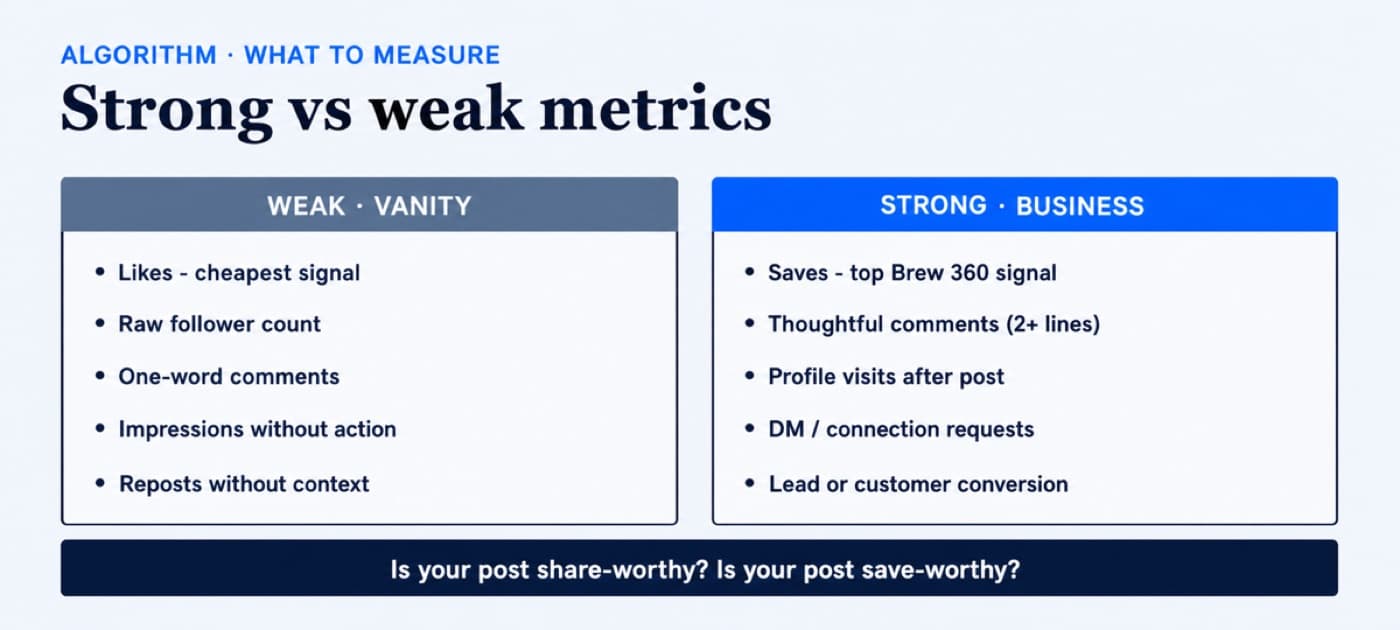
The full weak vs strong metrics breakdown
Not all engagement is equal.
Here is how I think about it.
Weak metrics
-
Likes
The cheapest signal on the platform. Good for ego, weak for diagnosis. -
Raw follower count
A big audience helps, but relevance matters more than size. -
One-word comments
"Great." "Guide." "This." These do very little compared to a real response. -
Impressions without action
Reach is useful context, not proof of value. -
Reposts without context
If somebody shares your post with no added opinion, that is weaker than it looks.
Strong metrics
-
Saves
Best signal that the content had practical value. -
Meaningful comments
Two or more lines. Added thought, disagreement, example, question. -
Profile visits after a post
Especially important if your sales happen through trust and DMs. -
Connection requests and DMs
A strong sign the content moved someone from passive reader to active buyer or peer. -
Lead and customer conversion
The final score. Numbers do not matter if they do not connect to business outcome.
This is also why I tell founders not to obsess over averages. In my own data, roughly 5% of posts drive 95% of reach. That pattern is common. Don't optimize for the median post. Optimize for the breakout.
Why likes are the cheapest signal
A like is not useless. It just gets too much credit.
People like posts for all kinds of lazy reasons:
- They know you
- They agree with the headline
- They want to be polite
- They barely skimmed it
- They are scrolling fast and tap almost by reflex
None of that means the post was memorable.
None of that means the post taught anything.
None of that means the reader would ever come back, share it privately, visit your profile, or buy from you.
That is why high-like content often underperforms in business terms. It can be emotionally pleasant, socially safe, and strategically weak.
A post with fewer likes but more saves is often doing a much better job. It is becoming a reference point, not just a passing reaction.
If you want attention, likes can flatter you.
If you want distribution and business results, you need stronger signals.
The two questions I ask before posting
Before I publish, I run a simple filter.
-
Is this share-worthy?
Would someone send this to a colleague, founder, marketer, or friend because it makes them look smart or helpful? -
Is this save-worthy?
Would someone want to come back to this later because it contains a framework, a sharp insight, a breakdown, or a useful example?
If the answer to both is no, I usually should not post it.
This sounds harsh, but most B2B content fails here. It talks without giving the reader a reason to keep it.
There is another good filter I like: does the post make people laugh, learn, or feel? If it does none of the three, it is usually too flat to travel.
On LinkedIn, "nice" is rarely enough.
Useful wins.
Sharp wins.
Specific wins.
How to make content more save-worthy
This is the practical part.
If you want more saves, stop writing for applause and start writing for utility.
Here are the patterns that help most.
-
Package lived experience into frameworks
People save structure. Checklists, models, step-by-step breakdowns, decision rules. -
Write from a clear role
Leader, Reporter, or Curator. Or a hybrid. My best posts are usually Curator + Leader. I take a public signal and add my own lens. -
Make the first two lines do all the work
If the preview does not hook, nothing below it matters. You have seconds, not minutes. -
Use contrast and tension
"Everyone tracks likes. The real metric is saves." Contrarian framing creates a reason to stop. -
Teach something concrete
Templates, examples, mistakes, breakdowns, benchmarks, comparisons. General inspiration gets likes. Specific instruction gets saves. -
Turn scattered information into one clean artifact
This is why curation works so well now. People do not need more information. They need less noise. -
Write posts people can act on today
If a reader can apply the idea this week, save-rate goes up. -
Avoid flat AI voice
LinkedIn is getting better at recognizing templated, lifeless writing. Human voice matters. Strong opinion matters. Real experience matters.
One more thing: virality is not always the goal.
I have had posts with large reach and near-zero business value because the topic had no connection to my product or my ideal customer. Big numbers can still be a waste.
The target is not random reach. The target is relevant attention.
What to actually track and how often
Most people either over-track or track the wrong things.
My recommendation is simple.
After every post, track:
- Saves
- Meaningful comments
- Profile visits
- Shares or sends if you have access to that data
- DMs, connection requests, and leads that came in after the post
Once per week, review:
- Which hooks created the strongest stop-rate
- Which topics generated the most saves
- Which posts drove profile actions, not just feed activity
- Which format fit the goal best: text, carousel, image, list, story
Once per month, review:
- Your top 5% posts, not your average post
- Topic repetition across your 2-3 core themes
- Whether your content is pulling the right audience into your profile
- Whether the content is turning into pipeline, not just reach
Also, do not trust LinkedIn post analytics blindly. I have seen cases where a single post appeared to drive only a modest number of followers in-post, while the actual follower growth over the next week was much higher. Some effects arrive later through profile revisits.
So use post analytics as a directional signal. Then validate against the broader account trend over a 7-day window.
FAQ
What metrics matter on LinkedIn the most?
Saves are the strongest content-quality signal, then meaningful comments, profile visits, DMs, connection requests, and conversion to leads or customers. Likes are the weakest widely-used metric because they are so cheap to give.
Are likes useless?
No. They are just overrated. Likes can help confirm that a topic has emotional or social appeal, but they are weak evidence that the post created lasting value. I would never use likes as the main success metric.
Does LinkedIn really reward saves more than likes?
From my own data and what I see across creator analytics, yes. Saves are strongly connected to dwell time and practical value. A post people want to return to is more likely to keep getting distributed than a post that only gets fast reactions.
How often should I review LinkedIn metrics?
I like a three-layer rhythm: after each post for direct signals, weekly for pattern recognition, monthly for strategic review. Daily obsession is noise. Monthly-only review is too slow. Weekly is where most of the useful learning happens.
Should every post be optimized for saves?
Not every post, but most educational or authority-building content should be. Some posts are better for conversation, some for emotion, some for profile clicks. But if you want sustainable distribution, save-worthy content should be a core part of your mix.
More LinkedIn guides
How Oliver Baker 16x'd his LinkedIn reach by changing one thing
A real LinkedIn case study. Oliver Baker, a mathematician and founder, was already posting before 2pr.io with low return. Across 25 posts, his average impressions went from 960 to 15,588 (16x) and engagement from 15 to 141 (9x). Same author, same voice. Here is what actually changed.
June 23, 2026LinkedIn profile optimization: the quarterly review checklist
If you want a practical LinkedIn profile optimization checklist, use this one every quarter: update your Headline, About, Featured, and Endorsements. That...
September 18, 2026LinkedIn's Network tab: what the feed split means
LinkedIn split the feed into For You and Network tabs. Here is what the change does, why it happened, and what it means for creators.
Grow on LinkedIn with 2pr
Ideas, AI drafts in your voice, carousels, scheduling, and analytics: one tool. Start your free trial.
Start free trial