
LinkedIn profile optimization: the quarterly review checklist
June 23, 2026
TL;DR
If you want a practical LinkedIn profile optimization checklist, use this one every quarter: update your Headline, About, Featured, and Endorsements. That is the core system. Your profile is not a one-time setup. It is a live sales asset. If your positioning changed, your profile should change too. If your content improved, your profile should support it. If people are visiting after a post, a comment, or a referral, your profile should make the next step obvious. I review LinkedIn profiles this way because quarterly updates beat annual rewrites every time.
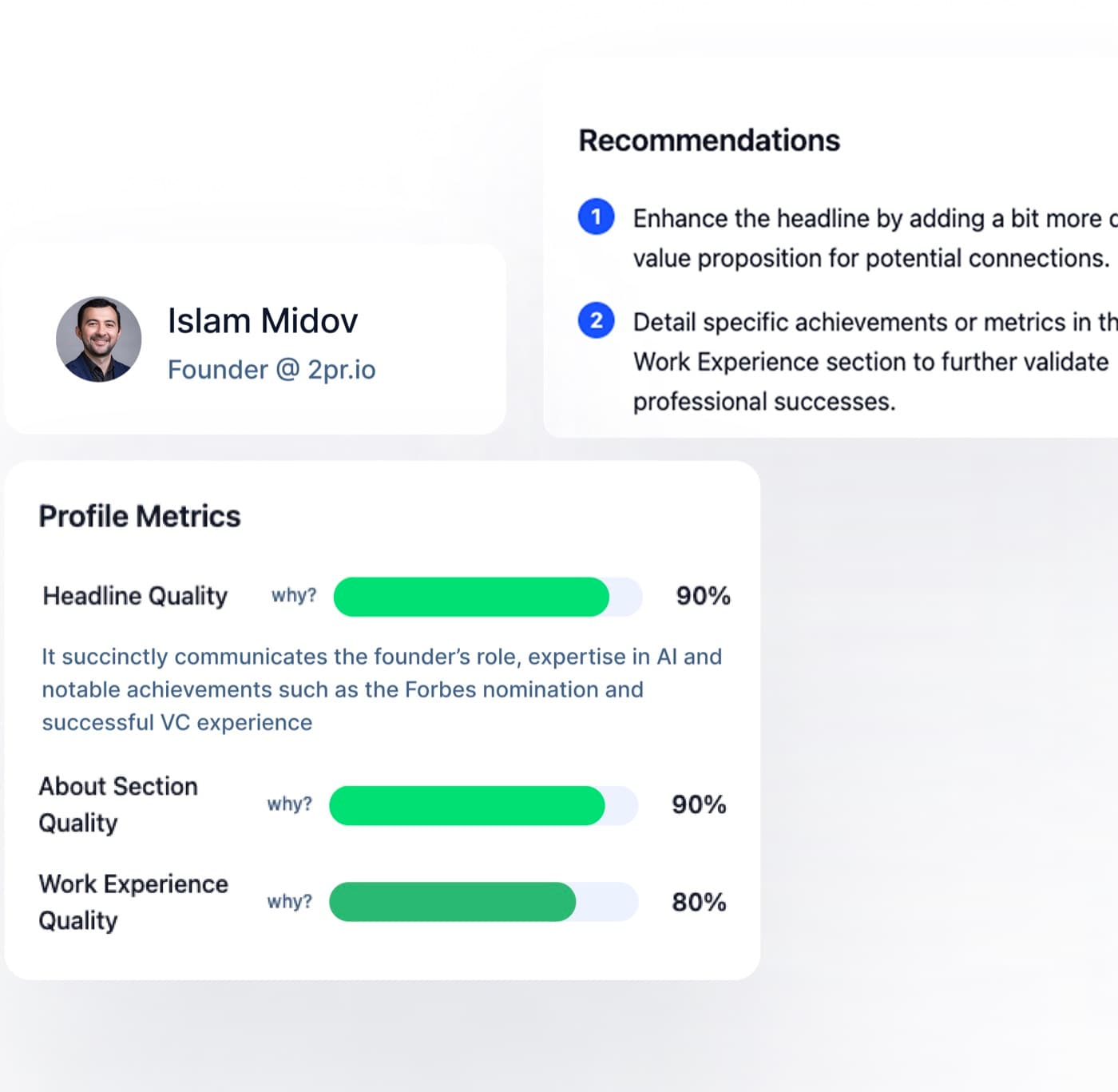 If you want a practical LinkedIn profile optimization checklist, use this one every quarter: update your Headline, About, Featured, and Endorsements. That is the core system. Your profile is not a one-time setup. It is a live sales asset. If your positioning changed, your profile should change too. If your content improved, your profile should support it. If people are visiting after a post, a comment, or a referral, your profile should make the next step obvious. I review LinkedIn profiles this way because quarterly updates beat annual rewrites every time.
Your profile is your website
I know people say this all the time, but it is still true: your LinkedIn profile is your website.
The problem is that most people build it once, upload a headshot, write a generic job title, and then leave it untouched for two years.
You would never do that with a real website. You would update the headline, tighten the copy, swap weak proof for strong proof, and make sure the page still matches what you actually sell.
Your LinkedIn profile deserves the same treatment.
Especially now, profile quality matters more than many people think. On LinkedIn, attention is short. People scan fast. They decide in seconds whether you are relevant, credible, and worth messaging. If the profile feels vague, outdated, or overstuffed, that visit dies right there.
The Becca Chambers case made this obvious
Last week, this idea became visible in public.
Becca Chambers shared her LinkedIn profile review, and it took off. The post went viral. But the interesting part was not just the reach.
It was the comments.
People started posting their own profile reviews, their own before-and-afters, their own fixes. The comments filled up with professionals realizing the same thing: they had been treating their profile like a static CV, not like a living conversion asset.
That reaction did not surprise me.
Most people do not ignore their profile because they are lazy. They ignore it because they think profile work is a one-time job. Set it up once, done forever. That is the wrong mental model.
The better model is this: every quarter, run a profile health check.
Why quarterly beats one big rewrite
Quarterly is the right rhythm because your positioning changes faster than you think.
Maybe your offer changed.
Maybe your target customer changed.
Maybe your best-performing content revealed what people actually come to you for.
Maybe you changed roles, moved upmarket, narrowed your niche, or stopped wanting to be known for three things at once.
Your profile should keep up with that.
A yearly rewrite is too slow. By then, your profile is usually lagging behind your business. A quarterly review is small enough to do consistently and frequent enough to keep you aligned.
I like this cadence because it forces clarity without turning into a giant branding project.
Every 90 days, ask one simple question: if a stranger lands on my profile today, do they see the version of me I actually want to sell now?
The 4-element LinkedIn profile optimization checklist
This is the framework I use.
- Headline
- About
- Featured
- Endorsements
That is it.
Not 17 micro-optimizations. Not endless keyword stuffing. Not rewriting every section every week.
Just four elements that shape how people understand you.
1/ Headline: specialization + tagline, not job title
Most headlines are wasted.
People write something like: “Founder at X” or “Account Executive at Y” or “Marketing Manager | SaaS”.
That tells me almost nothing.
Your headline should communicate specialization + tagline.
In plain English: what are you specifically known for, and how do you frame the value?
A weak headline: “Founder at ABC Agency”
A stronger one: “B2B SaaS email strategist | I help founders turn lifecycle emails into revenue”
Another weak one: “Product designer at Startup”
A stronger one: “Fintech product designer | I simplify complex flows so users convert faster”
Job title is internal. Specialization is market-facing.
This matters because a profile visit is a fast scan, not a deep read. The headline does a big part of the work. It should help the right person say, “Yes, this is relevant to me.”
If it could belong to 100,000 people, it is too generic.
2/ About: positioning, not resume
The About section is where many smart people accidentally write a boring autobiography.
They list career history. They explain where they worked. They summarize experience like a compressed CV.
That is not what this section is for.
Your About section should position you.
I want to understand:
- What lane are you in?
- Who do you help?
- What kind of problems do you solve?
- What is your angle or philosophy?
- What should I do next if I want to work with you?
Resume language sounds like this: “I have 8+ years of experience across strategy, operations, and business development in multiple sectors.”
Positioning language sounds like this: “I help B2B founders clarify their message and turn expertise into content that brings qualified inbound.”
See the difference?
One describes your background. The other tells me why I should care.
Your About section does not need to be long. It needs to be sharp. I would rather read 6 clear lines than 25 lines of polished fog. The About box has no native styling, so if you want a line to stand out, run it through a LinkedIn text formatter and bold the one sentence that carries your positioning.
3/ Featured: show the best proof, not random links
Featured is one of the most underused parts of LinkedIn.
Many people leave it empty. Others fill it with whatever was convenient that day.
That is a mistake.
Featured should function like proof and direction. When someone wants one level deeper, this section should guide them.
The simplest version is:
- Your 3 best posts
- A landing page
- A lead magnet
That mix works because it covers three needs at once.
The posts show thinking and credibility.
The landing page gives a direct commercial next step.
The lead magnet gives a softer step for people who are interested but not ready.
If you do not have all three, start with the strongest proof you already have. Good case study post. Strong breakdown post. Useful free resource. Sharp company page. Anything that helps the visitor move from “interesting” to “I get what this person does.”
Do not feature clutter. Feature leverage.
4/ Endorsements: key skills only, not everything
Endorsements are not the most important section, but they still shape perception.
The common mistake is leaving every possible skill there. That creates noise.
You do not need to look broad. You need to look legible.
Pick the skills that support your positioning.
If you want to be known for B2B content strategy, demand generation, and LinkedIn ghostwriting, those should be visible.
If your profile still highlights obsolete or irrelevant skills from a previous era, you are sending mixed signals.
I would rather see 5 tightly aligned skills than 40 random ones.
A quarterly review is the right time to trim this list.
What changes if you sell self-serve vs through DMs
This is where profile optimization gets more strategic.
Not every business should optimize the profile the same way. It depends on the sales model.
If you sell self-serve or small-ticket offers, content usually matters more than profile.
The person sees the post, clicks the link, and buys or signs up. The decision happens in the feed. In that case, content is doing most of the heavy lifting, and the profile is secondary support.
If you sell through DMs, calls, demos, or larger-ticket services, content and profile work as a pair.
The post gets attention. Then the person checks your profile before messaging you.
That means profile quality directly affects conversion from attention to conversation.
This is why I tell founders not to obsess over vanity metrics. A viral post is not the finish line. If it sends people to a vague profile, you waste the traffic.
For DM-led businesses, the profile is where trust gets confirmed.
For self-serve businesses, the profile still matters, but it matters less than the path from post to offer.
That difference should shape what you optimize for.
The quarterly review questions I actually use
If you want to keep this simple, use these questions every 90 days:
- Does my headline say what I am specifically known for now?
- Does my About section position me clearly, or just summarize my past?
- Does Featured show my best proof and the next step?
- Do my top skills reinforce the market I want, not the career I had?
If one of these breaks, the profile starts drifting.
And drift is the real problem.
Most weak LinkedIn profiles were not created badly. They became inaccurate slowly.
FAQ
How often should I update my LinkedIn profile?
Quarterly is the best default. It is frequent enough to keep your positioning current, but not so frequent that you turn profile editing into procrastination. If you changed offer, audience, or messaging, update earlier.
Should I optimize my profile for keywords or for humans?
Humans first. Clear positioning beats awkward keyword stuffing. Yes, relevant terms matter, but LinkedIn profile optimization works best when the page reads naturally and instantly tells a visitor who you help and why you matter.
What matters more: content or profile?
It depends on your sales model. For self-serve and low-ticket offers, content usually carries more weight because the buying decision can happen directly from the post. For DM-led, service-led, or demo-led businesses, profile quality is critical because people check it before they reach out.
What should I put in the Featured section if I do not have a lead magnet?
Use your strongest proof. That can be your best-performing posts, a strong case study, a founder story that explains your angle, a landing page, or a high-value resource. The rule is simple: feature what helps the right visitor trust you faster.
Do endorsements still matter on LinkedIn?
Yes, but only as a supporting signal. They will not save a weak profile, but they can reinforce a strong one. Keep only the skills that match the reputation you want now. Relevance matters more than volume.
Is my LinkedIn profile really that important if I already post consistently?
Yes, especially if your goal is inbound leads, partnerships, hiring, or authority. Posts create attention. Profiles convert attention into action. That is exactly why I treat profile review as a recurring system, and why we built that thinking into 2pr.io in the first place.
More LinkedIn guides
LinkedIn Saves: the only metric that actually matters
If you're asking what metrics matter on LinkedIn, my short answer is this: saves matter most, then meaningful comments, profile visits, DMs, and...
June 23, 2026How to find LinkedIn post ideas in 15 minutes (the 5:3:1 method)
If you want to know how to find LinkedIn post ideas, my short answer is this: stop trying to invent ideas from scratch, study 5 strong donor posts from...
September 18, 2026LinkedIn's Network tab: what the feed split means
LinkedIn split the feed into For You and Network tabs. Here is what the change does, why it happened, and what it means for creators.
Grow on LinkedIn with 2pr
Ideas, AI drafts in your voice, carousels, scheduling, and analytics: one tool. Start your free trial.
Start free trial