
How to find LinkedIn post ideas in 15 minutes (the 5:3:1 method)
June 23, 2026
TL;DR
If you want to know how to find LinkedIn post ideas, my short answer is this: stop trying to invent ideas from scratch, study 5 strong donor posts from earlier-moving platforms, extract 3 hooks that already proved they can stop attention, and turn 1 of them into a post in your own territory. That is my 5:3:1 method.
I use it because LinkedIn is usually not where ideas are born. It is where ideas arrive after they already got validated somewhere else. If you know where to look, you can find a week or two of advantage in 15 minutes.
Why most people run out of ideas
Most people do not run out of ideas because they have nothing to say.
They run out because they use the wrong sources and the wrong standard.
The wrong sources are usually:
- Their own head
- The LinkedIn feed only
- Generic AI prompts that produce flat content
The wrong standard is "I need to be original."
That sounds noble, but it is a bad operating system for content.
Viral formats are rarely invented. They are observed. The hook, angle, emotion, and framing usually already worked somewhere else. Your job is not to create a completely new wave. Your job is to catch the wave before your niche sees it everywhere.
I learned this the hard way. It may seem like I went viral immediately. I did not. I have been in social media for 5+ years. Nobody is born knowing how to make viral content. It is a system and a craft.
Also, one more important point: nobody can guarantee a viral post. I cannot. You cannot. But you can absolutely increase the odds.
That is the game.
The platform diffusion chain most people ignore
The biggest mistake on LinkedIn is treating LinkedIn like the origin of trends.
Usually it is the endpoint.
In practice, the diffusion chain often looks like this:
- Reddit - week 0
- X - week 0-1
- LinkedIn - week 1-2
Sometimes Telegram runs in parallel for Russian-speaking audiences, but the principle is the same.
What does this mean in plain English?
By the time a topic feels "hot" on LinkedIn, it was often validated on Reddit weeks earlier.
Reddit is where raw pain, contrarian takes, weird edge cases, and emotionally loaded stories surface first. X picks them up faster, compresses them into sharper hooks, and stress-tests them in public. LinkedIn gets the cleaned-up professional version after the market already told you the topic works.
That is why I like Reddit so much for idea sourcing. One of my posts got 220K+ reach on LinkedIn after I took a trending topic from Reddit and brought my own professional angle to it.
The topic was not born on LinkedIn. The opportunity was.
Early wins. "Trendy" means late.
This is where most creators get confused.
They think, "I want to write about trends."
Fine. But at what stage?
There is a huge difference between early and trendy.
Early means:
- The topic has emotional heat
- A few posts are proving demand
- Your audience has not seen it 50 times yet
Trendy usually means:
- Everyone is already posting their version
- The novelty is gone
- You are competing in a crowded feed with weaker odds
Zaria Parvez from Duolingo framed this well: early entrants win, trendy means already late.
The same idea applies on LinkedIn. If you discover a topic only after it is obviously everywhere, you are not trend-riding. You are trend-following.
That is slower, noisier, and less effective.
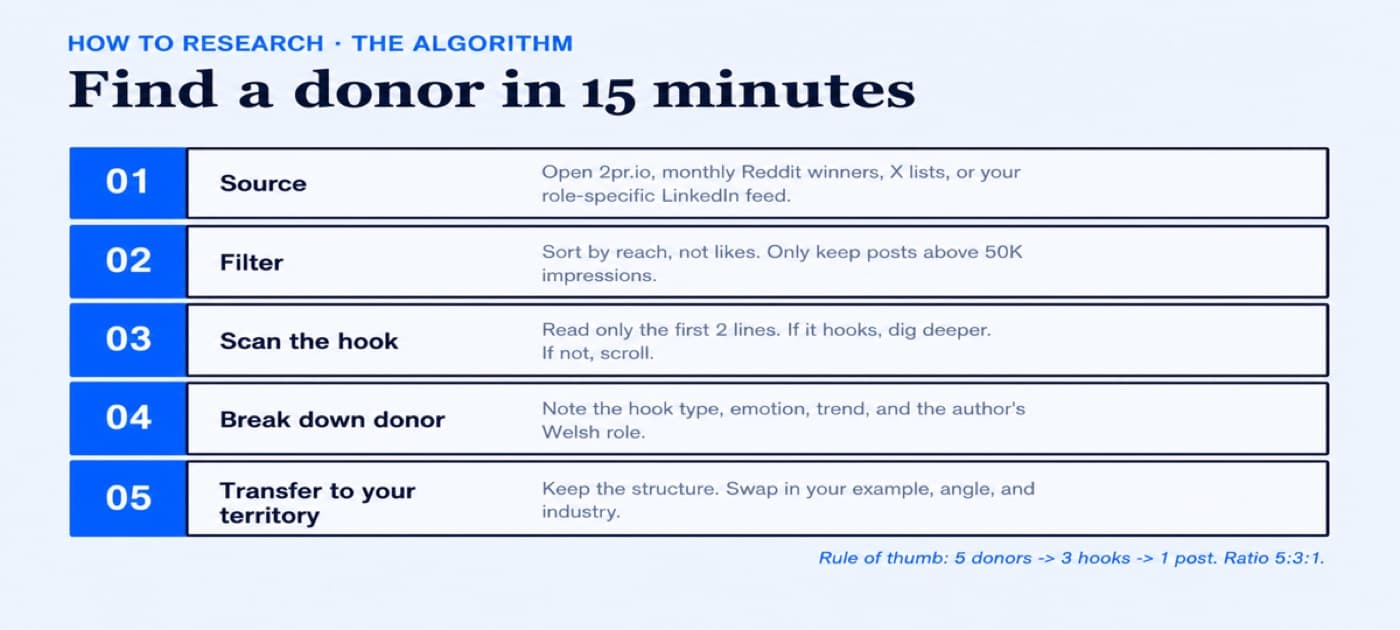
My 5-step donor research algorithm
This is the exact process I recommend when people ask me how to find LinkedIn post ideas fast.
You do not need hours. You need structure.
1/ Source
Open a source where strong ideas already exist.
My favorite sources:
- Reddit top posts of the month in relevant subreddits
- X lists with sharp operators in your niche
- LinkedIn posts from your role's canon creators
- In 2pr.io, viral post libraries and creator-level top content
The key is simple: do not start from a blank page. Start from proven energy.
2/ Filter
Do not sort by likes. Sort by reach or obvious breakout performance.
A post with decent likes can still be weak. A post with strange save behavior or strong dwell time can be far stronger than it looks from the outside.
My default filter is this:
- Only study posts with serious distribution
- Ignore average content
- Look for breakouts, not decent posts
This matters because 5% of posts usually drive 95% of reach. That pattern shows up in my own data and in most creator ecosystems.
Do not optimize the average post. Optimize for what breaks out.
3/ Scan the hook
Read the first two lines only.
That is usually enough.
On LinkedIn, the first line decides most of the post's fate. People scan fast. You often have 5-7 seconds. If the preview does not hook them, they do not open the post.
So ask:
- Did this stop me?
- Why did it stop me?
- What emotion is doing the work?
If the hook does not pull you in, scroll.
If it does, study it.
4/ Break down the donor
Now reverse-engineer what actually happened.
I write down four things:
- Hook type
- Core emotion
- Trend phase
- Welsh role of the author
For emotion, I use a simple hierarchy. Stronger emotions usually win attention: threat, unbelievable upside, blame, FOMO, curiosity. Weak corporate pride and boring competence-posting usually lose.
For role, I use the Justin Welsh framework:
- Leader - only I know, based on lived experience
- Reporter - almost nobody knows, based on access or original research
- Curator - this is public, I filtered it for you
This part matters because the same topic lands differently depending on who you are allowed to be.
5/ Transfer to your territory
This is the step where people either become useful or become copycats.
You do not copy the content.
You transfer the structure.
Same hook pattern. Different example. Different proof. Different perspective. Your industry. Your audience. Your lived experience.
For example, if the donor hook is contrarian, I might keep the contrarian structure but swap the subject for something I understand from my own background in venture, content, or B2B growth.
That is how you stay native to your voice while still borrowing proven mechanics.
The 5:3:1 rule
Here is the full ratio:
- Study 5 donor posts
- Extract 3 hooks worth adapting
- Publish 1 post
Why this ratio works:
Five donors are enough to spot patterns without drowning in research.
Three hooks are enough to create choice. One hook rarely gives you perspective. Three forces comparison.
One final post keeps the process tight. Research should feed output, not replace it.
This is also how you avoid the trap of endless inspiration.
The point is not to collect 50 screenshots and feel productive. The point is to publish.
Best sources by role: Leader, Reporter, Curator
Not every source fits every creator.
Use sources that match the role you can credibly play.
Leader
If you are a Leader, your best donors are:
- Strong opinionated creators in your field
- Contrarian operators with clear lived experience
- Posts that trigger a "I have seen this from the inside" reaction
You are not borrowing facts. You are borrowing framing.
Reporter
If you are a Reporter, your best donors are:
- Public datasets
- Industry reports
- Multi-post conversations across Reddit and X
- Threads that hint at a pattern nobody compiled yet
Reporter content wins when you do the homework other people skip.
A great Reporter post often starts with public information. The edge is not secret access. The edge is original synthesis.
Curator
If you are a Curator, your best donors are:
- Reddit tops
- X trend clusters
- LinkedIn posts with unusual saves or comments
- Smart niche newsletters and roundups
Curator is underrated. In the age of AI content flood, attention is worth more than information. If you can consistently say "ignore the noise, this is the thing that matters," you are already useful.
Hybrid: Curator + Leader
This is my main mode.
I take a public story, trend, or signal and add my own angle.
That is also the easiest pattern for many experts. You do not need insider access. You need taste plus perspective.
Most good LinkedIn commentators are really Curator + Leader hybrids.
How to turn this into a 15-minute weekly habit
This does not need to become a content ritual that eats your calendar.
Here is the weekly version:
- Spend 5 minutes pulling 5 donors from Reddit, X, or your reference creators
- Spend 5 minutes scanning the first two lines and breaking down the best hooks
- Spend 5 minutes drafting 3 hook options and choosing 1 post to write
That is it.
If you do this once a week, you stop relying on random inspiration.
You also stop panicking every time you open LinkedIn and think, "What should I post today?"
Over time, your pattern recognition gets faster. You start seeing hook mechanics everywhere. You start spotting trend timing earlier. You also get more honest about what fits your actual audience.
And that part matters.
I have had posts with big reach and zero business value. One of my flops hit around 150K reach but brought no real result because the topic was wrong for my ICP and had no connection to the product. Numbers are not the goal by themselves.
Reach is useful when it reaches the right people.
FAQ
Is virality the goal?
Not always. Reach is not the goal. Leads, trust, hiring, demand, and authority are the goal. Some creators should optimize more for authenticity or balance than for maximum reach. The best power users I know care a lot about voice, not just numbers.
Do I need a huge audience to use this method?
No. You do not need a giant profile. Relevance matters more than size. Even 5,000 strong connections in the right niche can be enough to get meaningful distribution if the post is sharp and the topic is timely.
Can I just use AI to generate LinkedIn post ideas instead?
AI can help you process and rewrite, but it is a weak substitute for taste. Brew 360 increasingly rewards live human voice, semantic relevance, and posts people actually save or comment on meaningfully. If the output feels templated, flat, or generic, it will usually underperform.
How often should I post on LinkedIn?
For most people, 3-5 times per week is enough if you can sustain it for 6+ months. Consistency matters more than a heroic burst. I would rather see someone post three solid posts every week than seven forgettable ones.
When should I expect results?
Usually in 3-6 months of systematic work, not from the first post. The method improves your odds, but this is still a craft. You need reps, better judgment, and feedback loops. That is normal. The people who look effortless usually have years of invisible practice behind them.
More LinkedIn guides
LinkedIn profile optimization: the quarterly review checklist
If you want a practical LinkedIn profile optimization checklist, use this one every quarter: update your Headline, About, Featured, and Endorsements. That...
June 23, 202650 LinkedIn hook formulas that actually work
If you’re searching for LinkedIn hook formulas, here’s the direct answer: the best hooks are short first lines that trigger one of a few predictable...
September 18, 2026LinkedIn's Network tab: what the feed split means
LinkedIn split the feed into For You and Network tabs. Here is what the change does, why it happened, and what it means for creators.
Grow on LinkedIn with 2pr
Ideas, AI drafts in your voice, carousels, scheduling, and analytics: one tool. Start your free trial.
Start free trial