
50 LinkedIn hook formulas that actually work
June 23, 2026
TL;DR
If you’re searching for LinkedIn hook formulas, here’s the direct answer: the best hooks are short first lines that trigger one of a few predictable reactions fast. Curiosity. Threat. Contrarian tension. Surprise. Relevance. Specificity. Proof. I’ve collected 50 LinkedIn hook formulas across 7 categories, and they work because they help you win the first 5 to 7 seconds of attention. That matters more than ever under LinkedIn’s Brew 360 era, where dwell-time, saves, and meaningful comments beat vanity metrics.
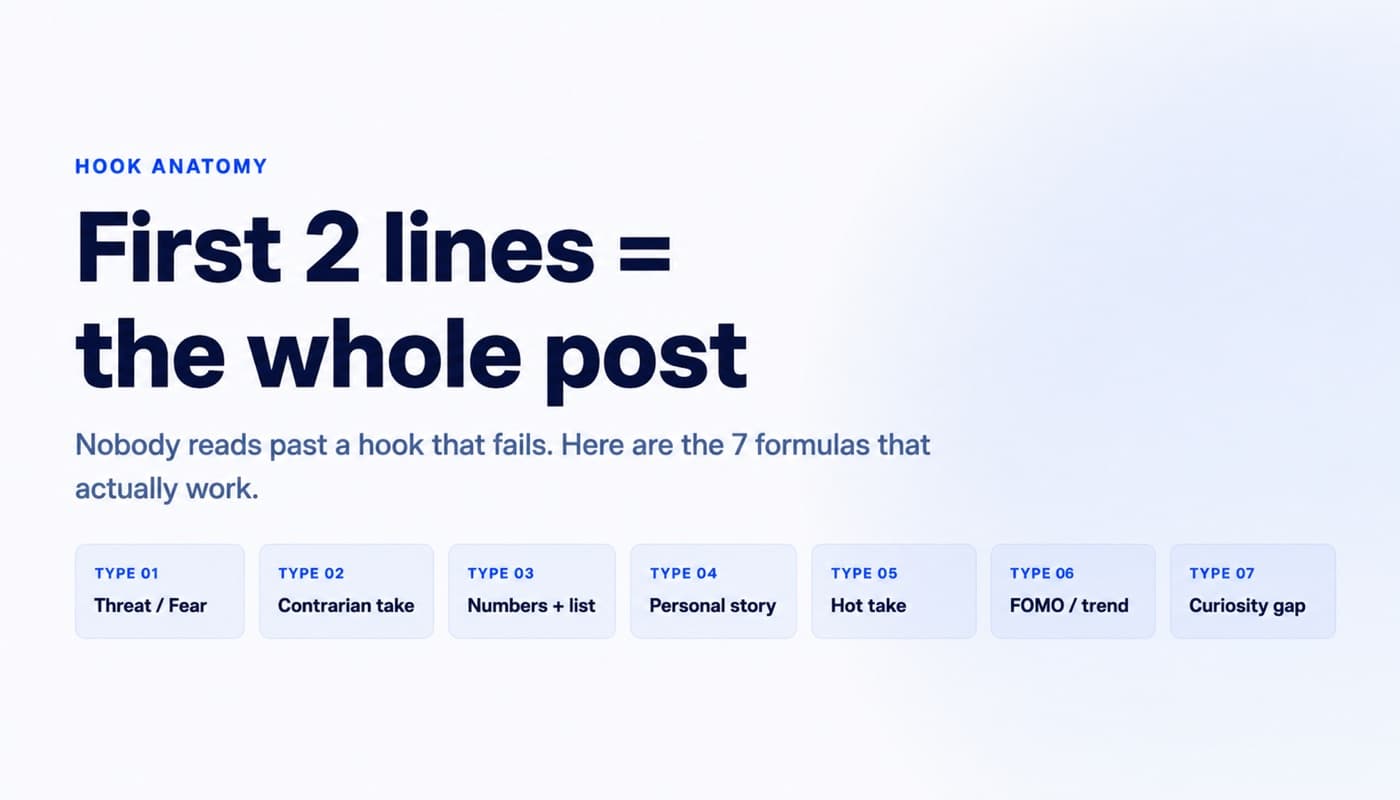 If you’re searching for LinkedIn hook formulas, here’s the direct answer: the best hooks are short first lines that trigger one of a few predictable reactions fast. Curiosity. Threat. Contrarian tension. Surprise. Relevance. Specificity. Proof. I’ve collected 50 LinkedIn hook formulas across 7 categories, and they work because they help you win the first 5 to 7 seconds of attention. That matters more than ever under LinkedIn’s Brew 360 era, where dwell-time, saves, and meaningful comments beat vanity metrics.
Why hooks matter more than ever
Most people still think a good LinkedIn post wins because the body is smart.
That is backwards.
The first line and first two preview lines decide whether the post gets a real chance. After that, the rest of the post can help. But first you need the click, the pause, or at least the stop-scroll.
Brew 360 made this even harsher. The algorithm is less about raw likes now and more about whether people actually spend time with your post. Dwell-time is one of the clearest quality signals, and in practice you have about 5 to 7 seconds before most people move on.
That is why I care so much about hooks.
From my own content data, and from what I’ve seen across creators, the distribution is brutal: 5% of posts drive 95% of reach. So I do not optimize the average post. I optimize for breakout potential.
Important disclaimer: nobody can guarantee virality. I cannot. You cannot. But you can absolutely improve the odds. This is not luck-only. It’s a craft.
The anatomy of a hook: what happens in 7 seconds
In those first seconds, a reader is subconsciously asking:
- Is this about me?
- Is this new?
- Is this useful?
- Is this risky to ignore?
- Is this worth opening?
A hook works when it answers at least one of those questions fast.
Weak hooks are vague, self-centered, or too polite.
Strong hooks usually do one of these things:
- Create tension
- Promise a useful payoff
- Show a sharp opinion
- Signal inside information
- Frame a problem the reader already feels
I define the hook as the first three lines, including line breaks before the "...more" button. On LinkedIn, that preview is the whole game.
The 7 hook categories and 50 formulas
Below is the library I keep coming back to. Do not copy-paste these word for word. Use them as structures.
1. Contrarian hooks
These work when the market is repeating the same opinion and you have a sharper take.
- Everyone is telling founders to do X. I think that’s a mistake.
- The popular advice on LinkedIn is wrong for most people.
- I used to believe X. Then I saw the numbers.
- The best growth tactic right now is the one nobody wants to hear.
- More content is not the answer. Better hooks are.
- Virality is overrated if it has no product connection.
- What looks smart in theory often fails in the feed.
2. Data and research hooks
These are ideal for Reporter energy. Show the work. Show the sample size.
- I analyzed 50 posts in this niche. Here’s what kept repeating.
- I reviewed 100 founder profiles. Almost all made the same mistake.
- We tracked the top-performing posts and one pattern stood out.
- I compared median posts vs breakout posts. The gap is bigger than people think.
- I spent 3 hours studying creators in this category. These 5 things mattered.
- I pulled examples from 20+ creators with 9M+ followers.
- One metric looked noisy. One metric actually predicted quality.
3. Mistake and failure hooks
People stop for pain faster than they stop for polish.
- Most founders are wasting great ideas on bad first lines.
- I spent years posting the wrong way.
- This one content habit quietly kills reach.
- I got reach, but zero business value.
- If your posts get likes but no leads, this is probably why.
- I made the classic LinkedIn mistake: I optimized for applause.
- A post can look successful from the outside and still fail.
4. Specific outcome hooks
Specificity beats generic inspiration every time.
- This post got 264K reach from one simple angle shift.
- Here’s the exact hook structure behind a 227K post.
- How I turned one public source into a breakout LinkedIn post.
- What normal reach looks like at 5-10K followers, and what breakout looks like.
- One post brought attention. Another brought actual buyers.
- The first line changed, and the post performance changed with it.
- 5,000 connections is enough if the topic is right.
5. Curiosity and open-loop hooks
Use these when the payoff is real. If the body disappoints, readers stop trusting you.
- I didn’t expect this hook category to outperform the others.
- The strongest LinkedIn signal is not the one most people watch.
- There’s a reason some posts feel impossible to ignore.
- One role on LinkedIn is easier than people think.
- The format looked viral. The business result was zero.
- I keep seeing smart operators miss the same simple lever.
- By the time a trend reaches LinkedIn, something important has already happened.
6. Authority and experience hooks
These work best when you’ve actually lived the thing.
- As a former VC, this is how I read this trend.
- After 5+ years in social media, here’s what I believe now.
- Building audience taught me something metrics alone never could.
- Founders ask me the same hook question again and again.
- I’ve seen enough posts flop to know where the real problem starts.
- From the outside this looked like a win. Up close, it wasn’t.
- Experience gave me an angle data alone would miss.
7. Framework and swipe-file hooks
These perform well because they promise a tool the reader can reuse.
- Here are 7 hook categories I use to write faster.
- I built a simple matrix for choosing the right hook.
- Use this 5:3:1 rule when researching posts.
- If you don’t know what to post, start with this role framework.
- Steal this structure, not the wording.
- Save this list before your next LinkedIn post.
- These are the only hook questions I ask before publishing.
- If a post doesn’t make people laugh, learn, or feel something, cut it.
How to adapt a hook to your voice, not copy-paste it
This is where most people get lazy.
A hook formula is not a finished sentence. It is a container. You still need your own example, your own tension, and your own tone.
I usually adapt a hook in four steps:
- Keep the structure
- Swap in my domain
- Add real specificity
- Remove phrases I would never say out loud
For example, don’t copy “Everyone is wrong about X.”
Instead write the version that fits your voice:
- “Most seed founders are getting bad LinkedIn advice”
- “In B2B SaaS, this content advice breaks fast”
- “I ignored this for too long, and it cost me reach”
The point is not originality for its own sake.
The point is to use a proven shape and make it sound human.
Brew 360 is increasingly hostile to flat, templated, AI-slop writing. Live voice matters. Expertise matters. Specificity matters.
The matrix: your Welsh role x hook type
Justin Welsh’s framework is still the cleanest way to decide what kind of creator you are on LinkedIn.
You are usually one of three roles:
- Leader - you have lived experience
- Reporter - you did the research or had the access
- Curator - you filtered the noise for others
There’s also a hybrid, which is where I operate most of the time: Curator + Leader.
Here’s how I think about the best role x hook combinations:
-
Leader + Contrarian
Best for founders, operators, investors, experts with scars. Strong because opinion plus experience is hard to fake. -
Leader + Authority
Best when you genuinely earned the perspective. Weak if you are performing expertise you do not have. -
Reporter + Data
Probably the most reliable combination for trust. It turns scattered information into signal. -
Reporter + Specific outcome
Great for teardown posts, studies, and benchmarks. Readers like evidence with numbers. -
Curator + Curiosity
Strong for trend commentary and insight roundups. Especially useful if you are early to a pattern. -
Curator + Framework
Great for beginners building consistency. You do not need insider access to help people organize information. -
Hybrid + Contrarian or Framework
This is my favorite. Take a public event, layer a real point of view on top, and package it clearly.
If you are unsure where to start, start as a Curator. It has the lowest barrier and the least risk of sounding fake.
FAQ
What are LinkedIn hook formulas?
LinkedIn hook formulas are reusable first-line structures that help your post win attention in the preview. They are not templates to copy blindly. They are patterns for triggering curiosity, tension, relevance, or authority in the first 5 to 7 seconds.
How many lines should a LinkedIn hook be?
I treat the hook as the first three lines, including line breaks before the "...more" cutoff. In practice, the first one or two lines do most of the work. If they don’t earn attention, the rest of the post rarely matters. Visual emphasis helps too: a bold first line made with a LinkedIn text formatter holds the eye a beat longer, as long as the words underneath earn it.
Which hook category works best for founders?
Usually Contrarian, Authority, and Framework hooks. Founders do best when they combine real experience with a sharp point of view. If you do not have enough lived stories yet, Curator + Framework is a better starting point than pretending to be a thought leader.
Should I optimize for virality or leads?
Depends on your sales model. For self-serve or lower-ticket offers, content often matters more than profile. For demos, DMs, or higher-ticket services, content and profile work together. Reach without relevance is a vanity win. I’ve had posts with huge reach and zero business value.
Can AI-generated hooks still work on LinkedIn?
Only if they stop sounding AI-generated. Flat phrasing, safe generalities, and generic inspiration are getting filtered out both by people and by the platform. Use AI for idea expansion or pattern recognition if you want. But the final hook still needs a real human voice.
More LinkedIn guides
How to find LinkedIn post ideas in 15 minutes (the 5:3:1 method)
If you want to know how to find LinkedIn post ideas, my short answer is this: stop trying to invent ideas from scratch, study 5 strong donor posts from...
June 23, 2026Do LinkedIn engagement pods still work in 2026?
Short answer: no, not if by "work" you mean organic reach growth. LinkedIn engagement pods can still inflate visible activity, but they optimize the wrong...
September 18, 2026LinkedIn's Network tab: what the feed split means
LinkedIn split the feed into For You and Network tabs. Here is what the change does, why it happened, and what it means for creators.
Grow on LinkedIn with 2pr
Ideas, AI drafts in your voice, carousels, scheduling, and analytics: one tool. Start your free trial.
Start free trial