
Do LinkedIn engagement pods still work in 2026?
June 23, 2026
TL;DR
Short answer: no, not if by "work" you mean organic reach growth. LinkedIn engagement pods can still inflate visible activity, but they optimize the wrong metric. They manufacture comments, not resonance. In 2026, LinkedIn is much better at telling the difference between a real conversation and a coordinated clap circle. The same goes for "comment GUIDE and I'll DM you" posts. That tactic is alive, but it is solving a lead-gen problem, not a virality problem. If you want reach, pods are mostly a dead end. If you want a narrow pipeline action, they can still have a place.
What engagement pods actually are and what they do
An engagement pod is a group of people who agree to like and comment on each other's posts quickly after publishing.
The promise is simple: early engagement should make LinkedIn think the post is good, so it gets distributed further.
That logic used to be directionally true. The problem is that pods don't create genuine reader response. They create a pattern.
And platforms are very good at detecting patterns.
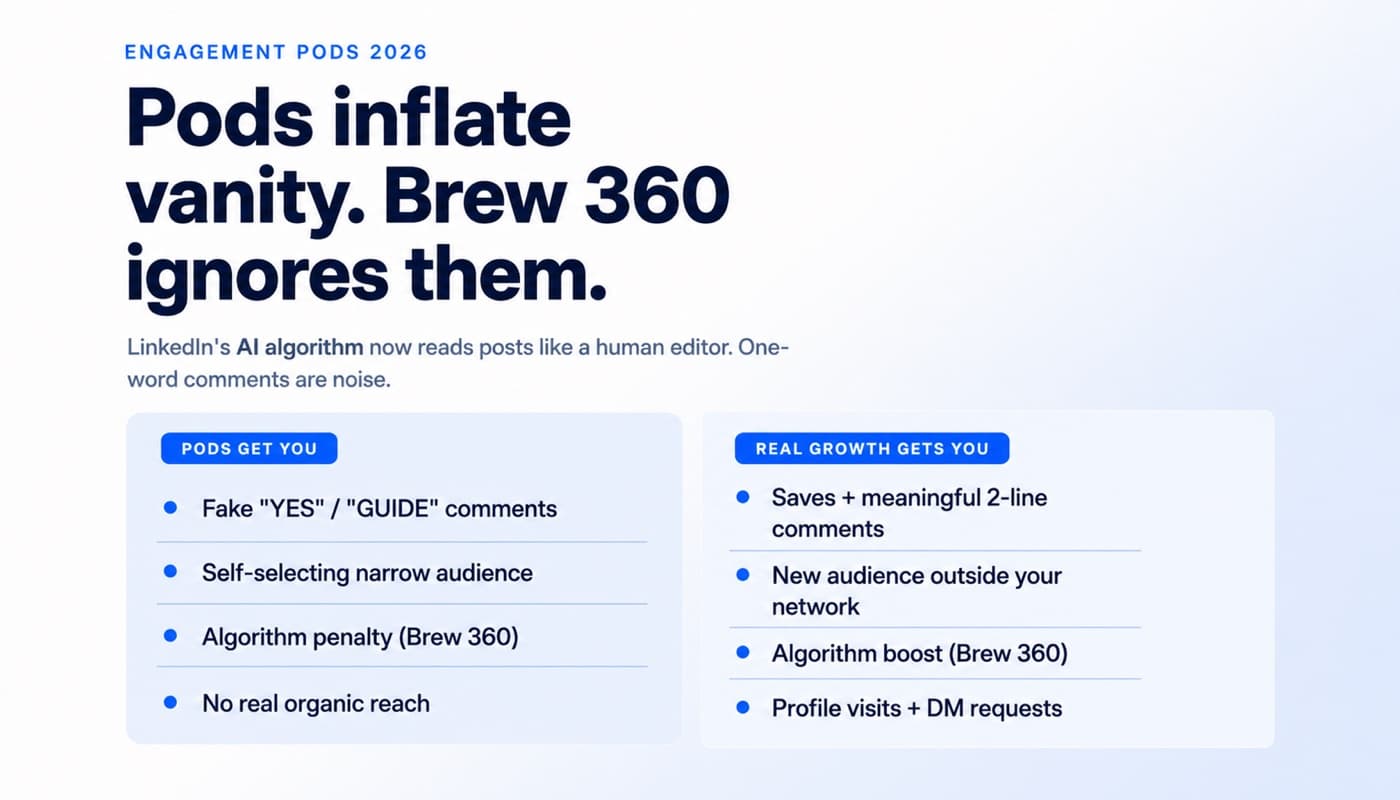
What pods usually generate is weak engagement:
- Likes
- One-line comments
- Repetitive phrasing
- The same accounts showing up every time
- Activity disconnected from real reader interest
That matters because weak engagement is not the same as strong engagement.
The weak metrics are vanity:
- Likes
- Raw follower count
- One-word comments like "YES" or "GUIDE"
- Impressions without action
- Reposts with no context
The strong metrics are business:
- Saves
- Meaningful comments with actual substance
- Profile visits after the post
- DM requests and connection requests
- Conversion to lead or customer
That distinction is the whole story.
The 2022-2023 peak and why LinkedIn explicitly called them out
Pods peaked around 2022 and 2023 because they were easy, organized, and for a while they worked just enough to keep people addicted.
You had Telegram groups, WhatsApp groups, Slack circles, private communities, all doing the same thing. Post link. Everyone rushes in. Drop a like. Leave a comment. Move on.
It was mechanical, but the feed still rewarded some of that behavior.
Then LinkedIn started talking about it more directly. Not by naming your private pod chat, obviously, but by tightening distribution around authenticity and relevance. Richard van der Blom's recent reporting put a sharper number on what many operators were already seeing: detection got much better, and pod-heavy accounts started flatlining.
That tracks with what I've seen myself.
The old shortcut stack on LinkedIn used to be:
- Have a big follower base
- Use pods to simulate momentum
Both got weaker.
Follower count is not useless, but it is not the moat people think it is. And pod comments are now a much noisier signal than they were a few years ago.
LinkedIn had to address this because pods break the product. If users keep seeing posts boosted by fake coordination instead of real interest, the feed gets worse. And once the feed gets worse, everyone loses.
How Brew 360 reads one-liner comments like "YES" and "GUIDE"
People talk about LinkedIn's algorithm like it is magic. It is not magic. It is a ranking system looking for signals of actual value.
Brew 360, LinkedIn's AI ranking approach, is much better than older systems at reading language quality and interaction quality. That is the key shift.
A one-liner like "YES" is not the same as a comment that adds an example, challenges a claim, asks a sharp question, or reframes the point more clearly.
Those comments are not equal, even if both count as "a comment" in the UI.
If a post gets 80 comments that all look like:
- "YES"
- "GUIDE"
- "Interested"
- "Great post"
- "Love this"
that is a weak signal.
Not because LinkedIn hates short comments in theory, but because weak comments correlate with low reader depth. They usually mean the person did not really engage with the idea.
The better question is not "Did people comment?"
It is:
- Did they save it?
- Did they reply to each other?
- Did the author get thoughtful responses?
- Did readers visit the profile after reading?
- Did the post pull in people outside the usual circle?
That is why I always ask: is your post share-worthy, and is it save-worthy?
Pods are bad at both.
Pods for lead-gen vs pods for reach: two completely different tools
This is where people get confused.
"Pods don't work" is too broad. Better: pods don't work for organic reach the way people hope.
But a coordinated engagement behavior can still work for a different goal.
If your goal is reach, you want:
- Saves
- Thoughtful comments
- Broader distribution outside your existing circle
- Content that pulls in new relevant people
If your goal is lead-gen, you may want:
- A visible CTA
- A self-selecting audience
- A list of people raising their hands
- DMs or follow-up conversations
Those are different systems.
A pod can help create social proof around a narrow commercial motion. It can make a post look active enough that more qualified people notice the offer. That is not the same as helping the post travel widely.
One is distribution.
The other is activation.
Confusing those two is why so many creators think they are "winning" when they are just producing dashboard noise.
The content-for-comment tactic is the same pattern
"Comment GUIDE and I'll DM it to you" is not meaningfully different from pod behavior.
It is the same underlying mechanic: optimize for low-effort comments that trigger a surface metric.
Again, that does not make it useless. It just means you should call it what it is.
This format can be effective for lead capture because it creates a narrow funnel:
- Person sees the post
- Person wants the asset
- Person comments a keyword
- You DM them
- Some of them become leads
Fine. That is a workable lead-gen flow.
But it is not a clean organic reach strategy.
Why? Because keyword comments like "GUIDE" are still weak comments. They tell LinkedIn less than a real discussion does. They are functional, not meaningful.
So when people say, "But my GUIDE post got 200 comments," my reaction is: okay, but what was the actual outcome?
- Did it get saved?
- Did it attract the right audience?
- Did it create profile visits?
- Did it convert?
- Did it expand your reach on future posts?
Sometimes the answer is yes on conversion and no on reach.
That is normal. It means the tactic did its job, but the job was lead-gen, not virality.
What to use instead if you want organic reach growth
If you want organic reach in 2026, I would focus on substance and positioning, not coordination hacks.
The cleanest framework I use is this:
- Pick your role
Are you a Leader, Reporter, or Curator?
Leader means you have real lived experience.
Reporter means you did original homework or had special access.
Curator means the information is public, but you save people time by filtering the noise.
Most people should not pretend to be Leaders. Better to be a strong Curator than a fake expert.
-
Build posts that deserve saves
Saves are a much stronger signal than cheap applause. Depth wins. -
Use donor posts, not copied posts
Study what already worked. I like a simple process: -
Find 5 high-reach donor posts
-
Break down the hook
-
Transfer the structure into your own domain
-
Publish 1 strong original post
That 5:3:1 ratio works.
- Comment well on posts that will travel
LinkedIn comments are their own growth surface. Early, meaningful comments on the right donor posts can outperform your own publishing when you're small.
The rule is simple: "Great post" is damage. Add something real or say nothing.
- Tie reach to business
I learned this the hard way. I had posts with six-figure reach that created zero business value because the topic had no connection to my actual product or buyer.
Numbers are not money. Virality without product relevance is you building someone else's brand.
When pods are the right tool and when they're not
There are cases where pods or pod-like coordination are still rational.
If you are using them, be honest about why.
Pods can be the right tool when:
- You are running a lead-gen campaign and want surface activity around a specific offer
- You are testing messaging in a small trusted circle
- You care more about visible traction than broad feed distribution
Pods are the wrong tool when:
- You want sustainable organic reach growth
- You want to train the algorithm on who genuinely responds to your content
- You want stronger future post distribution
- You are using them as a substitute for having something worth saving or discussing
My view is simple: if you need pods every time, the content is not carrying its own weight.
And if the content is not carrying its own weight, that is the real problem to solve.
FAQ
Do LinkedIn engagement pods still work at all?
Yes, but mostly as a cosmetic or lead-gen tool, not as a reliable reach engine. They can create visible activity and sometimes help a campaign look busy, but they do not produce the kind of strong signals that grow organic distribution over time.
Is "comment GUIDE and I'll DM you" bad?
Not inherently. It is fine if your goal is lead capture. I just would not confuse it with virality. Keyword comments are usually weak signals for ranking, even if they help you collect interested prospects.
What signals matter more than pod comments now?
Saves matter a lot. So do meaningful comments, profile visits after a post, DM requests, connection requests, and actual conversion. Those are stronger signs that the content landed with a real person, not just a coordinated circle.
Can small accounts grow without pods?
Yes. In many cases, small accounts grow faster without them because they learn what real resonance looks like. Strong comments on donor posts, sharp hooks, and clear positioning usually outperform forced engagement loops over time.
What should I do this week instead of joining a pod?
Write one save-worthy post and leave five meaningful comments on posts that are likely to travel. Use a clear role: Leader, Reporter, or Curator. If you cannot say something original in a post, add something original in the comments. That is still one of the highest-leverage growth plays on LinkedIn in 2026.
More LinkedIn guides
50 LinkedIn hook formulas that actually work
If you’re searching for LinkedIn hook formulas, here’s the direct answer: the best hooks are short first lines that trigger one of a few predictable...
June 23, 2026How to Find Your LinkedIn Content Pillars
Jumping between too many topics is the most common LinkedIn mistake. Here is how to find the 3-4 content pillars that resonate with you and your audience.
September 18, 2026LinkedIn's Network tab: what the feed split means
LinkedIn split the feed into For You and Network tabs. Here is what the change does, why it happened, and what it means for creators.
Grow on LinkedIn with 2pr
Ideas, AI drafts in your voice, carousels, scheduling, and analytics: one tool. Start your free trial.
Start free trial