
How to Find Your LinkedIn Content Pillars
June 23, 2026
TL;DR
The biggest LinkedIn content mistake is jumping between too many topics, because the things you find interesting are always more than the things your audience wants from you. The fix is content pillars: the few themes that genuinely resonate with you and land with your audience at the same time. You cannot see them from the inside, so you have to analyze your profile from the outside.
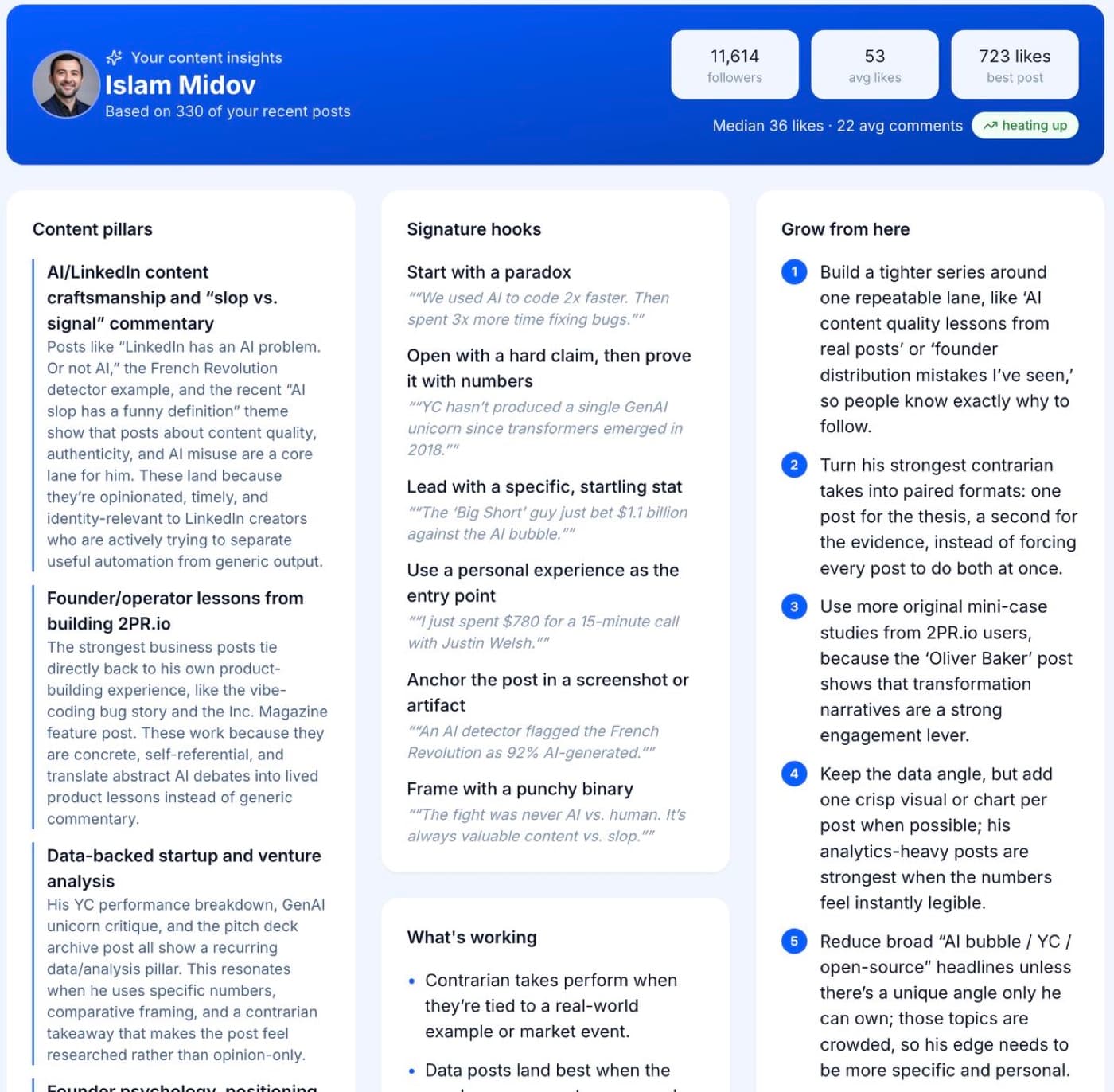
The biggest mistake in LinkedIn content is jumping between too many topics. I was guilty of it myself, and any smart, curious person is at risk of it. The number of topics you find interesting is always bigger than the number your audience actually wants to read from you. The fix is finding your content pillars: the handful of themes that genuinely resonate with you and land with your audience at the same time.
What a content pillar actually is
A content pillar is a theme you return to often enough that people start to associate it with you. Most strong LinkedIn creators run on three to four. Not one (too narrow, you run dry), not ten (too scattered, you teach your audience nothing).
A real pillar sits at an intersection:
- You have genuine expertise or curiosity about it, so you can write on it for months without forcing it.
- Your audience actually wants it from you, so it earns reach and replies instead of polite silence.
The trap is that those two circles are smaller than they feel. You are interested in far more than your audience wants to read from you specifically. Pillars are the overlap, not your full list of interests. This is the same problem we cover from the founder's angle in should founders post about multiple topics on LinkedIn; this piece is the practical how-to for narrowing them down.
Why you cannot see your own pillars
Here is the catch: you cannot find your pillars from the inside. From where you sit, every topic you post feels equally important, because you know why you wrote each one. Your audience does not have that context. They only see which posts made them stop, react, and remember you.
So you have to look at your profile from the outside, the way a stranger scrolling your last few months would. That means looking at the data, not your intentions:
- Which posts actually pulled reach and real comments, not just a few polite likes.
- Which hooks worked (often a contrarian take backed by evidence) versus which fell flat (usually a topic you found interesting but your audience did not).
- Which themes show up again and again in your best posts.
How to find your pillars, step by step
- Pull your last 30-60 days of posts. Recent only, because the feed shifts fast and old patterns mislead. See the best day to post on LinkedIn for why we only trust recent data.
- Rank them by real engagement. Sort by reach and by genuine comments, not vanity likes. The metric that signals a pillar is people stopping to engage, not scrolling past with a reflex like. We make the case for that in the LinkedIn metric that actually matters.
- Group the winners into themes. Look at your top posts and ask what they have in common. You will usually see three or four clusters emerge.
- Cut the curiosity bets. Be honest about the topics you posted because they interested you, not your audience. Those are not pillars. They are hobbies. Park them.
- Name your three to four pillars and use them as a filter. Before you post, ask which pillar this serves. If it serves none, it is probably the topic-hopping mistake creeping back in.
What this looks like in practice
When I did this on my own account, the breakdown was clear: my real pillars were AI and content. The hooks that worked were contrarian takes with evidence behind them. The bets that fell flat were the ones driven by my own curiosity, interesting to me, invisible to my audience.
Seeing it from the outside made idea generation far easier. Instead of staring at a blank editor wondering what to post, I had three or four lanes to pull from, each one already proven to land. Topic-hopping is exhausting precisely because every post starts from zero. Pillars give you a running start.
Ghostwriters often charge $100 to $300 just to do this kind of pillar research by hand. It is valuable work, but it is also pattern-matching on data, which means it can be done instantly. We added content-pillar analytics to our free profile analyzer for exactly this reason: it shows your real pillars, which hooks work, and which bets fell flat, from the outside view you cannot get on your own.
Where a tool helps
Once you know your pillars, the next job is producing for them every week without burning out. That is what 2pr.io is built for. It learns your voice and your pillars, drafts posts inside those lanes so you are never starting from a blank page, and gives you a planner to keep a steady cadence. Its analytics keep showing you what is landing, so your pillars stay honest as your audience evolves. And it runs on the official LinkedIn API, so your account stays safe.
If you want to compare options first, here is a fair rundown of AI tools for LinkedIn content, and you can try a few free tools before committing. Plans start at $19/month on annual billing, or $39 month to month, on the pricing page.
The bottom line
If your reach is inconsistent, the problem is usually not effort, it is focus. You are interested in more than your audience wants from you, so you hop between topics and teach them nothing to remember you by. Find the three or four themes where your genuine interest and your audience's attention overlap, look at your own data from the outside to confirm them, and use them as a filter for everything you post. Fewer topics, done consistently, is how a scattered feed turns into a personal brand.
More LinkedIn guides
Do LinkedIn engagement pods still work in 2026?
Short answer: no, not if by "work" you mean organic reach growth. LinkedIn engagement pods can still inflate visible activity, but they optimize the wrong...
June 23, 2026Why LinkedIn browser extensions put your account at risk
Yes, LinkedIn browser extension account ban risk is real. If a tool installs as a browser extension, reads your cookies, and performs actions on LinkedIn as...
September 18, 2026LinkedIn's Network tab: what the feed split means
LinkedIn split the feed into For You and Network tabs. Here is what the change does, why it happened, and what it means for creators.
Grow on LinkedIn with 2pr
Ideas, AI drafts in your voice, carousels, scheduling, and analytics: one tool. Start your free trial.
Start free trial