
Should founders post about multiple topics on LinkedIn?
June 23, 2026
TL;DR
Yes, you can post about multiple topics on LinkedIn.
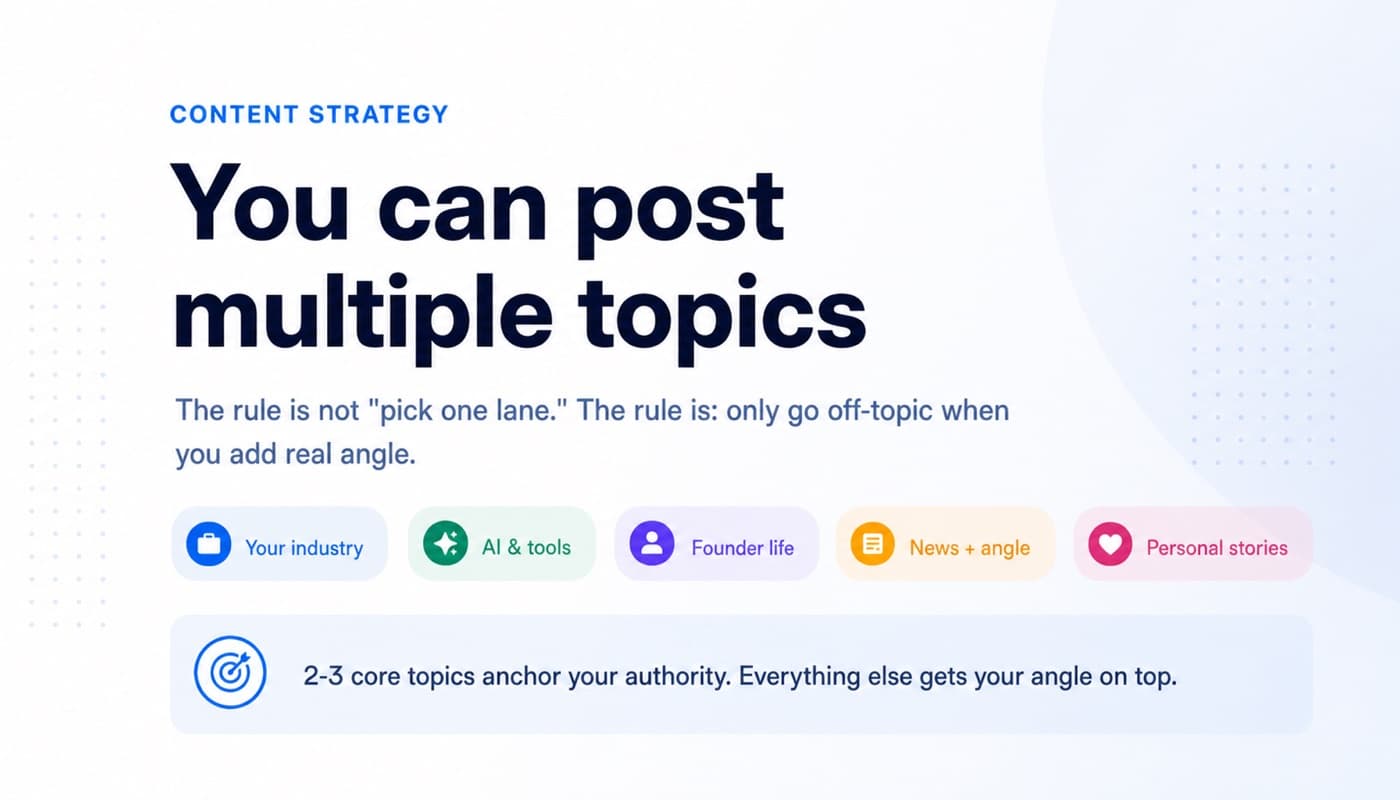
The real rule is not "pick one lane and never leave it." The real rule is: only go off-topic when you have credibility there. If people can reasonably believe you know what you're talking about, a tangent can outperform your main niche. If you have no credibility, no audience fit, and no business reason for the post, it will usually die or worse, get attention from the wrong people.
Most founders are asking the wrong question. It is not "Can I post about multiple topics?" It is "Which topics have I earned the right to talk about?"
The conventional wisdom: pick one lane
The standard LinkedIn advice is simple: pick one topic, repeat it forever, and become associated with that category.
There is a reason this advice exists. It works often enough.
People follow accounts because they want predictable value. The algorithm also needs clear signals. Under Brew 360, LinkedIn is trying to understand what your profile is about semantically, not just through hashtags or keywords. If your profile says one thing and your content says five unrelated things, you create friction.
So yes, consistency matters.
But people take this advice too literally.
"One lane" is useful for beginners because it reduces confusion. It is not a law of nature. It is a simplification. And like most simplifications, it breaks when real credibility enters the picture.
I have seen too many founders self-censor because some creator told them every post must map to the exact same content pillar. That is too rigid. It produces clean positioning, but often boring content.
And boring loses in a 7-second feed.
The 250K finance post: my biggest post was completely off-topic
My biggest LinkedIn post was a finance post.
Not startup tactics.
Not LinkedIn growth.
Not AI content.
Finance.
It crossed 250K reach.
That was uncomfortable, because it contradicted the advice everyone gives, including advice I have repeated myself in the past. Stay in your lane. Build authority through repetition. Keep the profile-content match tight.
Then I posted something outside my core topic cluster, and it became the biggest post.
That should tell you something important: topic consistency is not the highest rule. It is a useful proxy. But it is still a proxy.
What actually happened?
The post was interesting. The hook worked. The timing worked. The packaging worked. And most importantly, I had enough real-world credibility in that tangent that people accepted the authority immediately.
That last part is what most people miss.
The lesson is not "post about whatever you want."
The lesson is narrower and more useful: an off-topic post can break out if the audience believes you have the right to speak on it.
Why it worked: CFA plus 10 years in finance
That finance post was not random.
I am not a tourist in finance. I have CFA credentials. I spent 10 years in finance. I worked in venture. I have real context, pattern recognition, and scars from that world.
So from the outside, the post was off-topic relative to my recent content. But from the reader's point of view, it was still credible.
That is the distinction that matters.
If a SaaS founder suddenly posts about biotech regulation with no background, it looks opportunistic. If that same founder used to build in biotech for eight years, it lands differently. Same "topic shift," completely different reception.
Credibility travels.
It does not have to come only from job title, either. Credibility can come from:
- Direct experience
- Formal expertise or credentials
- Access to unusual information
- Original research
- Repeated public proof that your takes are sharp
This is also why the Welsh framework matters so much on LinkedIn.
If you are posting as a Leader, the question is: did you actually live this?
If you are posting as a Reporter, the question is: did you do the homework?
If you are posting as a Curator, the question is: do you have the taste to filter signal from noise?
My best posts are usually a Curator plus Leader hybrid. I take a public signal, then add a point of view I earned somewhere else. That finance post fit that pattern.
The real rule: credibility beats topic consistency
If I had to compress this into one line, it would be this:
Credibility beats topic consistency.
Not every time. But often enough that founders should stop following lane advice mechanically.
A narrow, consistent content strategy is a safe default. A credible, slightly broader strategy is often stronger.
Why?
Because LinkedIn is not rewarding neat content calendars. It is rewarding posts people stop for, open, save, and discuss. Brew 360 behaves more like an editor than an old engagement counter. The system is trying to infer whether the post is worth attention.
Interesting beats tidy.
Human beats templated.
Credible beats artificially consistent.
I would rather follow a founder with 2-3 real dimensions than one who has flattened themselves into one sterilized niche because some guru said the algorithm likes purity.
The feed is competitive. You have 5-7 seconds. The first two lines do most of the work. If your only priority is staying perfectly on-brand, you will often publish safer and duller content than the founder who is willing to use a credible tangent.
Also, remember the Pareto distribution: 5% of posts drive 95% of reach.
That means you should not optimize for the average post. You should optimize for the posts that can break out. Credible tangents are one of the ways that breakout happens.
When off-topic kills you
There is a big difference between a credible tangent and a random attention grab.
Off-topic content usually fails for three reasons:
-
No credibility
You have no real experience, insight, receipts, or angle. Readers can smell this fast. -
Wrong ICP
The post attracts people who will never buy, refer, hire, or amplify the right thing for you. -
No CTA or business connection
Even if the post gets reach, it creates no downstream value.
I have had this happen too.
One of my posts reached around 150K. On paper, great result. In practice, zero business value. The topic was interesting but irrelevant to my actual ICP. It did numbers, but it did not produce the right profile visits, the right DMs, or the right pipeline.
That is the trap founders fall into. They confuse "this worked on LinkedIn" with "this worked for my business."
Those are different statements.
If an off-topic post gets you vanity metrics and no meaningful next step, you just spent time building someone else's brand.
How Brew 360 handles multi-topic profiles
Brew 360 does not mean you should become chaotic.
The better model is 2-3 clear themes, stated and reinforced across your profile.
That part matters.
Your profile is a landing page. Your headline should show specialization, not just a job title. Your About section should position you, not read like a resume. Your Featured section should support the themes you want people to associate with you.
For most founders, I would structure it like this:
-
Core business theme
What you are building now -
Adjacent expertise theme
The domain you already have credibility in -
Personal strategic lens
The recurring angle that makes your thinking recognizable
That is enough range to stay interesting without confusing people.
This is also how I think about multi-topic profiles in 2pr.io and in my own work more broadly. Not unlimited freedom. Not one-topic prison. A small set of clear, defensible themes.
That gives the algorithm semantic consistency and gives humans a coherent reason to follow you.
How to know which tangents you can credibly post about
Most founders do not need more permission. They need a filter.
Here is the filter I would use before posting outside your main lane:
-
Did I live this long enough to have a non-obvious opinion?
If yes, good sign. -
Can I explain why I have authority in one sentence?
If not, the reader probably will not infer it. -
Would this make sense to someone who visits my profile after the post?
If the jump feels bizarre, rethink it. -
Does this topic intersect with people I actually want in my audience?
Reach from the wrong crowd is expensive attention. -
Can I connect this post back to my broader positioning without forcing it?
If you need a gymnastics routine to tie it back, skip it. -
Would I still stand by this post if it got 500K views?
A good test for opportunistic posting.
Another practical rule: list your "earned themes," not your "interesting themes."
Earned themes come from experience, proof, and reputation. Interesting themes come from what you happened to read this week. Those are not the same thing.
And one more thing. Nobody can guarantee a viral post. I cannot. You cannot. But you can improve the odds. This is still a craft. It may look like people go viral casually. Usually they do not. They just have more reps than you think.
FAQ
Can I post about multiple topics if I am still building my audience?
Yes, but keep it tight. If you are early, I would stay within 2-3 related themes, not seven. The smaller your audience, the less confusion you can afford. Breadth works better when there is already enough context on your profile for people to understand why the topics belong together.
What counts as credibility on LinkedIn?
Real experience is the strongest form, but not the only one. Credentials help. Operator history helps. Original research helps. Consistently sharp curation helps. The test is simple: if a smart stranger read your post and then your profile, would they say, "Fair, this person can talk about this"?
What if my off-topic posts get more reach than my core topic?
That is not automatically a win. Check strong signals, not vanity metrics. Did the post generate saves, meaningful comments, profile visits, qualified DMs, or useful followers? If not, you may have found a reach topic, not a business topic. Those are different assets.
Should every post connect directly to my product?
No. That makes content stiff and self-promotional. But your body of content should connect to your positioning over time. Some posts are for reach, some for trust, some for conversion. The mistake is publishing viral but irrelevant content so often that the audience you grow has nothing to do with what you sell.
How often should I repeat my core themes?
Often. Repetition is not the enemy. For most people, 2-3 recurring themes are the foundation, and a credible tangent appears every few posts, not every day. If every post is a new identity, you look scattered. If every post is the same angle, you become ignorable. The balance is consistency with range.
More LinkedIn guides
How to make AI write like you, not like everyone else
If you want AI to write like you, the answer is simple: stop treating every post as a new prompt and start teaching the model your repeatable patterns. Most...
June 23, 2026Founder-led marketing: the complete guide for B2B SaaS founders
Founder-led marketing for B2B SaaS means the founder becomes the main distribution channel for trust, demand, and narrative. Not just by posting on...
September 18, 2026LinkedIn's Network tab: what the feed split means
LinkedIn split the feed into For You and Network tabs. Here is what the change does, why it happened, and what it means for creators.
Grow on LinkedIn with 2pr
Ideas, AI drafts in your voice, carousels, scheduling, and analytics: one tool. Start your free trial.
Start free trial