
How to make AI write like you, not like everyone else
June 23, 2026
TL;DR
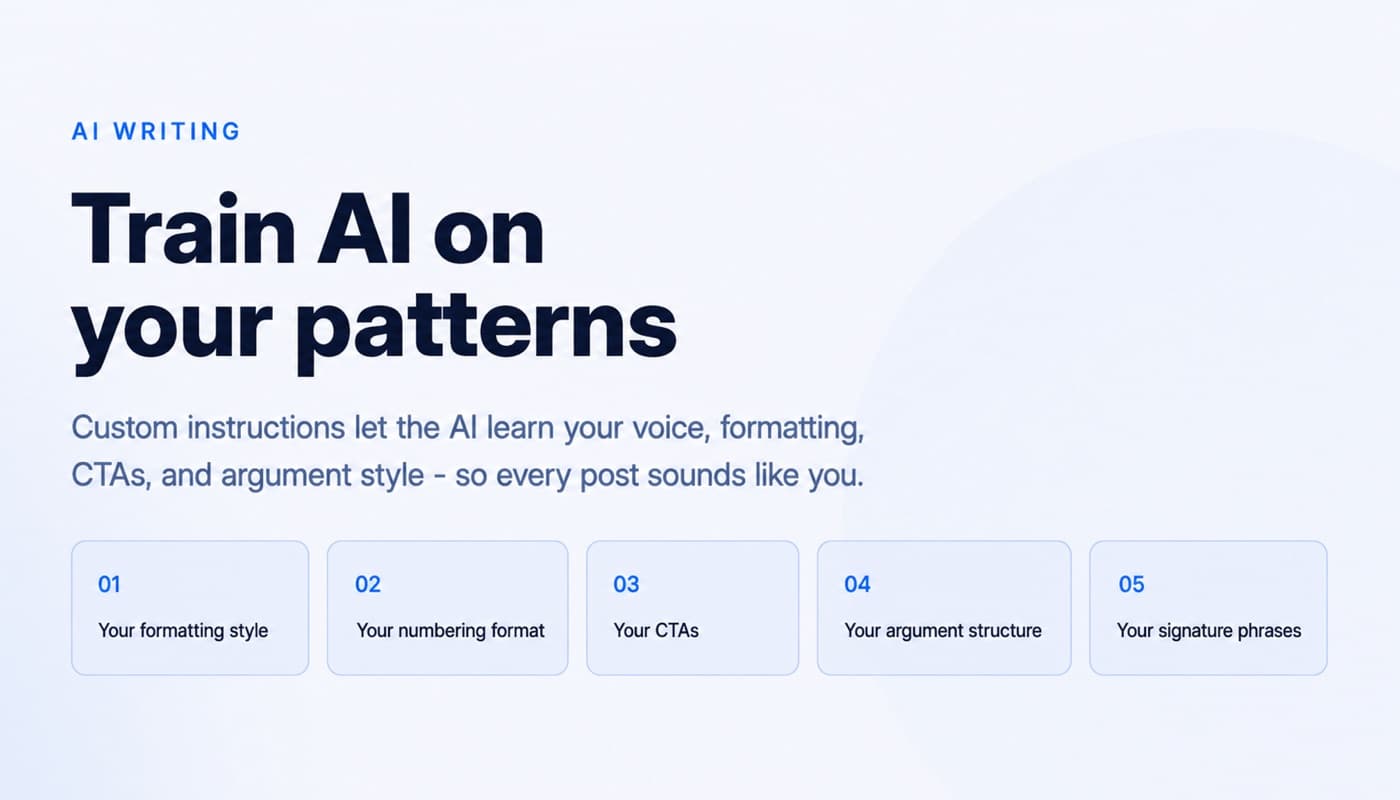
If you want AI to write like you, the answer is simple: stop treating every post as a new prompt and start teaching the model your repeatable patterns. Most AI writing sounds generic because it defaults to the average style of the internet. To fix that, you need custom instructions that define how you format ideas, structure arguments, use CTAs, repeat signature phrases, and stay consistent from post to post. Once the AI knows those patterns, it stops sounding like a tool and starts sounding a lot more like you.
Why AI content sounds the same
Most AI tools are trained to produce a safe, broadly acceptable answer.
That means they are very good at sounding competent and very bad at sounding specific.
The result is content that feels polished but interchangeable. Same rhythm. Same transitions. Same fake confidence. Same empty punchlines pretending to be insight.
This is not because AI is bad at writing.
It is because the default mode of AI is averaging. It has seen too much of the internet, and the internet is full of recycled structure, borrowed tone, and watered-down opinions.
So when people ask me how to make AI write like you, not like everyone else, my first answer is this:
The problem is not that AI cannot write.
The problem is that, left alone, it writes toward the mean.
The 2pr.io bet: we bet on sounding like you, not on virality
A lot of tools bet on virality.
I understand why. Virality is easy to sell. It is a clean promise. More reach, more impressions, more growth.
But I have never thought that was the real problem.
The real problem is that most founders, operators, and experts do not want more content. They want content that still feels like theirs after AI touches it.
That is the bet behind 2pr.io.
Not: how do we make everyone sound more viral?
But: how do we make AI sound more like the person using it?
Because no single AI writing tool can be perfect for everyone.
Every creator has different instincts. Different pacing. Different ways of making a point. Different habits their audience already recognizes.
If the tool ignores that, you end up with posts that may perform, but they slowly erase your identity.
That is a bad trade.
Voice matters more than virality if you are building long-term trust.
The 6 dimensions of voice
When people say "I want AI to sound like me," they usually mean something vague.
In practice, voice is not one thing. It is a stack of patterns.
These are the six dimensions I focus on.
1/ Formatting
Some people write in dense blocks.
Some write in short, sharp paragraphs.
Some use line breaks to create rhythm. Some use symbols. Some like visual flow that makes the post easy to scan.
This matters more than people think.
Formatting is often the first thing your audience recognizes before they even read the substance.
If you always break ideas into compact chunks, AI should not hand you a wall of text.
If you use specific markers or spacing patterns, that should be part of the instructions.
2/ Numbering style
This is one of the easiest signals to miss and one of the easiest to teach.
I like 1/ style numbering.
Other people prefer classic bullets, Roman numerals, or no numbering at all.
It seems small. It is not.
Numbering style affects pace. It affects how authority feels on the page. It affects whether the post sounds like your natural way of thinking or like a generic content template.
3/ CTAs
A lot of AI-generated CTAs sound like they were written by a growth intern who swallowed a LinkedIn playbook.
That is a fast way to break trust.
Your CTA is part of your voice.
Some people end with a direct question. Some use a soft invitation. Some never ask for anything. Some have recurring sign-offs or recognizable endings.
If your CTA style is wrong, the whole piece feels off, even if the body is strong.
4/ Argument structure
This is the most underrated part.
Voice is not just how you sound. It is how you think.
Some people open with a contrarian statement, then back it with proof.
Some start with a story, then generalize into a lesson.
Some use a clean sequence:
problem -> why it happens -> what to do instead
Others stack credibility first, then move into action.
If AI does not understand your natural argument structure, it may use your words but still miss your logic.
And readers feel that immediately.
5/ Signature phrases
Every strong writer has recurring language.
Not buzzwords. Not slogans forced by brand guidelines.
I mean phrases they naturally reach for. Words they use to sharpen contrast. Patterns they repeat because they actually think that way.
These phrases make the writing recognizable.
They are part of what makes readers think, "I know who wrote this" before checking the name.
If you never define these, AI replaces them with generic filler.
6/ Voice consistency
This is where most people struggle.
They can get one good AI output. Maybe two.
But the third post slips. The fifth becomes generic again. The tenth sounds like a different person entirely.
That is because consistency does not come from a clever one-off prompt.
It comes from stable instructions that keep the model anchored across outputs.
Without that, you are manually correcting the same drift every single time.
Before custom instructions: 30 minutes editing every post. After: 2 minutes tweaks
This is the real operational benefit.
Before custom instructions, writing with AI often looks efficient at first.
You generate a draft in 30 seconds.
Then you spend 30 minutes fixing it.
You change the opening. Tighten the structure. Rewrite the CTA. Delete robotic phrases. Put your style back into the post line by line.
That is not leverage.
That is editing a machine that still does not know you.
Once the instruction layer is strong, the workflow changes.
Now the draft arrives closer to your default.
Your formatting is there. Your structure is there. Your common phrasing is there. The tone is aligned from the first line.
So instead of rewriting the whole thing, you make two minutes of tweaks.
That is the difference between using AI as a novelty and using it as a system.
How to write custom instructions that actually work
Most people write bad custom instructions because they stay abstract.
They say things like:
- "Sound authentic"
- "Write like me"
- "Be insightful"
- "Keep my tone"
That does not help much.
AI needs observable patterns, not flattering adjectives.
A better template looks like this:
Formatting
Use short paragraphs, 2-3 lines max. Add white space between ideas. Avoid long blocks.
Numbering style
When listing points, use 1/ 2/ 3/ style, not bullets or 1. 2. 3.
CTAs
End with a direct question to the audience. Avoid generic engagement bait.
Argument structure
Open with a sharp claim. Then explain why most people get this wrong. Then give a practical framework or example.
Signature phrases
Use phrases I naturally repeat. Example: "that is the real problem", "this is where people get stuck", "bad trade".
Voice consistency
Write in a direct, founder-operator tone. No corporate language. No hype. No filler. No motivational fluff.
That is the level of specificity that works.
If you want even better results, pull 5 to 10 examples of posts you actually like and extract the recurring patterns manually.
Do not ask what style you admire.
Ask what you repeat.
That is where your real voice lives.
The difference between prompt engineering every post vs training the AI once
A lot of people are stuck in a loop.
Every time they want a post, they write a longer prompt.
Then a longer one.
Then a mega-prompt with ten rules, three examples, two constraints, and a mini therapy session about tone.
It works a bit.
Then they do it again next time.
This is expensive, repetitive, and fragile.
Prompt engineering every post means you are rebuilding context from scratch.
Training the AI once through custom instructions means you are creating a reusable layer of preference.
That layer compounds.
Instead of reminding the model every time how you think, how you break down ideas, how you close, how you sound, you encode those defaults once and keep refining them.
That is a better system.
Less effort per post.
Better consistency across posts.
Much less annoyance.
Warning: what custom instructions can't fix
Custom instructions are powerful, but they are not magic.
They cannot fix weak ideas.
They cannot make an unoriginal point sound profound.
They cannot replace actual experience, sharp thinking, or a real opinion.
They also cannot fully rescue writing if your source material is vague.
If you feed AI generic inputs, you still get generic thinking dressed in your formatting.
And they cannot solve taste for you.
You still need judgment.
You still need to know when a post is too broad, too safe, too self-important, or just boring.
Custom instructions improve expression.
They do not replace substance.
That distinction matters.
FAQ
How do I make AI write like me instead of sounding robotic?
Give it repeatable patterns, not vague style labels. Define how you format, structure arguments, end posts, and which phrases you naturally use. "Write authentically" is weak instruction. "Use short paragraphs, open with a contrarian claim, end with a direct question" is usable instruction.
What should I include in custom instructions for writing?
Start with six areas: formatting, numbering style, CTAs, argument structure, signature phrases, and voice consistency. These are concrete enough for AI to follow and broad enough to affect every draft. If one area feels too abstract, add real examples from your past posts.
Is custom instructions better than writing a detailed prompt every time?
Yes, if you publish regularly. A detailed prompt can help for one draft, but it forces you to rebuild your style each time. Custom instructions create a stable system. Then each post-specific prompt only needs to cover the topic, angle, and audience.
Can AI ever fully match my voice?
Close, yes. Perfectly, not always. Your voice changes with mood, context, and conviction. AI can capture your common patterns and save a lot of editing time, but it still benefits from your final judgment. I treat it as leverage, not replacement.
What is the biggest mistake people make when trying to personalize AI writing?
They describe the vibe instead of the mechanics. They say "make it smart, human, and bold" instead of specifying how they actually write. Voice is built from repeatable decisions. Once you define those decisions clearly, the output improves fast.
More LinkedIn guides
Leader, Reporter, or Curator: which LinkedIn creator role fits you
If you’re asking what type of LinkedIn content creator you should be, the short answer is this: don’t copy the biggest creators. Pick the role that matches...
June 23, 2026Should founders post about multiple topics on LinkedIn?
Yes, you can post about multiple topics on LinkedIn.
September 18, 2026LinkedIn's Network tab: what the feed split means
LinkedIn split the feed into For You and Network tabs. Here is what the change does, why it happened, and what it means for creators.
Grow on LinkedIn with 2pr
Ideas, AI drafts in your voice, carousels, scheduling, and analytics: one tool. Start your free trial.
Start free trial