
Leader, Reporter, or Curator: which LinkedIn creator role fits you
June 23, 2026
TL;DR
If you’re asking what type of LinkedIn content creator you should be, the short answer is this: don’t copy the biggest creators. Pick the role that matches your actual advantage. If you have lived experience, be a Leader. If you can do original homework, be a Reporter. If you’re great at filtering signal from noise, be a Curator. Most people fail on LinkedIn because they borrow someone else’s style without borrowing the thing that makes it credible. The role matters more than the format.
I learned this the hard way.
A lot of founders look at top LinkedIn creators and think, “I should write like that.” But those creators are often playing a role you cannot play yet. A former operator can teach from scars. A connected insider can report from rooms you’ve never entered. A sharp curator can turn chaos into clarity.
If you pick the wrong role, your content feels forced. If you pick the right one, your posts get easier to write and more useful to read.
The 3 LinkedIn creator roles
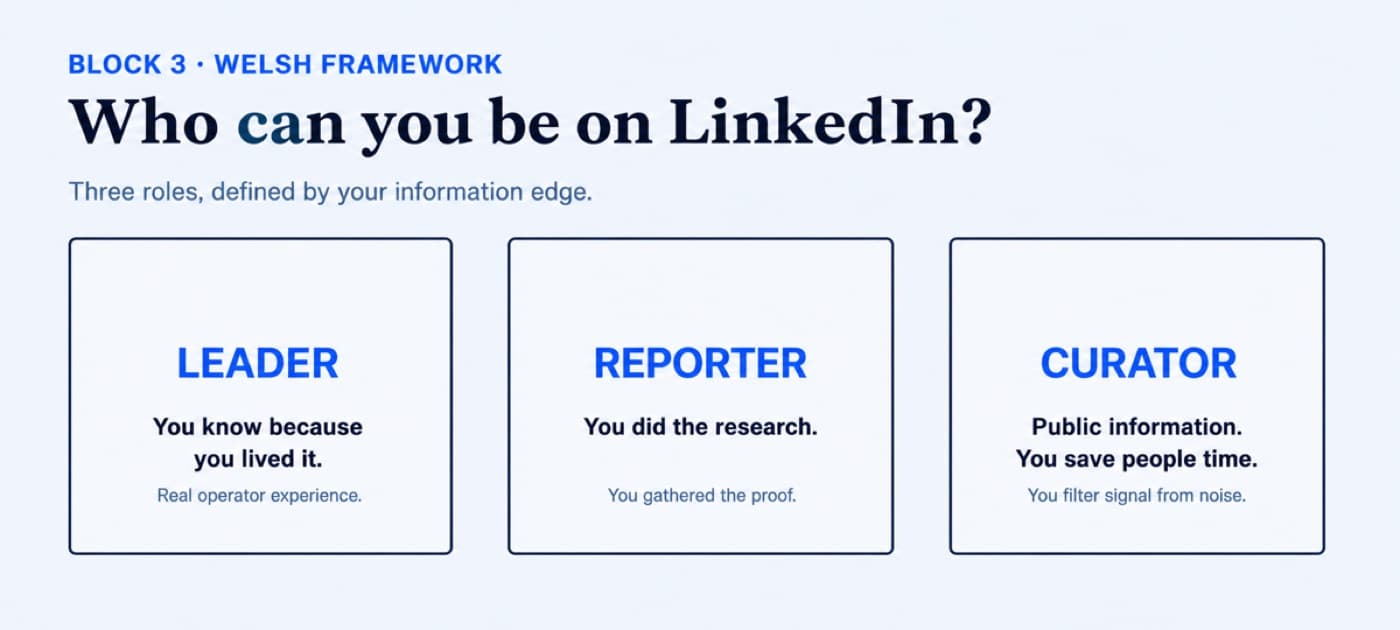
I use Justin Welsh’s framework because it’s simple and accurate. On LinkedIn, most strong creators fit one of three roles:
-
Leader - “Only I know.”
You share lessons from real experience. -
Reporter - “I did the research.”
You bring insights people would not find on their own. -
Curator - “I save you time.”
You filter the noise and show what matters.
This is not about personality type. It’s about information advantage.
The best content usually comes from access. Not access to a fancy studio or a ghostwriter. Access to insight.
Leader: powerful when real, painful when fake
Leader content works when you’ve actually lived through something.
You built a company. Closed enterprise deals. Ran growth at scale. Invested through cycles. Made mistakes. Changed your mind. Now you can package that into frameworks, contrarian takes, principles, or warnings.
That’s when Leader content has weight.
It fails when people try to sound wise before they’ve earned the right. LinkedIn is full of fake Leader posts. You can spot them in two lines. Clean formatting, empty ideas.
Better to be a good Curator than a bad Leader.
Inside the Leader role, I see four common voices:
-
Preacher
You teach principles and frameworks. This is the classic Justin Welsh style. -
Provocateur
You attack lazy industry assumptions. Done well, this creates strong reactions. Done badly, it becomes engagement bait. -
Motivator
You give people energy, ambition, and belief. This works best when tied to real receipts. -
Validator
You say the quiet part out loud. You articulate what your audience already feels but hasn’t phrased.
If you’ve built, operated, sold, invested, or failed in a real arena, Leader can be your main role. If not, don’t force it.
Reporter: original work beats borrowed opinions
Reporter content is underused because it requires effort.
There are two versions.
-
Privileged access
You talk to people others can’t access. Founders, operators, investors, buyers. You synthesize what they’re seeing before the wider market catches up. -
Primary research on public data
This one is more interesting because almost anyone can do it. You gather scattered public information into one useful insight.
A great example is reviewing 50 versions of Duolingo onboarding over five years. None of that information was secret. But almost nobody would do the work to collect, compare, and explain it. That’s Reporter content in 2026.
You do not need to “know more” than everyone else.
You need to do more homework than everyone else.
That’s the difference.
If you’re the person willing to read the reports, scrape the examples, map the patterns, and explain what they mean, Reporter is available to you even without a giant network.
Curator: the strongest role for most people in 2026
Curator used to sound like the weakest role.
Now I think it’s the most powerful one.
Why? Because information is abundant and attention is scarce. AI has flooded every feed with flat summaries, generic advice, and recycled “10 lessons” posts. In that environment, a good curator becomes extremely valuable.
A curator says: I already spent the time. Here’s the signal. Ignore the rest.
That is useful.
It is also the best role for beginners. You don’t need a huge track record. You don’t need insider access. You need taste, pattern recognition, and consistency.
The job is not to repeat content. The job is to filter well.
- What is actually worth attention?
- What is already late?
- What is noise disguised as insight?
- What matters for your niche right now?
If you can answer those four questions repeatedly, Curator is not a fallback role. It’s a serious one.
The Hybrid: Curator + Leader
This is where I sit most of the time.
And for most founders, it’s the best path.
The Hybrid model is simple: take something public, then add a point of view that comes from your own experience.
You are not inventing content from scratch. You are observing what already has energy, then transferring it into your territory with an expert angle.
That makes it achievable.
You don’t need exclusive access. You don’t need to pretend you invented the conversation. You need to notice the right thing early, understand why it matters, and explain it in a way your audience cares about.
A lot of the best “thought leadership” on LinkedIn is actually Curator + Leader.
Case study 1: 264K views from Curator + Leader done right
One of my top posts hit 264K around a “Big Short against AI” narrative.
The source was public. Someone on X posted about a major bearish bet against AI. Lots of people saw the headline. Very few explained why it mattered.
My angle came from my background in VC. I understood the underlying tension immediately: when everyone is euphoric, a smart contrarian bet becomes a story people cannot ignore.
That post worked because it had all three ingredients:
- A proven external signal
- A contrarian hook
- My own interpretation, not just a repost
That is Hybrid content at its best.
Not “look what happened.”
More like “look what happened, and here’s what it means if you understand markets.”
Case study 2: 227K views from a Reddit donor post
Another strong post reached 227K.
The source was a top Reddit post in r/entrepreneur. I did not invent the raw material. I observed it, recognized it had transfer potential for LinkedIn, then rebuilt it for a different audience.
The key step was not copying the post.
It was summarizing the best comments, extracting the real lesson, and presenting it with a stronger structure. Reddit had the raw conversation. I turned it into a cleaner argument.
Same Hybrid formula:
- Public source
- High-interest topic
- Curation plus my framing
This is why I tell people not to obsess over originality. Viral formats are usually observed, not invented.
Case study 3: 150K reach, 0 leads
Now the painful one.
I had a post reach about 150K and generate basically zero business value.
On paper, it looked like a success. In reality, it was a waste.
Why?
- The topic was OpenAI vs open-source
- The audience it attracted was mostly developers
- Those people were not my ICP for a LinkedIn AI ghostwriting product
- There was no CTA and no product bridge
- I spent around 3 hours on it
So yes, the post performed. But it performed for the wrong market.
That was a useful reminder: numbers are not money.
A post can explode and still do nothing for pipeline, trust, or sales. Personal profiles usually get far more reach than company pages, which is why creator-led distribution works. But if that attention does not connect to your actual offer, you are building someone else’s brand, not your own business.
Also, 5 percent of posts often drive 95 percent of reach. That is normal. Do not optimize the average post. Optimize for breakout opportunities that are relevant.
How to find your role
Use these four questions.
-
Do I have lived experience people would actually learn from?
If yes, you may be a Leader. -
Am I willing to do heavy homework others won’t do?
If yes, Reporter is open to you. -
Am I good at spotting signal early and filtering noise?
If yes, Curator is likely your natural role. -
Can I take public information and add a credible expert angle?
If yes, you’re probably a Hybrid, which is where most founders should start.
If you’re unsure, start as a Curator. Then grow into Leader as your experience compounds.
That path is far more believable than trying to sound like a guru on day one.
FAQ
What type of LinkedIn content creator should I be if I’m just starting?
Usually Curator. It has the lowest barrier and the highest usefulness in an AI-flooded feed. You do not need a huge resume. You need taste and the discipline to filter what matters. If you already have real operating experience, move toward Curator + Leader.
Is Leader content the best role for growth?
Only if it’s real. Strong Leader content can build trust fast, but fake Leader content is obvious and damages credibility. Most early creators should not start by trying to sound like a philosopher-CEO. Start with signal, then layer in your own lessons as you earn them.
What’s the difference between Reporter and Curator?
Reporter creates value through original legwork. Curator creates value through filtering. A Reporter might analyze 50 onboarding flows and publish patterns. A Curator might track the best conversations across Reddit, X, and LinkedIn and save the reader five hours. Both are useful, but Reporter is heavier work.
Can a viral LinkedIn post still be bad for business?
Absolutely. I’ve had that happen. A 150K-reach post brought attention from the wrong audience, no CTA, and no product connection. Reach without relevance is vanity. Saves, profile visits, meaningful comments, DMs, and lead flow matter more than raw impressions.
How long does it take to see results on LinkedIn?
Usually 3 to 6 months of systematic work, not three posts. Nobody is born knowing how to create breakout content. It may look like someone went viral immediately, but in my case there were years of pattern recognition behind it. It’s a craft. You cannot guarantee virality, but you can absolutely improve the odds.
More LinkedIn guides
LinkedIn algorithm 2026: what Brew 360 actually changed
If you're searching for the LinkedIn algorithm 2026 changes, here's the short answer: LinkedIn stopped acting like a dumb engagement counter and started...
June 23, 2026How to make AI write like you, not like everyone else
If you want AI to write like you, the answer is simple: stop treating every post as a new prompt and start teaching the model your repeatable patterns. Most...
September 18, 2026LinkedIn's Network tab: what the feed split means
LinkedIn split the feed into For You and Network tabs. Here is what the change does, why it happened, and what it means for creators.
Grow on LinkedIn with 2pr
Ideas, AI drafts in your voice, carousels, scheduling, and analytics: one tool. Start your free trial.
Start free trial