
LinkedIn algorithm 2026: what Brew 360 actually changed
June 23, 2026
TL;DR
If you're searching for the LinkedIn algorithm 2026 changes, here's the short answer: LinkedIn stopped acting like a dumb engagement counter and started acting more like a human editor. Brew 360 does not just count likes and hashtags. It tries to understand what your post is about, whether people actually stop to read it, whether they save it, and whether the comments mean anything. That change killed a lot of old LinkedIn advice. It also made good writing, clear positioning, and real expertise much more valuable.
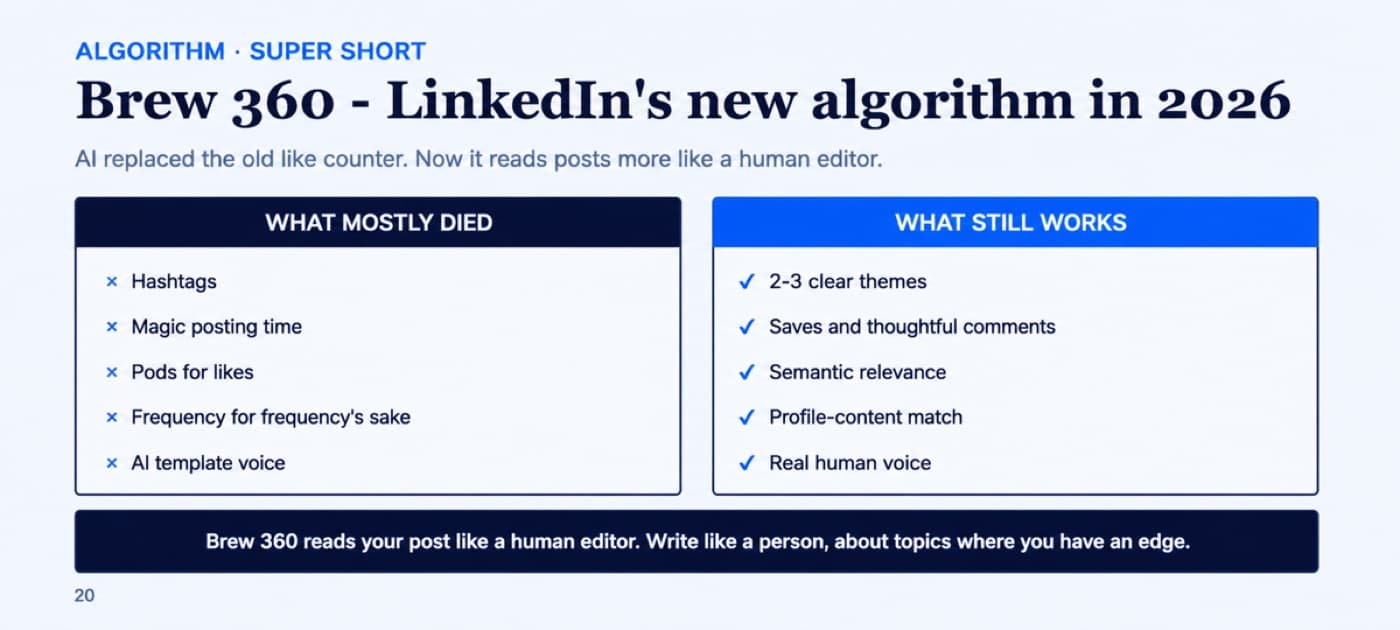
What changed
My synthesis is simple: AI replaced the old engagement counter.
Valentina Casasola's Brew 360 research is the clearest framing I've seen. The system now reads posts more semantically. It looks less at cheap visible signals and more at whether the post feels relevant, useful, and human.
That changes the game.
Old LinkedIn rewarded people who could game distribution. New LinkedIn rewards people who can hold attention and stay coherent around a real topic.
This is why some posts with average-looking engagement keep spreading, while posts with lots of likes quietly die.
It also explains why so many people feel like their old playbook stopped working in 2026. It did.
What died
Six things got weaker, and some of them deserved to die.
1/ Hashtags
Hashtags used to function like topic labels.
Now Brew 360 is much better at extracting meaning from the actual text. If your whole distribution strategy depends on adding five hashtags at the bottom, you're using a map from the previous version of LinkedIn.
Write clearly enough that the machine doesn't need your training wheels.
2/ Magic posting time
People still obsess over "best time to post."
I think this is mostly cargo cult now. Timing can matter at the margin, especially for early velocity, but it is not the main variable. If the hook is weak, 8:13 AM won't save it. If the post is strong, it can travel outside your first-hour window.
Quality beats superstition.
3/ Engagement pods for likes
Pods can still inflate the appearance of activity.
But likes are the cheapest signal on the platform. Brew 360 seems much less impressed by a burst of shallow engagement. Same for tagging random people to manufacture interaction.
You can still game vanity metrics. It's just less connected to reach than people think.
4/ Frequency for its own sake
A lot of creators learned the wrong lesson from consistency.
Yes, posting matters. No, posting five mediocre things a week does not create momentum by itself. In my own metrics, and frankly in most creator datasets, a tiny share of posts drives the vast majority of reach.
Roughly 5% of posts create 95% of reach.
So don't optimize for average output. Optimize for breakout probability.
5/ AI templates
This one is obvious the moment you open LinkedIn.
Same rhythm. Same fake vulnerability. Same "here are 3 lessons." Same tone that sounds written by a productivity intern trapped inside ChatGPT.
Brew 360 seems increasingly good at detecting flatness. Not "AI text" in some magical binary sense. Flatness. Predictability. Generic structure. Dead phrasing.
That is why template-heavy content gets polite engagement and then disappears.
6/ Bullshit phrases
You know the ones.
"I've been reflecting lately..." "Let that sink in." "Read that again." "Few understand this." "Hot take."
These phrases signal nothing. They are empty wrappers. They do not create tension, insight, or specificity. They just remind readers they are being managed.
A human editor would cut them. Brew 360 increasingly does the same.
What works
Five things matter more now.
1/ Two to three clear themes
LinkedIn needs to know what bucket to place you in.
If one week you post about SaaS pricing, the next about crypto drama, then hiring, then gym mindset, you're making the machine guess and the audience work too hard.
I tell people to own 2-3 clear themes and state them in the profile. Not vague interests. Real territories.
That consistency helps distribution and trust at the same time.
2/ Saves
This is the strongest visible signal most creators still underrate.
A like says, "I noticed this."
A save says, "I may need this again."
That is a much stronger vote. In practice, I have seen posts with noisy engagement do nothing, and posts with a high save count keep compounding. From the outside, they can look similar. Underneath, they are not.
Ask a brutal question before you publish: is this save-worthy?
3/ Meaningful comments
Not all comments are equal.
"Great post." "Needed this." "Guide?"
That is not conversation. That is pollution.
Meaningful comments are usually 2+ lines. They add a case, challenge a point, summarize the idea more sharply, or ask a real question. Brew 360 appears to understand that difference.
This is also why comment-bait is a tradeoff. It may help lead gen in some cases. It is not the same thing as broad reach.
4/ Semantic relevance
Keywords matter less than meaning.
You do not need to stuff phrases into the post like it's 2014 SEO. You need to be recognizably about something. Your profile, your recent posts, your audience response, and the language you naturally use all create a semantic cluster.
Brew 360 seems to reward coherence.
This is why profile and content now work as a pair. If your profile says one thing and your content sounds like another person chasing trends, the mismatch costs you.
5/ Human voice
This is the big one.
Not "authenticity" as branding theater. Actual human voice. A point of view. An angle. A sentence rhythm that sounds like a person who has lived through something, observed something, or bothered to think.
I usually frame LinkedIn voices through Justin Welsh's roles:
- Leader - I know because I lived it
- Reporter - I know because I gathered or accessed the evidence
- Curator - I know what matters and filtered it for you
Most strong creators are not pure anything. I'm mostly a Curator + Leader hybrid. I take public material, layer my own experience on top, and turn it into something sharper.
That pattern still works very well in 2026.
The 7-second window
If you understand one mechanical fact about LinkedIn, make it this: you have about 5-7 seconds.
The first line decides most of the post's fate. The first two lines are effectively the whole post because that's what people see in preview.
Brew 360 appears to use dwell-time as a core quality signal. That matches older dwell-time research and also matches common sense. If people stop, scan, and continue reading, LinkedIn sees quality. If they bounce instantly, the post gets downgraded.
So yes, the hook matters more than almost everything else.
Not because hooks are a trick. Because they decide whether the post even gets a chance to exist.
Real reach benchmarks
Most people have terrible intuition about reach.
They compare themselves to outliers or think every decent post should "do numbers." It shouldn't.
Shield Index looked at 50,000 posts in February 2026. For profiles with 5K-10K followers, median reach was about 774 impressions.
That matters.
It means normal is lower than people think.
For that same follower band:
- Median post: about 774 impressions
- Viral post: 5K+ impressions
- Breakout post: 48K+ impressions
So when someone says "my post only got 1,200 impressions," that may not be failure. It may be normal.
The other practical implication is important too: virality is not a small improvement on average. It's a different outcome class. Stop trying to make every post slightly better. Build a system that occasionally produces breakout candidates.
What this means for your content strategy
First, personal profiles still beat company pages by a lot. In B2B, people buy from people. Trust moves through personality, not logos.
Second, choose your role. Leader, Reporter, Curator, or a hybrid. Do not improvise a new identity every week.
Third, build around 2-3 themes and repeat them. Not every post, but often enough that both the audience and LinkedIn can place you.
Fourth, optimize for strong signals:
- Saves
- Meaningful comments
- Profile visits
- DMs and connection requests
- Actual leads
Fifth, stop worshipping average-post performance. A small minority of posts will do most of the work. That's normal. My own data reflects this too. The goal is not perfect consistency at the post level. The goal is consistent exposure to breakout upside.
Sixth, steal structure, not substance. Viral formats are usually observed, not invented. Find donor posts that already proved they can hold attention, then transfer the structure into your territory with your own example and your own angle.
Seventh, keep your voice. The best users of tools like 2pr.io are not the ones who want maximum volume at any cost. They're the ones who want leverage without losing themselves on the page.
FAQ
Does LinkedIn still care about hashtags in 2026?
Much less than before. I would treat hashtags as optional garnish, not distribution strategy. Brew 360 is better at reading the actual meaning of your post, so clear writing and topical consistency matter more than tagging the topic manually.
How often should I post now?
3-5 times per week is a solid range if you can sustain it for six months without turning robotic. Frequency still helps you take more shots, but frequency alone does not create reach. One sharp post beats three filler posts every time.
Can LinkedIn detect AI-written content?
Not in a simplistic "AI or not AI" way. But Brew 360 seems very good at detecting flat, templated, generic writing. If your post sounds like everyone else's generated copy, performance usually suffers. The problem is not the tool. The problem is dead voice.
Do I need a huge audience to go viral?
No. You do need relevance. Around 5,000 followers is enough to produce strong outcomes if the topic, hook, and profile fit are right. Reach is not purely a size game anymore. It is increasingly a quality and coherence game.
Should virality be the goal?
Not always. Reach is useful, but business value depends on what the post is about and who it attracts. I've had posts with huge reach and zero commercial value because the audience was wrong. The real goal is not "go viral." It's to create posts that pull the right people toward trust, conversation, and action.
More LinkedIn guides
The LinkedIn attention hierarchy: why 99% of B2B content gets ignored
If your LinkedIn content gets no engagement, the answer is usually simple: your post sits too low in the attention hierarchy. Most B2B posts live at level...
June 23, 2026Leader, Reporter, or Curator: which LinkedIn creator role fits you
If you’re asking what type of LinkedIn content creator you should be, the short answer is this: don’t copy the biggest creators. Pick the role that matches...
September 18, 2026LinkedIn's Network tab: what the feed split means
LinkedIn split the feed into For You and Network tabs. Here is what the change does, why it happened, and what it means for creators.
Grow on LinkedIn with 2pr
Ideas, AI drafts in your voice, carousels, scheduling, and analytics: one tool. Start your free trial.
Start free trial