
LinkedIn now flags AI slop. What it means for you
July 31, 2026
TL;DR
LinkedIn is rolling out a "slop" flag next to "unfollow" and "show less," letting people mark low-effort AI content. Slop is content anyone could have produced with no point of view and no human in the loop. The fix is not to avoid AI, it is to keep a person in the loop and add real perspective.
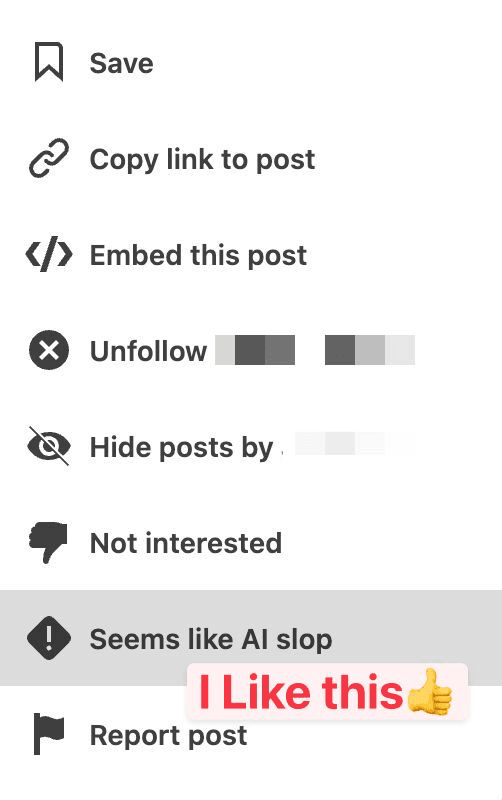
Short answer: LinkedIn is adding a way to flag "AI slop" in the feed, and the practical takeaway is simple. Keep a human in the loop and say something only you could say. The flag sits alongside the existing "unfollow" and "show less" controls, so it is one more way for readers to curate what they see. Whether or not it ever touches the algorithm, it changes the incentive: lazy, generic output now has a button pointed at it.
I build an AI copilot for LinkedIn, and I think this is a good move. That is not a contradiction. The problem was never that people use AI to write. The problem is content produced with no point of view and no person checking it before it ships. Here is how to read the change and stay on the right side of it.
What counts as AI slop on LinkedIn?
Nobody has a crisp definition yet, including LinkedIn. So here is a working one you can actually use.
Slop is content anyone could have produced. Copycat takes, generic internet knowledge repackaged, the same five "lessons" everyone posts. There is no unique context, no real point of view, and no value for the person reading it. If you swapped the author's name for a stranger's and nothing would feel off, it is probably slop.
Slop is also content produced without a human in the loop. That is the sharper test. A bot generating and posting on a schedule with nobody reading the output is the clearest case. The tell is not "AI was involved." The tell is "no person made a judgment call about whether this was worth posting."
Put those together and you get a useful filter. AI that drafts from your ideas, your data, and your voice, with you editing before it goes out, is not slop. AI that spits out a generic take you paste and publish untouched is exactly what the flag is aimed at. If you want AI to sound like you rather than everyone else, the mechanics of that are worth teaching the model your own patterns.
Why the flag is a good thing
Three reasons it helps, even if you post with AI every day.
It gives readers another curation control. People have complained about feed quality for a while. "Unfollow" and "show less" were blunt. A dedicated slop flag is a more honest signal about what is dragging the feed down, and more control for the reader is generally good for everyone who posts something worth reading.
It makes people think before shipping. Even if the flag never influences ranking, the mere existence of a "this is slop" button makes lazy output feel riskier. That nudge alone raises the floor. A human in the loop stops being optional and starts being the obvious default.
It gives a real frustration somewhere to land. A chunk of the anti-AI anger online is economic anxiety looking for a target. Now it has a specific, low-stakes button instead of a pile-on in the comments. That is healthier for the platform than the alternative.
Where the flag could go wrong
It is not all upside, and it is worth being clear-eyed about the risks.
Flags become weapons. Any report button eventually gets used for beef rather than quality. Someone you disagreed with flags your post, not because it is slop, but because they are annoyed. That is the predictable dark side of every moderation control ever shipped.
Non-native English speakers are easier targets. Writing that reads as slightly "off" to a native ear is not the same as low effort, but it can look that way to a flag-happy reader. International creators who write in a second language will be easier to attack, and that is a real fairness problem LinkedIn has to design around.
Anonymity favors the haters. If flags are private and anonymous, the incentive tilts toward abuse. A public signal would be more accountable, even if it feels harsher.
Two changes that would make it better
If I were shipping this feature, I would change two things.
Make the flag public. Anonymity is what turns a quality signal into a harassment tool. If flagging is visible, people flag more carefully, and the target can see what is happening rather than getting silently buried.
Put it on comments first. The post gets all the attention, but comments are where the real slop lives. Comments piggyback on a host post's reach, which gives a huge incentive to generate them without a human in the loop. AI comments with nobody reviewing them are, in my experience, five to ten times more common than AI posts. That is where a slop flag would do the most good, and it is the part everyone is ignoring. If you want to see what good looks like instead, this framework for comments that actually land is a better use of the same effort.
How to stay on the right side of it
You do not need to avoid AI. You need to avoid slop. The two are not the same.
- Start from your own idea, not a blank prompt. The point of view has to be yours. AI is for getting it out of your head and onto the page faster, not for inventing the take.
- Add context only you have. A number from your own work, a story from a real conversation, a contrarian read on something everyone accepts. Specificity is the opposite of slop.
- Edit before you ship. Read the whole thing out loud. If a sentence sounds like it could have come from anyone, cut it or replace it.
- Keep a human in the loop, always. The single clearest slop signal is "no person checked this." Never let that be true of your posts.
- Do not automate comments. If you would not write it by hand, do not let a bot write it. This is where the flag will hurt people first.
This is exactly the workflow 2pr.io is built around. It drafts posts in your own voice, learned from persona and AI interviews, so you start from your idea instead of a generic template, and it keeps you in the editor making the final call rather than auto-posting behind your back. Its analytics show you what is genuinely resonating so you double down on your real point of view instead of guessing, and it runs on the official LinkedIn API so your account stays safe. Plans start at $24/month on annual billing (or $49 month to month), and you can see the details on the pricing page. If you are comparing options, this rundown of AI tools for LinkedIn content is a fair starting point.
The bottom line
LinkedIn flagging AI slop is not an attack on AI, it is an attack on laziness. Slop is content anyone could have written, produced with no human in the loop. The flag has real risks, it will get used for beef, and it should live on comments before posts. But the takeaway for anyone posting seriously is the same one that was always true: bring a point of view, add context only you have, and keep a person in the loop before you hit publish. Do that and no flag will ever find you.
More LinkedIn guides
How to Start Posting on LinkedIn (Your First 10 Posts)
How to start posting on LinkedIn when you have never posted before. Your first 10 posts have one job, plus a simple system to begin and improve.
July 31, 2026Do scheduled posts hurt your LinkedIn reach?
Do scheduled LinkedIn posts get penalized? No. Here is the evidence, why "best time to post" advice is mostly noise, and what actually drives reach.
September 11, 2026Do LinkedIn bot farms work for lead generation?
No. LinkedIn bot farms are a negative-ROI lead-gen channel. Here is why fake profiles and bot DMs fail, and the three channels that actually book calls.
Grow on LinkedIn with 2pr
Ideas, AI drafts in your voice, carousels, scheduling, and analytics: one tool. Start your free trial.
Start free trial