
How to write viral LinkedIn comments (the 4-type framework)
June 23, 2026
TL;DR
If you want to write good LinkedIn comments, do this: comment early on posts that are already likely to spread, stay inside your niche, and make every comment do one of four jobs: Add, Challenge, Summarize, or Ask. That is the simplest answer. Most people treat comments like politeness. I treat them like distribution. A strong comment can get profile views, followers, replies, and inbound leads without publishing a post from scratch. On LinkedIn, comments are not leftover engagement. They are their own growth surface.
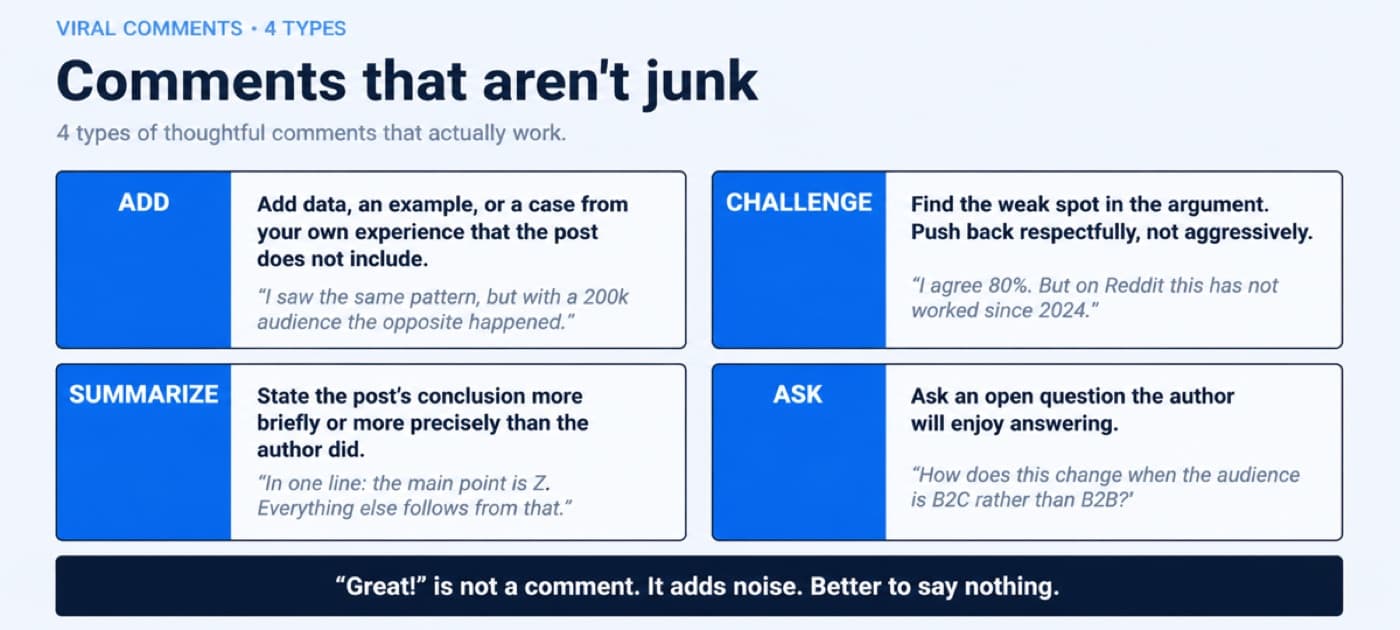 If you want to write good LinkedIn comments, do this: comment early on posts that are already likely to spread, stay inside your niche, and make every comment do one of four jobs: Add, Challenge, Summarize, or Ask. That is the simplest answer. Most people treat comments like politeness. I treat them like distribution. A strong comment can get profile views, followers, replies, and inbound leads without publishing a post from scratch. On LinkedIn, comments are not leftover engagement. They are their own growth surface.
Why comments are LinkedIn's most underused growth lever
I see the same mistake constantly.
People obsess over posting frequency, carousels, hooks, and formats. Then they leave comments like "Great point" under posts seen by 100,000 people.
That makes no sense.
A post is one shot. A comment is leverage on someone else's distribution. If the original post takes off, your comment can ride the same wave.
This matters even more on LinkedIn because attention is narrow and trust is personal. Personal profiles already get far more reach than company pages. Comments let you show expertise in public, next to an existing conversation people already care about.
I shared this in a post after watching Jasmin Alić break down his system: if you post daily, many people still see you once. If you comment strategically, the same audience can see you 20 to 50 times in a day.
That is why comments are underused. Most people still think of them as support for the author. I think of them as mini content assets.
Comments vs posts: different distribution mechanic, same algorithm signals
Comments and posts spread differently.
A post has to earn attention from zero. The first lines do most of the work. LinkedIn gives it an initial test, then expands or kills it based on reaction quality.
A comment starts with borrowed attention. It sits inside a post that already has momentum, authority, and audience. You do not have to create demand from scratch. You step into existing demand.
But the signals are similar.
Brew 360 does not care about empty activity. It cares about meaning. Saves matter. Real replies matter. Profile visits matter. Flat, one-word engagement does not.
That is true for comments too.
If your comment makes readers stop, think, reply, or click your profile, that is useful behavior. If your comment is just social noise, it is dead weight.
That is why I tell people to stop writing for the author and start writing for the audience reading the thread.
How to pick the right donor post
The quality of your comment matters. The quality of the donor post matters first.
I use a simple filter:
- The author has 50K+ followers
- Their niche overlaps with mine
- The topic is inside my expertise
- I think the post will travel
- It is ideally less than 10 minutes old
Why 50K+ followers?
Because comments need distribution to compound. You can write the smartest comment of your week under a weak post and nobody will see it. Reach first, craft second.
Why niche overlap?
Because random visibility is overrated. I learned this the hard way with viral posts that brought reach and zero business value. Numbers are not the goal. Relevant attention is.
A great donor post is one where the audience could realistically become your audience too.
If you are a B2B founder, comment where B2B founders, operators, marketers, and investors already gather. Do not chase generic virality if the people reading cannot buy, refer, or remember you for the right thing.
The timing rule: first 10 minutes
If you only remember one operational rule from this article, make it this one:
Comment in the first 10 minutes.
Early comments get prime real estate.
When a post begins to move, LinkedIn surfaces the comments that already triggered replies, reactions, and thread depth. That early position matters because most readers do not open every comment. They read the first ones. If your comment gets there early and earns engagement, it can stay visible for hours or days.
Late comments have to fight uphill.
This is why "magic posting time" is overrated for your own posts but timing is critical for comments on donor posts. The issue is not the clock itself. The issue is whether you get placed near the top before the thread gets crowded.
I would rather leave one strong comment in minute six than five strong comments six hours later.
The 4 comment types that actually work
Most useful LinkedIn comments fit into four buckets. If you can learn these, you will stop defaulting to flattery.
1/ ADD
This is the easiest and most reliable type.
You take the original post and contribute a missing piece: a data point, an example, a case from your experience, or a nuance the author did not include.
Use ADD when you genuinely know something extra.
Example:
I saw the same pattern with founder-led content, but there was one twist: the smaller audience saved more and clicked more. Reach looked worse, pipeline looked better.
Why it works:
- It extends the post instead of repeating it
- It signals real experience
- Readers learn something new without leaving the thread
2/ CHALLENGE
This is the highest-risk, highest-upside type.
You respectfully push against the argument. Not to posture. To sharpen the conversation.
The key is tone. Challenge the idea, not the person.
Example:
I agree with most of this, but not the "post more" part. In my experience, weak volume trains people to ignore you. Better to publish less and comment better.
Or:
Agree 80%. The exception is when the audience is already saturated. Then repeating the same angle hurts faster than inconsistency.
Why it works:
- Tension gets attention
- Good authors often reply
- Readers remember people who think, not people who clap
Bad CHALLENGE sounds aggressive.
Good CHALLENGE sounds like: "Here is the limit of this advice in the real world."
3/ SUMMARIZE
This one is underrated.
You compress the post into one sharp takeaway. You say the same thing more clearly or more memorably than the original version.
Example:
If I had to reduce this to one line: distribution beats effort. The best content is not always the one people see.
Or:
The real message here is simple: stop writing for approval and start writing for saves.
Why it works:
- People love clarity
- The author feels understood
- Readers often react because you gave them a clean mental model
This works especially well on long posts where the core lesson is buried.
4/ ASK
A good question can outperform a statement.
The mistake most people make is asking lazy questions they could have answered themselves. That adds nothing.
A strong ASK opens a second layer of the topic.
Example:
How would you change this playbook for a founder selling to enterprise, where profile credibility matters more than direct clicks?
Or:
Curious where you think this breaks. Is it still true once the audience moves from creators to buyers?
Why it works:
- Smart authors like answering smart questions
- It creates thread depth
- It shows you understand the topic well enough to explore the edge cases
If the author replies, your visibility grows again.
What "meaningful comment" means under Brew 360
LinkedIn used to be easier to game.
Now the system is much better at spotting empty language.
That is why one-word replies like "Great post," "This," "So true," or "Amazing insight" are weak signals. They do not move thought forward. They do not create dwell time. They do not deserve amplification.
When I say "meaningful comment," I mean a comment with actual semantic weight.
Usually that means at least one of these:
- A concrete example
- A disagreement with reasoning
- A compressed takeaway
- A question that opens a useful branch
In practice, meaningful comments are often 2+ lines, not one word.
This is also why comment-bait attracts the wrong kind of engagement. "Comment GUIDE and I'll DM it" can generate replies, but many of those replies are low-information. That can be fine if your goal is lead capture. It is not the same thing as building reach and authority through substance.
Different formats optimize different outcomes.
My weekly homework: 5 viral comments minimum
If you want this to work, do not turn it into theory.
I would set a simple rule: 5 viral comments per week minimum.
Not 5 random comments.
5 comments placed on donor posts with intent.
Here is the routine I would use:
- Build a list of creators in your niche
- Check who posts consistently and gets real reach
- Watch for fresh posts that fit your expertise
- Comment within 10 minutes when possible
- Use one of the four types, not generic praise
- Reply to follow-up comments if the thread starts moving
That volume is small enough to sustain and large enough to learn fast.
You do not need a guarantee of virality. Nobody can promise that. I have been in social media for more than five years, and I still cannot guarantee a viral outcome.
What you can do is increase the odds.
This is skill, not luck. System, not magic.
The best part is that comments are lower-pressure reps than posts. You can test angles, tone, contrarian takes, and audience response in public without having to build a full post every time. At 2pr.io, I think about this the same way I think about content generally: optimize for what breaks out, not for average output.
Five sharp comments a week is enough to start seeing patterns.
FAQ
How long should a LinkedIn comment be?
Long enough to add value, short enough to be read in one glance. Most strong comments are 2 to 5 lines. If you need 12 lines, it is probably a post. If it is one word, it is probably useless.
Can small accounts use this, or do you need a big profile first?
Small accounts can use this very well. You do not need a huge audience to benefit from commenting on large posts. In many cases, it is the fastest way to get profile views before your own posting engine is strong.
Should I comment on every big creator in my niche?
No. Relevance beats volume. Comment where your expertise fits and where the audience overlap is real. Chasing every big post creates noise and weakens your positioning.
Is it better to challenge or agree?
Neither is automatically better. ADD is usually safest, CHALLENGE has the highest upside if you can do it well, SUMMARIZE is the cleanest, and ASK is best when the edge case is interesting. Use the type that best serves the thread.
How fast should I expect results from this?
You can get visible results from a single strong comment, but I would judge it over 8 to 12 weeks. Like posting, commenting compounds with repetition. The people who win are the ones who do it every week, not the ones who try it twice.
More LinkedIn guides
How Kevin Meyer does 12M LinkedIn impressions a year, repeatedly
A real LinkedIn case study. Kevin Meyer consistently does around 1M impressions a month, 12M a year, with 60k followers. Not one viral fluke, a repeatable system: reverse-engineering winning posts, using memes as a business weapon, and a cadence that compounds. Here is how it works.
June 23, 2026Super Pareto: why 5% of your LinkedIn posts drive 95% of your reach
If you are searching for the LinkedIn content power law, here is the direct answer: on LinkedIn, reach is not distributed evenly across your posts. In my...
September 18, 2026LinkedIn's Network tab: what the feed split means
LinkedIn split the feed into For You and Network tabs. Here is what the change does, why it happened, and what it means for creators.
Grow on LinkedIn with 2pr
Ideas, AI drafts in your voice, carousels, scheduling, and analytics: one tool. Start your free trial.
Start free trial