
Super Pareto: why 5% of your LinkedIn posts drive 95% of your reach
June 23, 2026
TL;DR
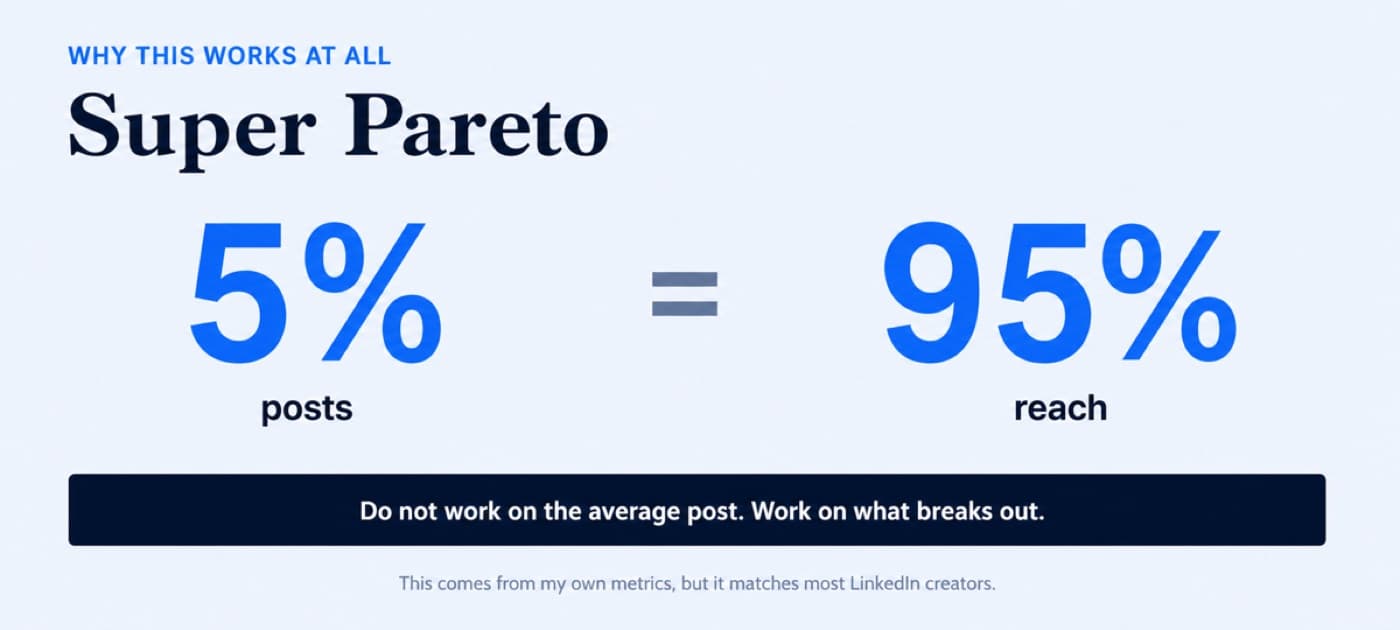
If you are searching for the LinkedIn content power law, here is the direct answer: on LinkedIn, reach is not distributed evenly across your posts. In my own data, about 5% of posts drive 95% of total reach. That is not a glitch. It is the rule. Most posts will be average or below average, and a small number will do almost all the work. Once you understand that, you stop judging your strategy by the median post and start building for breakouts.
 If you are searching for the LinkedIn content power law, here is the direct answer: on LinkedIn, reach is not distributed evenly across your posts. In my own data, about 5% of posts drive 95% of total reach. That is not a glitch. It is the rule. Most posts will be average or below average, and a small number will do almost all the work. Once you understand that, you stop judging your strategy by the median post and start building for breakouts.
The Super Pareto distribution from my own data
When I looked at my own LinkedIn performance, one pattern kept showing up.
A tiny share of posts generated almost all the reach.
Not 20% driving 80%. More extreme. More like 5% driving 95%.
I call this Super Pareto. It sounds dramatic, but it is normal for creator platforms. LinkedIn is no exception. The feed is not a fair distribution machine. It is a hit-driven system.
That matters because most people optimize for the wrong thing. They stare at the average post and ask, "How do I make every post perform better?"
Wrong question.
The better question is: how do I increase the odds that one of my next 20 posts breaks out?
That is how the platform actually works.
Why this is actually good news
Most people experience this power law as discouraging.
They post five times, ten times, fifteen times. Nothing explodes. They assume the content "isn't working."
I see the opposite.
This is good news because it means your average post does not need to be amazing. It needs to do one job: keep you in the game long enough to produce the outlier.
That changes the emotional math.
A post that flops is not proof you are bad at LinkedIn. It is often just a normal draw from a very uneven distribution. If you expect every post to win, you will quit before the system has time to work in your favor.
Nobody can guarantee a viral post. I cannot. No tool can. But you can absolutely improve the odds.
That is the craft.
It may look like someone "went viral overnight." Usually they did not. In my case, I have been in social media for more than five years. You do not start with instinct. You build it by publishing, observing, and adjusting.
What breakout posts have in common
Breakout posts are not random.
They share patterns, especially in the first few seconds of attention. On LinkedIn, you have roughly 5 to 7 seconds to win the scroll. In practice, the first line decides most of the post's fate. The first two lines are the whole game.
That is where attention hierarchy matters.
Some ideas naturally command more attention than others. Threat, conflict, blame, FOMO, and curiosity all beat bland advice. "How to do X better" is weak on its own unless it is wrapped in something sharper.
This is why many "valuable" posts die quietly. They are useful, but not urgent. Rationally good. Emotionally weak.
The second pattern is saves.
People on the outside still judge posts by likes. I do not. Likes are cheap. Saves are much stronger. I have seen posts with decent engagement and zero saves do nothing meaningful. I have also seen posts with fewer obvious vanity signals create real momentum because people wanted to keep them.
That is a major clue about how breakout content works now. A post that earns saves tells the feed, "this is worth returning to." That signal is stronger than applause.
When I look at my own top performers, many are not pure "thought leadership." They are usually Curator + Leader hybrids.
- I find something already validated in the wild
- I add my own angle from lived experience
- I package it with a stronger hook than the average LinkedIn post
That combination travels.
Volume vs quality: why you need both
People love to turn this into a debate.
Should you post more, or post better?
You need both. And you cannot really optimize one without the other.
If you only focus on quality, you usually under-publish. You spend three hours polishing a post, publish once a week, and then act surprised when the math does not work. In a power-law system, low volume means fewer lottery tickets, fewer tests, fewer chances to discover what resonates.
If you only focus on volume, you create noise. The platform has become better at detecting flat, templated, generic content. Readers are better at ignoring it too.
The real model is simple:
- Volume gives you enough attempts
- Quality increases the odds per attempt
- Together they create breakout probability
This is why I do not believe in frequency for frequency's sake. But I also do not believe in the fantasy of the perfect post.
You need a pace you can sustain for months, not a burst you cannot survive.
For most people, 3 to 5 posts a week is enough. Not because some magic posting calendar says so. Because it gives you enough repetitions to learn while staying human.
The Shield Index benchmarks: what breakout actually looks like in numbers
A lot of LinkedIn advice stays vague. "Create great content." "Be consistent." Fine. But what does breakout actually look like?
Using Shield Index benchmarks from 50,000 posts in February 2026, for creators in the 5K to 10K follower range:
- Normal post: about 774 impressions
- Viral post: 5,000+ impressions
- Breakout post: 48,000+ impressions
That gap is the whole story.
The difference between normal and breakout is not 2x. It is massive. That is why a handful of posts can dominate your total reach for a quarter, or even a year.
It also explains why your dashboard can feel emotionally confusing. You publish ten posts, most land in a narrow band, then one post does 50x the others. That is not inconsistency. That is the system revealing itself.
And one more thing: reach is not the same as business value.
I have had posts with huge reach and almost zero business impact because the audience was wrong. A post can hit 150K and still be a bad post for your company if it attracts the wrong people, on the wrong topic, with no path into your product or service.
Numbers are not money.
How to increase your breakout rate without burning out
You do not need infinite creativity. You need a repeatable system.
Here is the one I use.
-
Study donor posts
I do not start from a blank page if I can avoid it. I look for posts already proven in the market, often on X, Reddit, or LinkedIn itself. Viral formats are usually observed, not invented. -
Analyze only the hook first
If the first two lines do not catch me, I move on. Breakout posts nearly always advertise their payoff immediately. -
Map the emotion
Is this built on fear, curiosity, contrarian tension, or FOMO? If you do not know the emotional engine, you cannot transfer the format. -
Transfer, do not copy
I take the hook structure, then move it into my territory, my example, my lived angle. Same skeleton, different substance. -
Use the 5:3:1 ratio
Five donor posts become three possible hooks, which become one finished post. That keeps the research-to-output loop tight. -
Publish comments too
LinkedIn comments are their own distribution surface. A strong early comment on the right post can outperform a weak standalone post. The rule is simple: add insight, data, or a real challenge. "Great post" is dead weight.
This process matters because burnout usually comes from trying to invent brilliance on command. That is a bad system. Observation is lighter, faster, and more reliable.
Why "not working" is often just the law of large numbers
One of the biggest mistakes on LinkedIn is ending the experiment too early.
People publish six posts and conclude there is no audience. Or they publish for a month and decide the algorithm hates them. Usually neither is true.
In a power-law environment, results are noisy in the short run. A small sample lies to you.
What looks like failure is often just insufficient volume combined with unrealistic expectations. You are waiting for the outlier, but you are judging yourself as if every post should behave like one.
That is why I tell people to separate two questions:
- Is this post a flop?
- Is this strategy broken?
A post can flop inside a good strategy. That is normal.
A breakout post can also happen inside a bad strategy. That is dangerous, because it teaches the wrong lesson.
The real test is not whether every post wins. It is whether your system gradually improves your breakout rate, your save-worthiness, and your fit with the audience you actually want.
FAQ
How often should I post if LinkedIn follows a power law?
For most people, 3 to 5 times per week is enough. That gives you enough surface area to catch an outlier without turning your content into sludge. The point is not maximum volume. The point is sustainable repetition over 3 to 6 months.
Should I care more about virality or leads?
Leads, trust, and profile positioning come first. Virality is useful when it expands the right audience or strengthens your authority. It is useless when it pulls in people who will never buy. I have had high-reach posts that were great for profile growth and bad for business.
What metric matters most for breakout potential?
Saves are the strongest simple signal I watch. Likes are cheap and easy to fake psychologically. Saves mean the reader thinks, "I want this later." Meaningful comments also matter. One-word comments are weak. Profile visits and DMs matter more than applause.
Do I need to be a pure expert to write breakout content?
No. Most people should not force a pure guru persona. The easiest and most honest path is often Curator + Leader: find something already happening, then add your real interpretation. That is how many of my best posts work, and it is the most practical model for smart operators.
How long does it usually take before LinkedIn content starts compounding?
Usually 3 to 6 months of systematic work. Not three posts. Not one lucky week. You need enough repetitions to find your hooks, your role, your topics, and your audience fit. That is why understanding the LinkedIn content power law matters so much. It keeps you publishing long enough for the math to finally show up.
More LinkedIn guides
How to write viral LinkedIn comments (the 4-type framework)
If you want to write good LinkedIn comments, do this: comment early on posts that are already likely to spread, stay inside your niche, and make every...
June 23, 2026Personal brand vs company page on LinkedIn: the 5-10x reach gap
If you're asking about personal LinkedIn vs company page reach, the short answer is simple: personal profiles usually get 5-10x more reach than company...
September 18, 2026LinkedIn's Network tab: what the feed split means
LinkedIn split the feed into For You and Network tabs. Here is what the change does, why it happened, and what it means for creators.
Grow on LinkedIn with 2pr
Ideas, AI drafts in your voice, carousels, scheduling, and analytics: one tool. Start your free trial.
Start free trial