
Personal brand vs company page on LinkedIn: the 5-10x reach gap
June 23, 2026
TL;DR
If you're asking about personal LinkedIn vs company page reach, the short answer is simple: personal profiles usually get 5-10x more reach than company pages. In most B2B categories, I would start with the founder or operator profile first, not the brand page. LinkedIn distributes people better than logos, and readers trust people more than companies. The exception is not "big brand vs small brand." The real exception is your sales model. If you sell self-serve, content does most of the work. If you sell through DMs and demos, content and profile need to work together.
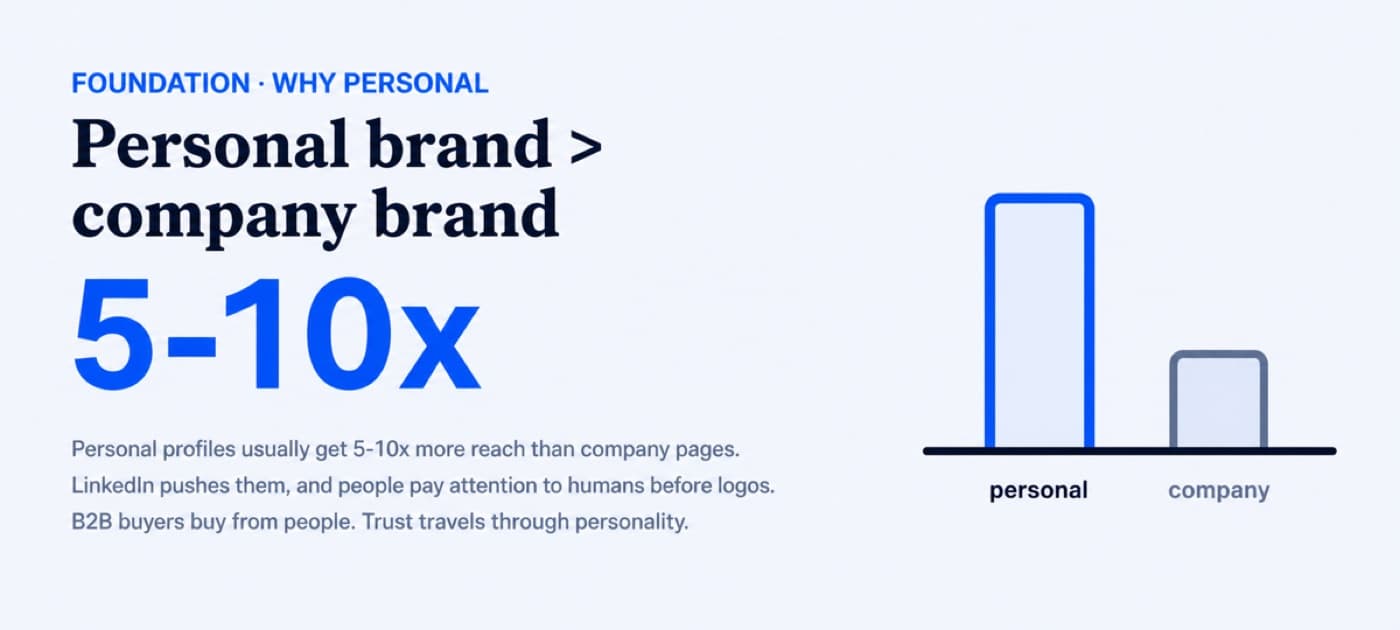
The 5-10x reach gap: why it exists
I have seen too many teams waste months trying to grow a company page when the founder profile was sitting there underused.
The reach gap exists for two reasons.
- Platform mechanics
LinkedIn is built around people, not logos. The feed is designed to reward identity, expertise, conversation, and relevance. A real person posting inside a clear niche sends stronger signals than a company page publishing generic updates.
The 2026 Brew 360 model pushes this even further. LinkedIn is less dependent on crude signals like hashtags or posting-time superstition, and more dependent on semantic relevance, saves, meaningful comments, and whether your profile matches your content.
- Human psychology
People do not want to spend attention on company pages unless they already care about the company.
B2B buyers buy from people. Trust moves through personality, tone, specificity, and lived experience. A company page feels like PR. A strong personal profile feels like access.
That is why the same idea posted from a founder often gets traction, while the same idea posted from the company account dies quietly.
LinkedIn pushes personal profiles - here's the evidence
The first layer is distribution.
From the workshop data I use, personal profiles get 5-10x more reach than company pages as a rule of thumb. That is not a cute opinion. It is the operating assumption I would use before allocating time.
The second layer is what the algorithm now values.
According to 2026 LinkedIn algorithm analysis from Project Neon, the system rewards:
- Clear themes
- Saves
- Meaningful comments
- Profile-content match
- Live human voice
A company page is weak on almost all five. It usually has vague themes, less human voice, fewer profile checks, and shallower comments.
The third layer is attention behavior.
You get 5-7 seconds at best. The first line decides most of the post's fate. People scan, judge, and scroll. A personal profile gives context instantly: who is this, why do they know this, should I care? A company page usually answers none of that fast enough.
The fourth layer is actual benchmark reality.
Shield Index reviewed 50,000 posts in February 2026. For accounts in the 5-10K follower range, normal performance was about 774 impressions. Viral was 5,000+. Breakout was 48,000+.
That gap matters because most buyers do not need to see you 50 times. They need to notice you once, believe you fast, and take the next step.
Self-serve model: content >> profile
If you sell a self-serve product or a small-ticket offer, content matters much more than profile.
Why? Because the buying decision can happen in-session.
Someone sees the post, clicks the link in the post or comment, lands on the site, and becomes a customer the same day. In that model, the post is the sales surface. The profile helps, but it is not carrying the conversion.
This is where I tell people to stop over-optimizing bios and start writing better posts.
- The hook matters more than the banner
If your first two lines do not stop the scroll, nothing else matters.
- The CTA matters more than your resume
If the post is relevant and the link is clear, people convert directly.
- Topic-product fit matters more than virality
I have had posts with big numbers and zero business value because the audience was wrong. Reach is not revenue.
For self-serve, I would prioritize:
- Strong hooks
- Tight product relevance
- Clear link placement
- Save-worthy ideas
- 4:5 visual format when using images or carousels
The same-day customer is real in this model. But only if the post connects directly to what you sell.
DM/demo model: content = profile
If you sell through DMs, calls, consulting, or large-ticket demos, the post and the profile work as a pair.
In this model, a viral post often produces profile visits before it produces conversations.
That is rational behavior. The buyer is thinking: who is this person, why should I trust them, what have they done, do they understand my problem, are they serious enough to contact?
This is where a weak profile kills conversion.
Content creates curiosity. Profile closes the gap between curiosity and contact.
I see this all the time. A post performs well, profile visits spike, but DMs stay flat. Usually the problem is not the content. The problem is the profile reads like a neglected resume, not a sharp market position.
If you sell via DM or demo, profile quality is not a nice extra. It is part of the funnel.
The profile as landing page - 4-element checklist
I treat the LinkedIn profile like a landing page, especially for service, consulting, agency, and founder-led B2B sales.
Here is the checklist I use.
- Headline
Do not waste this on a job title.
Use specialization plus a clear tagline. I want to know what you do, for whom, and why it matters in one quick scan.
Bad: "Founder at X"
Better: "I help B2B founders turn LinkedIn content into inbound pipeline"
- About
This is positioning, not autobiography.
Do not write a long career story unless it directly supports your credibility. Write what you believe, what problem you solve, and why your angle is different.
- Featured
This section should do real work.
I like three assets here:
- Best proof post
- Landing page or offer
- Lead magnet or case study
Most people leave Featured empty or fill it randomly. That is wasted buyer intent.
- Endorsements
Keep only the skills that support the position you want.
If your endorsements say a little bit of everything, they prove nothing. Relevance beats breadth.
When to invest in a company page and when it's a waste
A company page is worth investing in when it supports an existing demand engine.
Good reasons:
- You are hiring at scale
- You need brand legitimacy for enterprise buyers
- Employees will amplify from it
- You have real company news, launches, or customer proof worth centralizing
- You already have founder or exec distribution working
Bad reasons:
- "We should look professional"
- "Our competitor has one"
- "We don't want the founder to be the face"
- "Maybe the page will grow if we post often enough"
A company page is a waste when there is no strong human distribution behind it.
If no one already cares, the page becomes a low-reach content graveyard. You publish announcements to nobody, then conclude LinkedIn does not work.
LinkedIn works. The distribution strategy was wrong.
How to run both without doubling the work
You do not need two separate content engines.
I would run it like this:
- Build the main narrative on the founder or operator profile
That is where reach, trust, and conversation come from.
- Use the company page for proof and infrastructure
Post selective things there:
-
Product launches
-
Hiring updates
-
Customer wins
-
Repurposed best posts
-
Brand-level assets
-
Repurpose, do not duplicate blindly
A founder post can become a company post with a different angle. But do not copy-paste everything. The personal profile can be sharper, more opinionated, more specific.
- Keep profile and content aligned
Brew 360 rewards profile-content match. If you post about one thing and your profile says another, conversion drops.
- Measure strong signals, not vanity
I care far more about:
- Saves
- Meaningful comments
- Profile visits
- Connection requests
- DMs
- Customers
Likes are cheap. Impressions without action are weak. Numbers alone can lie.
At 2pr.io, one of the patterns I watch most closely is not just whether a post "did numbers," but whether it pulled the right people into the profile and moved them to act.
FAQ
Should I ignore my company page completely?
No. I would keep it clean, credible, and updated. I just would not expect it to be the main growth engine early on. For most B2B teams, the founder or operator profile should carry reach, while the company page supports trust, hiring, and proof.
What matters more: better content or a better profile?
It depends on the sales model. In self-serve, content matters more because buyers can click and convert immediately. In DM or demo sales, content and profile are tightly linked because the profile is where the buyer decides whether to contact you.
Do I need a huge personal audience for LinkedIn to work?
No. You do not need celebrity scale. Relevance beats size. A few thousand relevant followers and the right positioning can outperform a much larger but unfocused audience. I would rather have a profile that converts than a big audience that does not buy.
What should a founder post about if they do not want to become an influencer?
You do not need to become an influencer. You need a clear role. The easiest starting point is usually Curator + Leader: take something happening in your market, add your own informed angle, and connect it to a real business problem. That is enough to build trust without turning your feed into theater.
How often should I post?
3-5 times per week is a good target if you can sustain it for months. Consistency matters more than intensity. I would rather see one sharp, relevant post than daily filler. The algorithm is better at spotting flat, templated writing than most people think.
More LinkedIn guides
Super Pareto: why 5% of your LinkedIn posts drive 95% of your reach
If you are searching for the LinkedIn content power law, here is the direct answer: on LinkedIn, reach is not distributed evenly across your posts. In my...
June 23, 2026How to measure personal brand ROI when attribution doesn't work
If you want the direct answer to how to measure personal brand ROI on LinkedIn, here it is: stop trying to attribute every deal to one post, and start...
September 18, 2026LinkedIn's Network tab: what the feed split means
LinkedIn split the feed into For You and Network tabs. Here is what the change does, why it happened, and what it means for creators.
Grow on LinkedIn with 2pr
Ideas, AI drafts in your voice, carousels, scheduling, and analytics: one tool. Start your free trial.
Start free trial