
How to measure personal brand ROI when attribution doesn't work
June 23, 2026
TL;DR
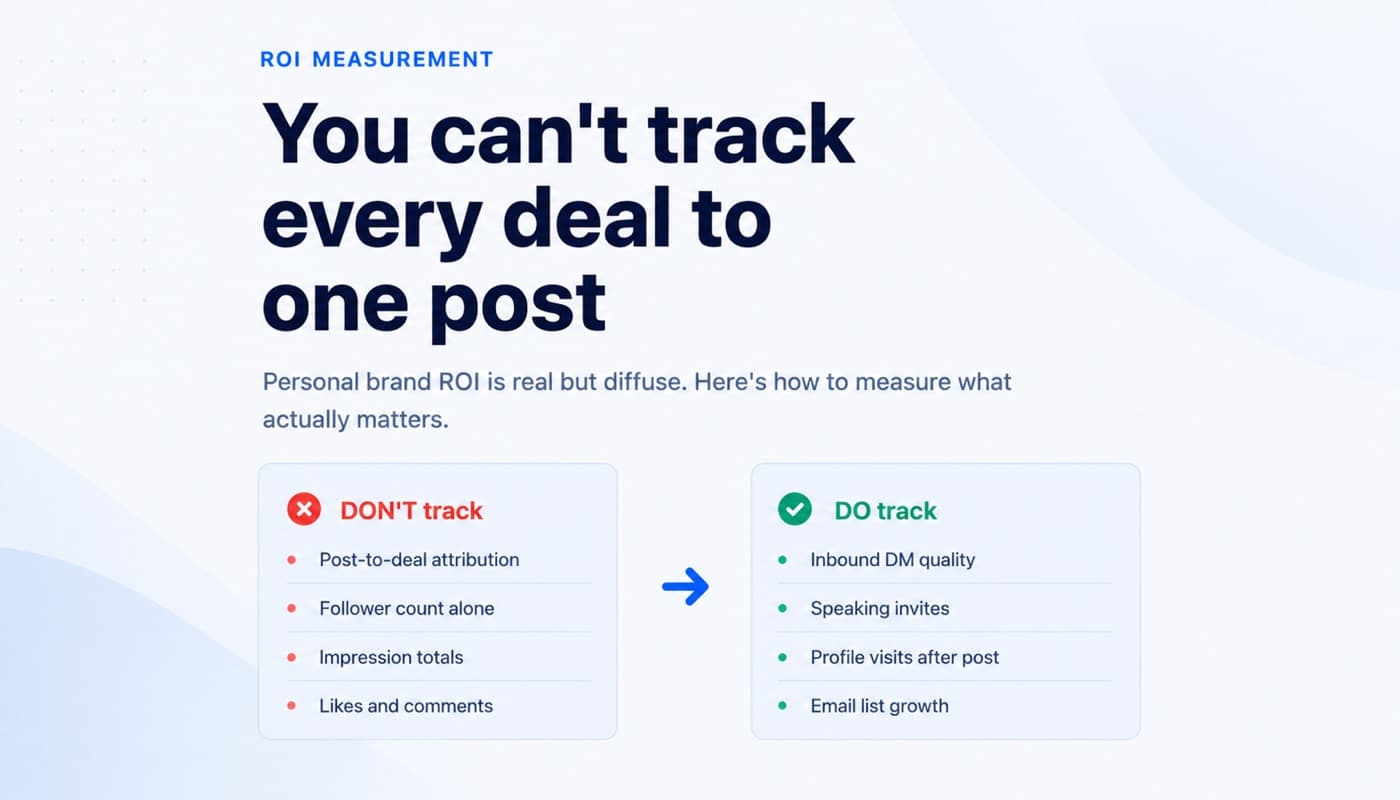
If you want the direct answer to how to measure personal brand ROI on LinkedIn, here it is: stop trying to attribute every deal to one post, and start tracking the proxy metrics that move before revenue shows up. For personal brand, the real signals are profile visits after posts, inbound DMs, connection request quality, mentions of "I follow you on LinkedIn" on sales calls, and pipeline quality over time. Attribution usually breaks because buying journeys are messy, delayed, and private. Personal brand ROI is real, but you measure it through patterns, not perfect last-click reporting.
 If you want the direct answer to how to measure personal brand ROI on LinkedIn, here it is: stop trying to attribute every deal to one post, and start tracking the proxy metrics that move before revenue shows up. For personal brand, the real signals are profile visits after posts, inbound DMs, connection request quality, mentions of "I follow you on LinkedIn" on sales calls, and pipeline quality over time. Attribution usually breaks because buying journeys are messy, delayed, and private. Personal brand ROI is real, but you measure it through patterns, not perfect last-click reporting.
Marketing attribution is an illusion of control
I dare to say marketing attribution is an illusion of control.
Especially for personal brand.
People love attribution because it feels precise. A dashboard gives you numbers. A spreadsheet gives you a story. A last-click model gives you a villain and a hero. But with founder-led content, most of that certainty is fake.
The problem is not that personal brand is unmeasurable.
The problem is that people expect it to behave like paid search.
It does not.
If someone sees my LinkedIn post today, visits my profile next week, follows me for three months, mentions my content in a call, and buys later through a referral or direct visit, which channel gets credit?
Usually not LinkedIn.
That does not mean LinkedIn did nothing. It means the tracking system is blind to how trust actually compounds.
Why standard attribution fails
Standard attribution fails because personal brand works through memory, familiarity, and private conversations.
That is exactly what dashboards are bad at capturing.
Here is where it breaks:
-
Dark social
People copy a profile link into Slack. They forward a screenshot in Telegram. They mention your post in a team chat. None of that shows up cleanly in analytics. -
DM conversions
A lot of high-value intent happens in direct messages. Someone reads your post, checks your profile, then sends a DM two days later. Good luck connecting that neatly to one content asset. -
Delayed buying behavior
The lurker problem is real. Someone can watch quietly for 90 days, never like a post, never comment, never click, then suddenly book a demo. -
Multi-touch reality
A buyer may see your comment on someone else's post, then your own post, then your profile, then your company site, then a founder interview. Which touchpoint "caused" the deal? -
LinkedIn is often top-of-funnel trust, not bottom-of-funnel capture
For larger-ticket sales, content and profile work as a pair. The post gets attention. The profile converts attention into trust. The sale happens later, somewhere else.
This is why founders get confused.
They look at a viral post, see no immediate revenue, and call it a vanity exercise.
Sometimes that is true. I have had posts with big reach and zero business value because the audience was wrong. Numbers do not equal money.
But I have also seen the opposite: a post that looks modest on the outside quietly changes the quality of inbound for weeks.
What you can actually measure: proxy metrics
If attribution is broken, the answer is not to give up.
The answer is to measure better leading indicators.
I separate metrics into weak and strong.
Weak metrics are easy to see and easy to overvalue: likes, follower count, raw impressions, one-word comments.
Strong metrics are closer to business reality: saves, meaningful comments, profile visits, DMs, qualified inbound, sales-call recognition.
For personal brand ROI on LinkedIn, I care about what signals intent and trust.
Not what looks good in a screenshot.
The proxy metrics framework
This is the practical framework I use.
1/ Profile visits after posts
For founder-led content, the profile is often the real landing page.
If people read a post and then check your profile, that means interest transferred from content to identity. That is a serious signal.
Personal profiles usually get much more reach than company pages. But reach alone is not the point. The point is whether the post makes the right people want to know who you are.
A strong post should create a lift in profile views.
Not every post. Remember the Pareto rule. In my own data, 5% of posts can drive 95% of reach. That distribution is normal. Do not optimize for the average post. Optimize for the breakout posts that create downstream trust.
2/ DM volume
Not all DMs matter, obviously.
But if posting consistently leads to more inbound messages, that is one of the clearest signs your personal brand is working.
Track:
- Number of inbound DMs per week
- Number of relevant DMs per week
- Number of sales conversations started from DMs
The shift from "nice post" to "can we talk?" is where ROI starts becoming visible.
3/ Inbound quality shift
This one matters more than volume.
Are better-fit prospects coming in? Are they more informed? Do they already trust your point of view? Do they need less education on the call?
This is where personal brand often pays back hardest.
People who come through founder content tend to arrive warmer. They know the framing. They know the beliefs. They know why you are different.
That reduces sales friction.
You may not be able to attribute the deal to Post #47. But you can absolutely observe that inbound quality improved after three months of consistent content.
4/ "I follow you on LinkedIn" rate on sales calls
Most teams do not track this, and they should.
On calls, ask one simple question early: "How did you hear about us?"
Then listen for the real answer, not the CRM answer.
When people say things like:
- "I've been following your posts"
- "I see you on LinkedIn all the time"
- "Your content has been useful"
- "I know your thinking already"
That is personal brand ROI.
Create a simple field in your CRM or call notes: LinkedIn awareness mentioned: yes/no.
If that number rises over time, your brand is entering the sales process before the call starts.
5/ Connection request quality
I also watch who starts reaching out.
Are connection requests coming from ICP accounts? Buyers? Founders? Recruiters? Investors? Partners?
A growing personal brand changes not just the quantity of attention, but the type of attention.
That shift is measurable.
How to set a baseline and track trends over time
Do not start with a fancy attribution model.
Start with a baseline.
For the next 4 weeks, track these weekly:
- Total posts published
- Profile views
- Inbound DMs
- Qualified inbound conversations
- Sales calls where LinkedIn was mentioned
- Connection requests from ICP accounts
- Closed revenue from self-reported LinkedIn influence
Then look at trendlines, not isolated spikes.
This matters because content is uneven. One post can underperform publicly and still bring the right person into your pipeline. Another can get huge reach and bring nothing useful.
You need enough time to see the pattern.
I usually tell people to think in 6-12 month windows, not 2-week windows.
Nobody is born knowing how to make content that works. It may look like some people went viral immediately. Usually they did not. They were building skill and judgment for years before the visible breakout.
Making the business case internally without hard attribution data
If you are a founder, you can decide to play the long game.
If you are trying to justify personal brand internally, you need a cleaner argument.
Here is the case I would make:
-
Personal brand increases trust before the sales conversation
That lowers CAC indirectly, even if you cannot model it perfectly. -
Personal profiles get more attention than company pages
In B2B, buyers buy from people. Trust is transmitted through personality. -
Content improves sales efficiency, not just lead volume
Warmer leads, faster calls, less skepticism. -
Some of the most important influence happens in dark social
If your market talks about you in private, attribution will undercount you by definition. -
Early-stage teams waiting for perfect measurement lose time
The teams that win are usually the ones experimenting where their audience actually lives.
I would never promise every post produces pipeline.
That is not how this works.
But I would argue that consistent, relevant founder content increases the odds of being remembered when buying intent appears.
That is strategically valuable even when the spreadsheet is incomplete.
The long-game numbers
The biggest mistake I see is people quitting too early.
They post for three weeks, see no direct revenue, and conclude personal branding does not work.
Wrong timeframe.
The real effect often shows up like this:
- Month 1-2: low signal, weak feedback, awkward reps
- Month 3-4: profile visits and recognition start rising
- Month 4-6: DMs and warmer intros increase
- Month 6-12: pipeline quality improves and sales calls start pre-sold
That does not mean every founder must chase virality.
In fact, virality is often overrated.
Reach without audience fit can build someone else's brand, not yours.
The better goal is consistent visibility inside the right market.
That is enough.
At 2pr.io, and in my own content, I have seen the same principle repeatedly: the market often looks "suddenly interested" long after the compounding has already started.
FAQ
How do I measure personal brand ROI on LinkedIn if nobody clicks my links?
Track what happens before the click. Look at profile visits, DMs, qualified connection requests, and how often prospects mention your content on calls. For many B2B offers, LinkedIn content creates trust first and clicks later. If you only measure link clicks, you will miss most of the value.
What is the best KPI for founder-led LinkedIn content?
There is no single perfect KPI, but profile visits plus qualified inbound is the best pair. Profile visits show attention transferred from content to identity. Qualified inbound shows that attention turned into business relevance. Likes are cheap. Trust signals are not.
How long does it take to see ROI from personal branding?
Usually 3-6 months to see clear movement, and 6-12 months to see strong pipeline impact. It can happen faster, but that should not be your assumption. Personal brand is a compounding asset, not a campaign with instant feedback.
Can I prove personal brand ROI to my team without hard attribution?
Yes, if you use a proxy-metrics framework and track it consistently. Show rising profile visits, more relevant DMs, improved inbound quality, and more sales calls where LinkedIn is mentioned. That is a business case. It is not perfect attribution, but it is honest measurement.
What if my posts get reach but no revenue?
Then the problem is usually one of three things: wrong audience, weak profile conversion, or no connection between your content topics and your offer. I have had posts with huge reach and zero business value. Viral does not automatically mean useful. The goal is not attention alone. The goal is attention from the right people.
More LinkedIn guides
Personal brand vs company page on LinkedIn: the 5-10x reach gap
If you're asking about personal LinkedIn vs company page reach, the short answer is simple: personal profiles usually get 5-10x more reach than company...
June 23, 2026How Oliver Baker 16x'd his LinkedIn reach by changing one thing
A real LinkedIn case study. Oliver Baker, a mathematician and founder, was already posting before 2pr.io with low return. Across 25 posts, his average impressions went from 960 to 15,588 (16x) and engagement from 15 to 141 (9x). Same author, same voice. Here is what actually changed.
September 18, 2026LinkedIn's Network tab: what the feed split means
LinkedIn split the feed into For You and Network tabs. Here is what the change does, why it happened, and what it means for creators.
Grow on LinkedIn with 2pr
Ideas, AI drafts in your voice, carousels, scheduling, and analytics: one tool. Start your free trial.
Start free trial