
How Oliver Baker 16x'd his LinkedIn reach by changing one thing
June 23, 2026
TL;DR
Oliver Baker is a mathematician and founder. He was already posting before 2pr.io, with decent effort and low return. Across 25 posts before vs after, his average impressions per post went from 960 to 15,588 (16x) and average engagement from 15 to 141 (9x). Same author, same voice. Two things changed at once: he found his content pillar (who he was talking to and what problem he was solving), and he had the right tool to carry it. Positioning unlocks results, technology amplifies them. Neither alone would have done it.
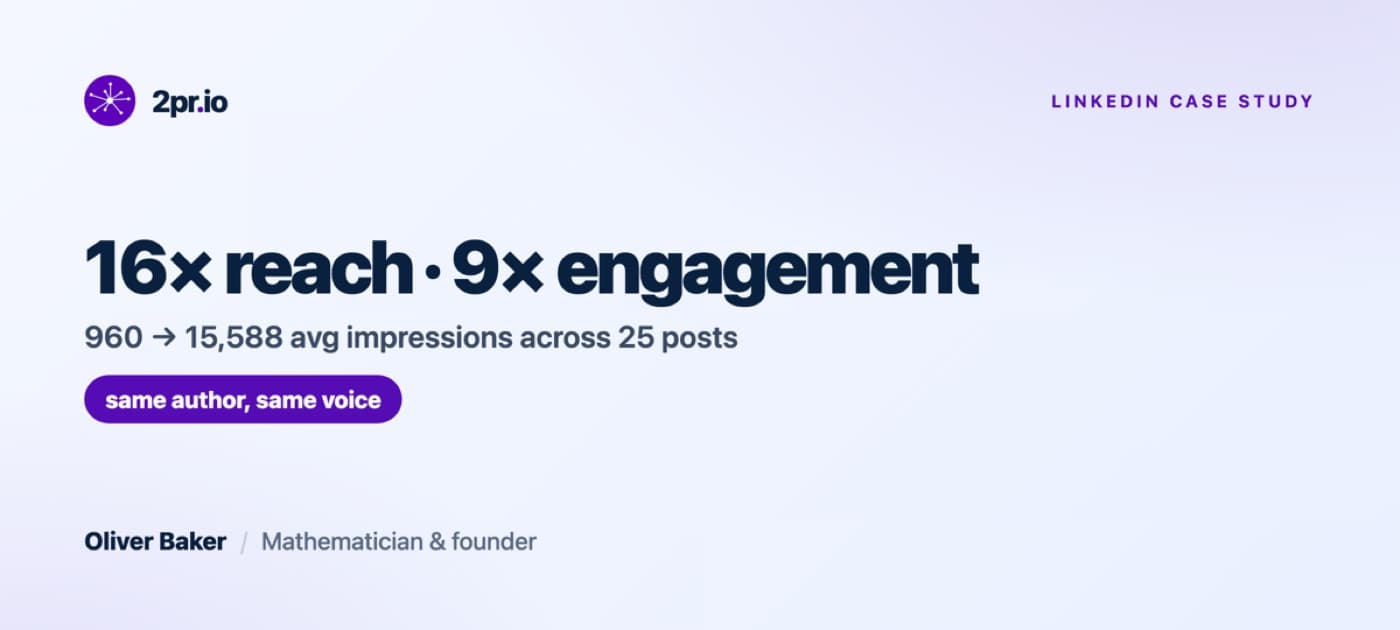
You can post 25 times and learn nothing. Or you can change one thing and 16x your reach. Oliver Baker did the second one, and the change is more useful than it looks.
Oliver is a mathematician and founder. He was posting before 2pr.io. Decent effort, low return. The kind of ratio that quietly kills your motivation to keep going.
The numbers
Across 25 posts, before vs after:
- Average impressions per post: 960 to 15,588 (16x)
- Average engagement per post: 15 to 141 (9x)
Same author. Same voice. No new audience trick.
Two things changed at once
This is the part worth understanding, because most "growth" advice only gives you half of it.
He found his content pillar. Who he was talking to. What problem he was solving for a specific person. Before, he was posting smart things into the void. After, every post had a direction and an intended reader.
He had the right tool to carry it. Once the direction was clear, he needed to produce consistently without burning hours per post.
Neither one alone would have done it.
Clear content direction without distribution gets ignored. Volume without a defined angle is just noise. The 16x came from putting both together.
In his own words
The tool completely changed the effort-to-result ratio. I spend almost no time on a post, 5 to 15 minutes, and get more out of it than before. Before, the volume of effort vs. result was really demotivating. Now everything is great.
That effort-to-result ratio is the thing nobody talks about. Most people do not quit LinkedIn because the strategy is wrong. They quit because the effort is high and the payoff is invisible, and that math is exhausting.
The reach was not even the point
Here is what made the 16x actually meaningful: it was not just bigger numbers.
It was the right people seeing his work. A better ICP match. Better conversations. Real leads from the right audience.
A post that hits 15,000 impressions of the wrong people is a vanity metric. A post that hits the right 15,000 is a pipeline. Positioning is what decides which one you get.
3 posts from his sharpened pillar
Once the angle was clear (startup funding and grants for founders), the breakouts followed. Real examples from his feed, impressions from our analytics:
- "A wearable water bottle just hit 15M views in 3 days." - May 9, 2026 - 84,004 impressions
- "Residence permit, plus grant money." - May 24, 2026 - 69,583 impressions
- "EU grants are the biggest funding source most founders ignore." - February 17, 2026 - 46,194 impressions
Same author who used to average under 1,000 impressions. The difference is a defined reader and a defined problem, carried by a tool that lets him ship it.
The lesson
Positioning unlocks results. Technology amplifies them.
If you only fix positioning, you stay slow and inconsistent, and you under-publish. If you only add a tool, you produce more noise faster. You need the angle and the engine at the same time.
Cases like Oliver's are the main reason we build 2pr.io: the tool gets you from a clear idea to a finished, well-targeted post in 5 to 15 minutes, so the effort-to-result ratio finally works in your favor.
FAQ
Was it the tool or the strategy that drove the 16x?
Both, at the same time. Oliver found his content pillar (a clear audience and problem) and used a tool that let him execute on it consistently in minutes per post. Either change alone would have underperformed. Positioning gives direction, the tool gives sustainable output.
Did his writing voice change?
No. It was the same author and the same voice. What changed was the angle (who each post was for) and the speed of producing it, not his personality on the page.
What does "effort-to-result ratio" mean here?
It is the amount of work a post takes versus what you get back. Oliver went from high effort with low, demotivating return to 5 to 15 minutes per post with far more reach and engagement. That ratio, more than any single viral post, is what keeps people publishing long enough to win.
Why does positioning matter more than reach?
Because reach of the wrong audience does nothing for your business. Oliver's 16x mattered because it brought the right people, better conversations, and real leads, not just a bigger impression count.
More LinkedIn guides
How to measure personal brand ROI when attribution doesn't work
If you want the direct answer to how to measure personal brand ROI on LinkedIn, here it is: stop trying to attribute every deal to one post, and start...
June 23, 2026LinkedIn Saves: the only metric that actually matters
If you're asking what metrics matter on LinkedIn, my short answer is this: saves matter most, then meaningful comments, profile visits, DMs, and...
September 18, 2026LinkedIn's Network tab: what the feed split means
LinkedIn split the feed into For You and Network tabs. Here is what the change does, why it happened, and what it means for creators.
Grow on LinkedIn with 2pr
Ideas, AI drafts in your voice, carousels, scheduling, and analytics: one tool. Start your free trial.
Start free trial