
How to get more impressions on LinkedIn: 12 lessons
October 2, 2026
TL;DR
To get more impressions on LinkedIn, stop optimizing your average post and start engineering breakouts. Most of your reach comes from a handful of posts, the hook decides whether a post gets a chance, and a clear lane plus honest measurement decides whether the reach turns into anything useful. These are 12 lessons from 2M impressions in one year, which put me in the top 5% of 1,000+ creators who connected their accounts to 2pr.io.
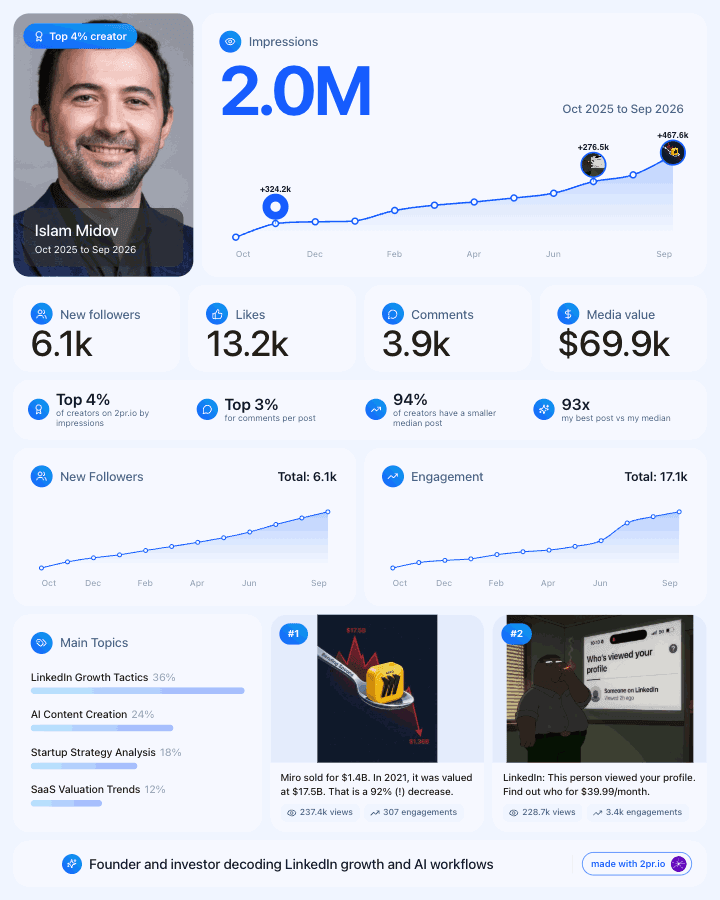
The fastest way to get more impressions on LinkedIn is to stop trying to lift every post and start engineering the few posts that break out, because a small share of your posts drives almost all of your reach. Everything else on this list either helps you produce those breakouts more often or makes sure the reach they bring is worth having.
I got 2M impressions on LinkedIn between October 2025 and September 2026. That is not massive by creator standards, but it is solid: top 5% based on data from 1,000+ creators who connected their accounts to 2pr.io. It came with 6.1k new followers, 13.2k likes, and 3.9k comments.
More importantly, it was a big deal for me personally. Before building 2pr.io, I was not good at content. Everything below is what I learned getting from there to here. Treat it as one operator's signal, not a study.
Why your reach is uneven (lessons 1 and 2)
1. Super Pareto rules: 5% of posts drive 95% of reach
This is the lesson that changes how you work. Reach on LinkedIn is not spread evenly across your posts. It follows a power law. My best post of the year did 93x my median post. That is not a rounding error, it is the whole game.
Once you see this, you stop agonizing over why a Tuesday post did 3,000 impressions instead of 4,000. That difference barely moves your year. What moves your year is how often you produce the outlier. I wrote a full breakdown of the pattern in Super Pareto: why 5% of your LinkedIn posts drive 95% of your reach.
What to do: judge your strategy by your breakout rate over a quarter, not by any single post.
2. Impressions are like calories
There is empty fluff and there is real nutrition. A post can collect 150k impressions from people who will never buy from you, hire you, or remember your name. Another might do a fraction of that with exactly the right founders and operators and turn into real conversations.
More impressions is the goal of this article, but only the kind that compound. Before you copy a format that "went viral", ask who it reached.
Why it is getting harder, and why it is still worth it (lessons 3 to 5)
3. The feed is zero-sum and attention is getting harder
Every year more people post, and the feed does not get longer. Your post competes with everyone else's for the same few seconds of scroll. That means the bar keeps rising. What worked two years ago with a decent hook and a list will not carry you now.
The answer is not more volume. It is sharper skills: better hooks, clearer ideas, stronger visuals.
4. Consistency only works if you measure results
"Just be consistent" is half the advice. Consistency multiplies whatever you are doing. If the formula is bad, repeating it produces bad results, consistently.
Measure every post. Look at impressions, profile views, and saves, then change one thing at a time. Consistency plus feedback is a system. Consistency alone is a habit.
5. No platform offers easier qualified attention
People complain about LinkedIn reach every month. Still, I have not found another platform where a B2B founder with a small following can get in front of buyers, investors, and peers this cheaply. You do not need to buy ads, build a YouTube channel, or win SEO for years. You need a point of view and a few months of reps.
How to choose what to post (lessons 6 to 9)
6. Pick a clear lane
Mine is LinkedIn tactics and startup breakdowns. My Wrapped card splits my year into LinkedIn growth tactics (36%), AI content creation (24%), startup strategy analysis (18%), and SaaS valuation trends (12%). Those topics overlap, and that overlap is the point: people know what they get when they follow me.
A clear lane helps the algorithm too. When your posts keep landing with the same kind of reader, LinkedIn gets better at finding more of them.
7. Humor is still underrated in B2B
Most B2B content is serious and forgettable. A good meme stands out. My second-best post of the year was a meme about LinkedIn's "who viewed your profile" upsell, at 228.7k views.
The catch: a good meme needs deep industry understanding. A generic office joke gets a laugh and nothing else. A meme that only someone in your niche would get signals that you are one of them.
8. Likes and impressions are loosely connected
Relatable rants and personal fluff farm likes easily. That does not mean they travel far or build anything. My top post of the year, a breakdown of Miro selling for $1.4B after a $17.5B valuation in 2021, did 237.4k views with only 307 engagements. The likes undersold it badly.
If you judge your content by the public like count, you will drift toward applause and away from reach. More on this in LinkedIn likes vs impressions: why likes mislead you.
9. Repurpose what already works
Nobody writes a legendary song without playing covers first. The same is true for posts. Most breakout formats are observed, not invented.
Find posts that already worked, in your niche or on other platforms. Study the hook, the structure, and the emotion behind it. Then rebuild it with your own example and your own take. Same skeleton, different substance. This is not copying, it is how every craft is learned.
How to make a post land (lessons 10 and 11)
10. Hooks drive 80% of a post's success
That is my rule of thumb, not a measured number, but I have watched it hold for a year. The first line and the preview decide whether anyone reads the rest. A great body under a weak hook is invisible.
And over half of a hook's success is visual. On a phone, the image or video is often the first thing people see, before your text. A strong visual earns the pause that gives your opening line a chance. If you want a starting point for the text side, I collected 50 LinkedIn hook formulas that actually work.
11. Your profile must match your content
Every breakout sends a wave of people to your profile. If your headline says something unrelated to the post they just read, most of them leave.
Make sure your headline, About section, and Featured section tell the same story as your posts. Talk about what people want to hear from you, and make your profile the obvious next step for someone who liked the post.
What actually holds it together (lesson 12)
12. Writing is not the hardest part, systems are
Writing one good post is hard. Writing a good post every week for a year, while running a company, is a different problem. You need a way to capture ideas, find formats that work, draft in your own voice, publish on schedule, and learn from the numbers.
That is the reason 2pr.io evolved from a writing partner into an AI head of content. The writing was never the bottleneck. The system around it was.
A quick checklist
Swipe sideways to compare
| Lesson | What to do this week |
|---|---|
| Super Pareto | Find your top 3 posts of the quarter and work out what they share |
| Calories | Check who engaged with your biggest post, not just how many |
| Measure | Rank your last 10 posts by impressions and profile views, not likes |
| Lane | Write down the 2-4 topics you want to be known for |
| Repurpose | Save 5 posts that broke out in your niche and study their hooks |
| Hooks | Rewrite the first line of your next post three times before you publish |
| Profile | Make your headline match what your best posts are about |
Where 2pr.io helps
If you want to see your own year the way I saw mine, you can generate a free LinkedIn Wrapped card at 2pr.io/wrapped. It uses the official LinkedIn API.
For the day-to-day, 2pr.io drafts posts in your own voice, learned from your persona and AI interviews, and pulls ideas from a library of high-performing posts so you are repurposing what already works instead of starting from a blank page. Its analytics show impressions, profile views, and saves, so you can see which posts actually break out. It runs on the official LinkedIn API, so your account stays safe. Plans start at $24/month for individuals on annual billing (or $49 month to month), and you can see the details on the pricing page.
The bottom line
Getting more impressions on LinkedIn is less about posting more and more about producing the rare post that breaks out, then making sure the reach it brings is the right reach. Pick a lane, win the hook, repurpose formats that already work, keep your profile in sync with your content, and measure everything by impressions and profile views instead of likes. None of it is magic. It is a system, and a system is something you can build.
More LinkedIn guides
LinkedIn's Network tab: what the feed split means
LinkedIn split the feed into For You and Network tabs. Here is what the change does, why it happened, and what it means for creators.
September 18, 2026LinkedIn likes vs impressions: why likes mislead you
Likes are a weak proxy for LinkedIn reach. Here is why impressions and profile views tell you what is actually working, with real data.
September 11, 2026Do LinkedIn bot farms work for lead generation?
No. LinkedIn bot farms are a negative-ROI lead-gen channel. Here is why fake profiles and bot DMs fail, and the three channels that actually book calls.
Grow on LinkedIn with 2pr
Ideas, AI drafts in your voice, carousels, scheduling, and analytics: one tool. Start your free trial.
Start free trial