
LinkedIn likes vs impressions: why likes mislead you
September 18, 2026
TL;DR
On LinkedIn, likes are the metric everyone can see, so they became the default way to judge what is "viral." That is a mistake. Real reach is private, and likes correlate with it far more loosely than people assume. In one comparison, a post with 220 likes drove 230K impressions and 300 profile views, while a post with 700 likes drove only 77K impressions and 50 profile views. If you study likes alone, you end up copying entertainment instead of authority. Judge content by impressions, profile views, and saves, not the number that happens to be public.
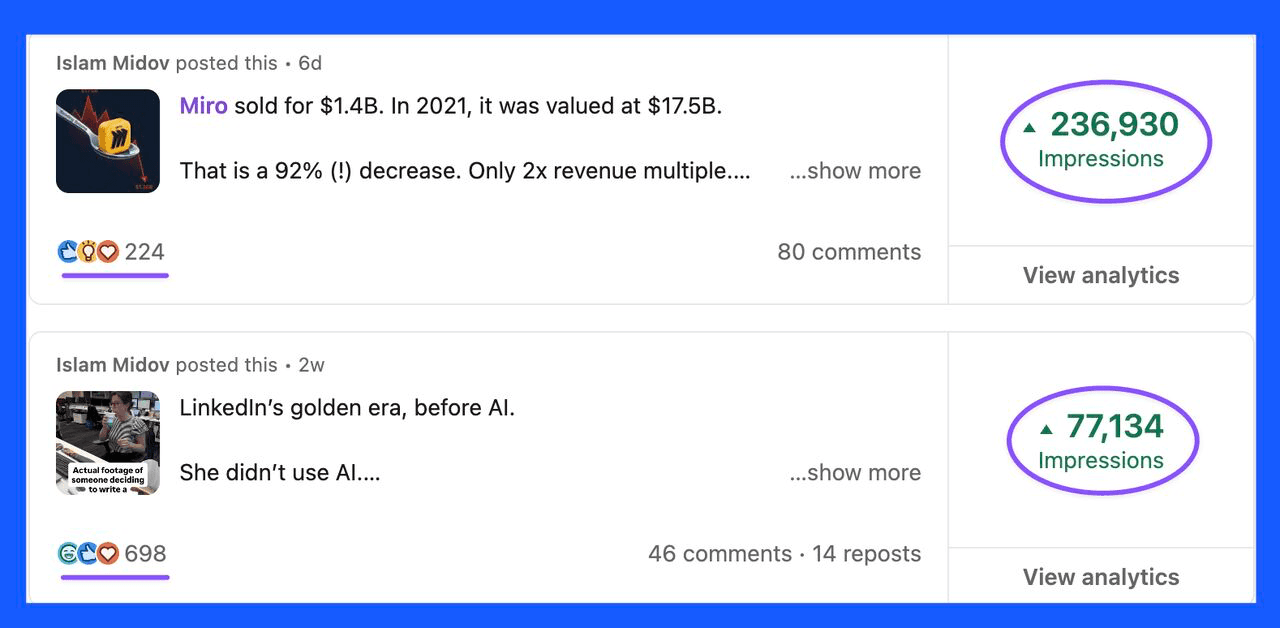
Likes are the weakest reliable signal of how far a LinkedIn post traveled. They are the only number everyone can see, so they became the default proxy for reach. But real reach is private, and likes track it loosely at best. If you want to know what actually worked, look at impressions, profile views, and saves instead.
This matters because most people research content the wrong way. They scroll the feed, see a post with a big like count, and assume it reached a lot of people. Then they copy the format. Often they are copying the wrong thing.
Why likes became the default metric
LinkedIn shows likes and comments publicly. It does not show impressions, reach, or profile views on anyone else's posts, only your own. So when you look at someone else's content, likes are the one hard number you have. Naturally, people started using them as a stand-in for everything else.
We ran into the same trap building the 2M-post viral library inside 2pr.io. Early on we filtered posts by 500+ likes, because likes were the only signal available at scale. It works as a rough filter, but it bakes in a blind spot: you only ever see the posts that got a lot of visible engagement, not the posts that got a lot of reach. Those two groups overlap less than you would think.
The data: likes and reach can point in opposite directions
Here is a real comparison between two posts, using the private analytics only the author can see:
Swipe sideways to compare
| Post | Likes | Impressions | Profile views |
|---|---|---|---|
| Product teardown (Miro) | 220 | 230,000 | 300 |
| LinkedIn meme | 700 | 77,000 | 50 |
Read that again. The meme got roughly 3x the likes. The teardown got roughly 3x the reach and 6x the profile views. If you had judged these two posts by the public number, you would have concluded the meme was the runaway winner and the teardown was mediocre. The private numbers say the opposite.
This is not a one-off. It is the predictable result of what different content does to a reader. A meme earns a fast, cheap like and then people scroll on. A teardown earns a slower, more considered response: fewer likes, but more people reading to the end, saving it, and clicking through to see who wrote it. That last part is what actually builds a business.
What each metric really tells you
Once you stop treating likes as the scoreboard, the other numbers start to mean something.
- Impressions tell you how far a post traveled. This is the closest thing to "did it go viral," and it is exactly the number you cannot see on other people's posts.
- Profile views tell you whether the post made anyone curious about you. A post can rack up reach and still generate almost no profile visits if it gave people no reason to want more. Views are a proxy for "this person is worth knowing."
- Saves tell you the post had lasting value. Someone decided it was worth keeping. Of all the visible signals, saves are the most honest, which is why we argue that saves are the metric that actually matters.
- Meaningful comments tell you the post started a real conversation, not a "great post!" reflex.
- Likes tell you the post was pleasant enough to tap approval on. That is the shallowest of the set.
None of these are useless, but they sit in a hierarchy. Likes are at the bottom. If you optimize for the bottom of the hierarchy, you get more of the content that earns cheap approval and less of the content that earns reach, trust, and inbound.
Two rules for content research
If you study other people's posts to figure out what to make, adjust for the blind spot:
- Memes and reactions are awareness plays, and likes are a weak read on them. They spike fast and fade quickly. A meme with a huge like count might have reached a fraction of a quieter, more substantive post. Use them sparingly and do not build a strategy on them.
- Teardowns and analysis combine broad reach with clear expertise, but they are time-sensitive. A teardown of a product, launch, or news moment does best in the first day or two. Wait a week and the same post can get a fraction of the reach, because the moment passed. If you spot a good teardown angle, move fast.
The deeper point: reach on LinkedIn is not evenly distributed, and the posts that carry it are not always the ones with the biggest like counts. A small number of posts drive most of your results, which is the super Pareto pattern we see again and again. Judging by likes hides which posts those are.
How to actually measure your own content
You have an advantage on your own posts that you do not have on anyone else's: you can see the private numbers. Use them.
- Stop ranking your posts by likes. Rank them by impressions first, then profile views and saves.
- When a post over-performs on reach but under-performs on likes, do not dismiss it. That is often your best content, the kind that builds authority rather than applause.
- When a post gets lots of likes but little reach or few profile views, be honest that it was entertainment, not distribution.
- Look at the shape over time, not a single post. One breakout tells you little; a pattern tells you what your audience actually rewards.
This is exactly where good analytics earn their keep. 2pr.io drafts posts in your own voice, learned from persona and AI interviews, and then its analytics show you the numbers that matter, impressions, profile views, and saves, not just the public like count. It pulls ideas from a library of high-performing posts so you are not guessing what to make, and it runs on the official LinkedIn API, so your account stays safe from the bans that come with sketchy automation. Plans start at $24/month for individuals on annual billing (or $49 month to month), and you can see the details on the pricing page.
The bottom line
Likes are the one number everyone can see, which is exactly why they mislead. Real reach is private, and it does not move in lockstep with visible approval. A post with a third of the likes can carry triple the reach and six times the profile views. If you research content by likes, you will keep copying what gets applause instead of what gets distribution and trust. Judge by impressions, profile views, and saves, and you will finally be optimizing for the thing that actually grows an audience.
More LinkedIn guides
LinkedIn's Network tab: what the feed split means
LinkedIn split the feed into For You and Network tabs. Here is what the change does, why it happened, and what it means for creators.
September 11, 2026Do LinkedIn bot farms work for lead generation?
No. LinkedIn bot farms are a negative-ROI lead-gen channel. Here is why fake profiles and bot DMs fail, and the three channels that actually book calls.
September 4, 2026How to use humor and memes on LinkedIn
Humor and memes are a real funnel on LinkedIn: they get you noticed before anyone knows your expertise. Here is how to use them without looking unserious.
Grow on LinkedIn with 2pr
Ideas, AI drafts in your voice, carousels, scheduling, and analytics: one tool. Start your free trial.
Start free trial