
Is LinkedIn reach dying? No, it is maturing
August 21, 2026
TL;DR
LinkedIn reach is not dying, it is maturing. The platform moved from a follower-first feed to an interest-first one, the same shift that hit every other social platform. That makes reach feel less predictable, but it also means small accounts can still reach a large share of their followers and travel well beyond them. The real lever is a useful point of view published consistently, not chasing follower count.
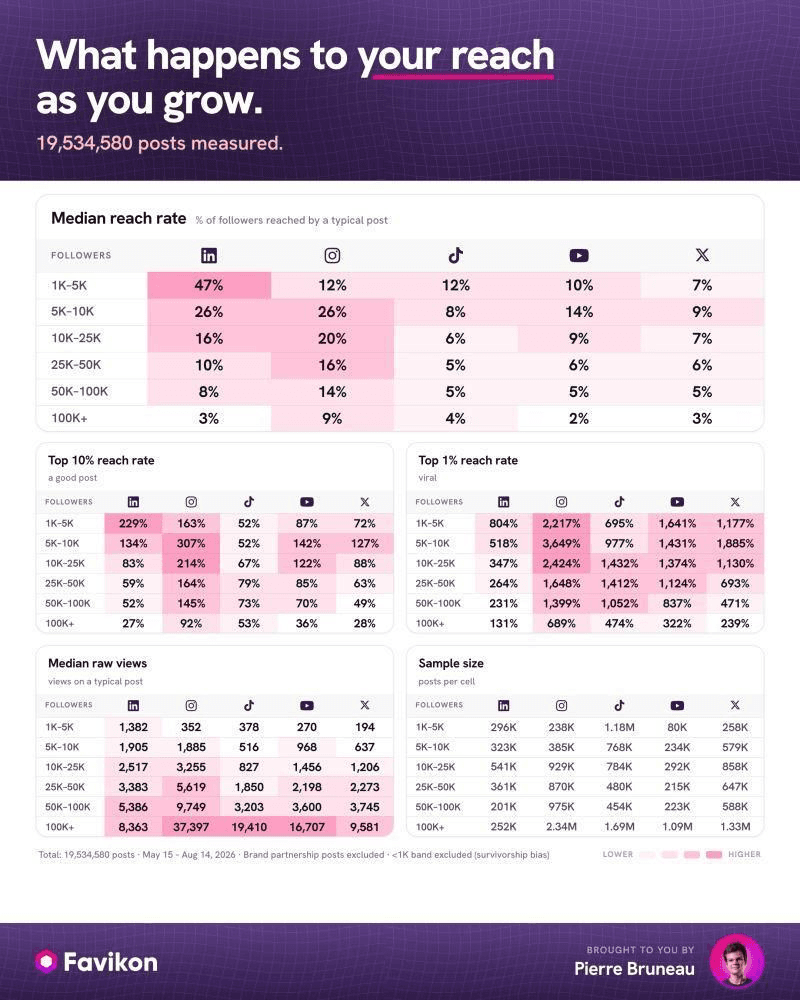 If you are searching whether LinkedIn reach is dying, here is the direct answer: no, it is maturing. Reach is getting harder to predict because the feed moved from showing your posts to your followers first to showing posts to whoever is likely to care, regardless of who follows you. That shift feels like a collapse if you were used to the old rules. It is not. For most people reading this, LinkedIn is still the easiest major platform on which to build a presence from scratch.
Why half your feed says reach collapsed and the other half says it never worked better
Both camps are describing the same change.
Half of LinkedIn will tell you their reach fell off a cliff this year. The other half will tell you the platform has never worked better for them. They are not contradicting each other. They are standing on two sides of the same shift.
For years, LinkedIn had a content deficit. There were more readers than there were people willing to post, so the feed rewarded almost anyone who showed up consistently. That is over. Supply is saturated now. There is far more content chasing the same attention, and attention is getting more expensive.
At the same time, distribution moved from follower-first to interest-first. Your post is no longer served mainly to the people who follow you. It is served to the people the system predicts will engage with the topic. This is the same TikTokization that hit every other feed, and it is the single biggest reason reach feels different.
If your content is sharp and lands with an interested audience, interest-first distribution is a gift. It carries you past your follower count. If your content is generic, the old follower safety net is gone, and it shows.
What "interest-first" actually changes for you
The unit of distribution is now the post, not the account.
Under follower-first, a big following was a moat. You could post something average and still get reach because the feed pushed it to your audience by default. Under interest-first, each post has to earn its distribution more or less on its own merits. A great post from a small account can travel a long way. A weak post from a large account can die quietly.
This is why chasing follower count as your main metric is a trap. More followers can still help, but it is no longer the thing that guarantees reach. What guarantees a shot at reach is a post that clearly signals its topic and its payoff in the first two lines, so the system can match it to the right readers and those readers stop to engage.
If you want to understand how uneven this gets, read our breakdown of why a small share of your posts drives almost all of your reach. Interest-first distribution makes that power law sharper, not softer.
Small accounts still have the advantage most people overlook
Here is the part that gets lost in the "reach is dead" panic.
For smaller accounts, a typical LinkedIn post still reaches a bigger share of its followers than it would on most other major platforms. LinkedIn has not fully compressed organic reach to near zero the way older feeds did. If you are early, that is a real edge, and it is the strongest argument for starting now instead of waiting.
There is a ceiling to this. As you grow into a very large following, that per-post share of your audience fades, and the platform behaves more like every other creator platform. If your goal is to be a full-time influencer with hundreds of thousands of followers, LinkedIn can actually be suboptimal at the top end. But that is not the problem most people reading this have yet. The problem most people have is getting the first few thousand of the right people to notice them at all, and for that, LinkedIn is still unusually generous.
Text also helps. On LinkedIn, a written post is far cheaper to create than video, and it still competes for the top of the feed. You do not need a studio. You need a useful point of view and the consistency to keep sharing it.
So is reach getting harder or not?
Both. It is harder to coast and easier to break out.
Reach is genuinely harder if your plan was to post filler and lean on your follower count. That plan is dead. Reach is easier than ever if you have something specific to say to a specific audience, because interest-first distribution will find those readers even if they have never heard of you.
The practical takeaway is to stop judging your strategy by the median post. Most posts will land in a narrow, unremarkable band. That is normal in a system like this. The job of your average post is to keep you in the game long enough to produce the occasional breakout that does most of the work. If you want a fuller picture of how the ranking itself changed, our post on what the LinkedIn algorithm actually rewards in 2026 covers what the system now reads in your posts.
What to do about it
The advice does not change much once you accept the shift. It just gets more honest.
- Lead with a real point of view. Interest-first distribution rewards posts that clearly say something. A useful, specific take beats a safe, generic one, because the system needs a topic signal to match you to readers.
- Publish consistently. Reach is uneven post to post, so you need enough attempts to catch the outliers. A sustainable pace over months beats a burst you cannot maintain.
- Write for the interested stranger, not just your followers. Assume your reader does not follow you. Make the first two lines earn the scroll on their own.
- Measure the right signals. Saves and meaningful comments tell you a post resonated far better than raw likes or follower count. Watch those to learn what your audience actually wants.
- Start before it feels ready. Attention keeps getting more expensive. The best day to start building a presence was ten years ago. The next best day is today.
This is exactly the loop 2pr.io is built for. It is an AI agent for LinkedIn that drafts posts in your own voice, learned from a persona interview, so you always start from something instead of a blank page. It gives you a planner so consistency does not depend on daily willpower, and its analytics show you which posts actually reached and resonated, so you can adjust on evidence instead of vibes. It runs on the official LinkedIn API, so your account stays safe. Plans start at $24/month on annual billing, or $49 month to month, on the pricing page.
The bottom line
LinkedIn reach is not dying. It is maturing from a follower-first feed into an interest-first one, and that only feels like a collapse if you were relying on the old rules. Supply is saturated and attention is expensive, but small accounts still reach a large share of their audience and can travel well beyond it with one strong post. The winners are not the people with the most followers. They are the people with a useful point of view and the consistency to keep publishing it. Start now, write for the interested stranger, and let the outliers do the heavy lifting.
More LinkedIn guides
X algorithm scoring weights, and what they teach you
X open-sourced its algorithm scoring weights. Here is what each weight means, why replies and reshares beat likes, and the lesson for LinkedIn creators.
August 7, 2026How to Start Posting on LinkedIn (Your First 10 Posts)
How to start posting on LinkedIn when you have never posted before. Your first 10 posts have one job, plus a simple system to begin and improve.
October 2, 2026How to get more impressions on LinkedIn: 12 lessons
How to get more impressions on LinkedIn, from 2M impressions in a year: chase breakout posts, win the hook, pick a lane, and measure every post.
Grow on LinkedIn with 2pr
Ideas, AI drafts in your voice, carousels, scheduling, and analytics: one tool. Start your free trial.
Start free trial