
Do scheduled posts hurt your LinkedIn reach?
July 31, 2026
TL;DR
There is no reach penalty for scheduling LinkedIn posts through a third-party tool on the official API. A post I scheduled on a Friday night still went viral, which also undercuts most "best time to post" advice. What actually drives reach is the content and the hook, not the clock or the publishing method.
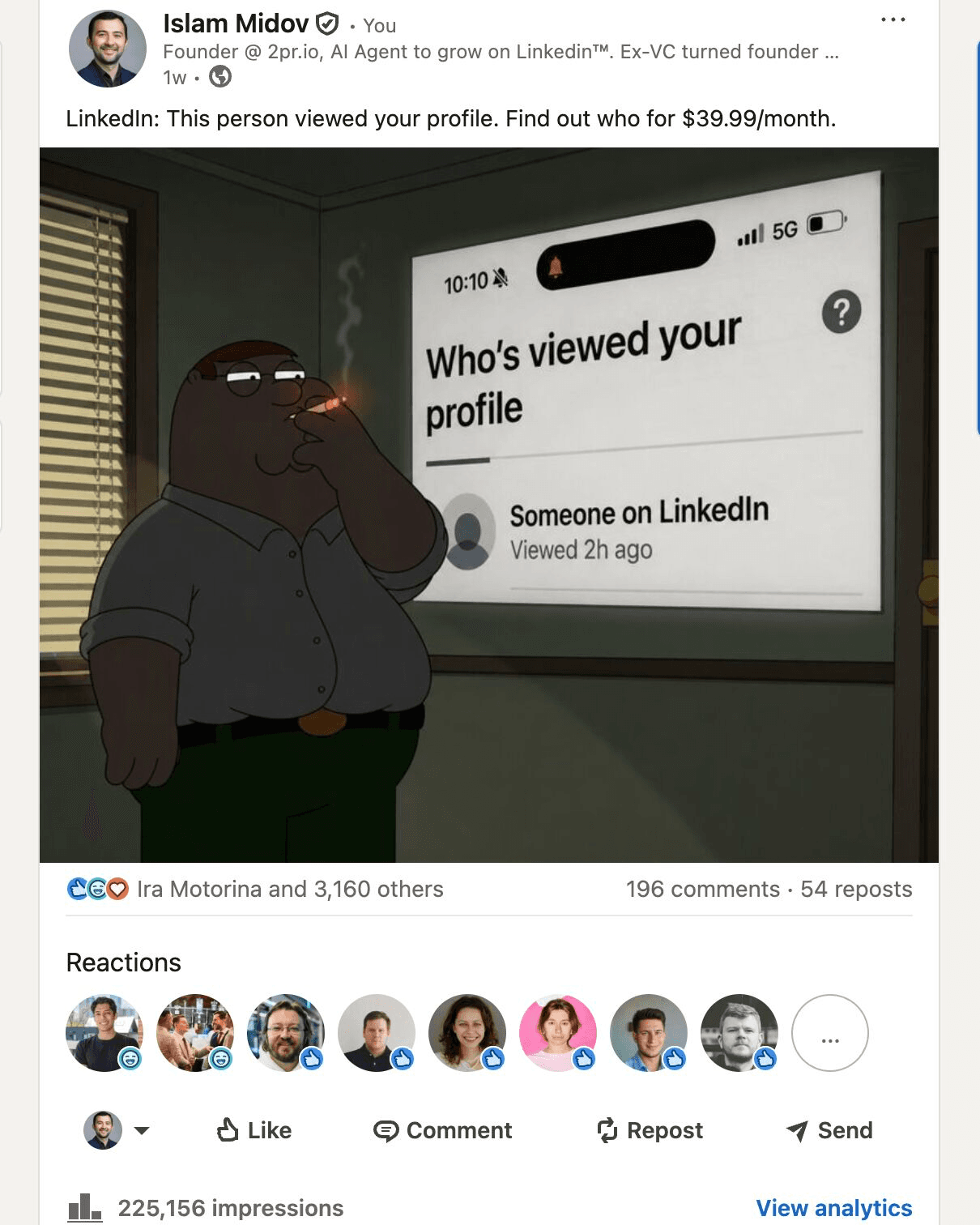
Short answer: no, scheduled posts do not hurt your LinkedIn reach. A post I scheduled through a third-party app, published on a Friday night, went on to get 3,100+ likes: more than two months of my previous posts combined. It was not posted natively through the LinkedIn UI, and it did not matter. There is no penalty for scheduling on the official API, and the timing myth that usually comes attached to this question does not hold up either.
This is one of the most common worries I hear from people who want to plan ahead: "won't LinkedIn punish me for not posting live?" Let me walk through why the answer is no, what the viral post actually taught me, and where you should put your energy instead.
Does LinkedIn penalize scheduled or third-party posts?
No. As long as the tool publishes through LinkedIn's official API, a scheduled post is treated the same as one you typed into the box and hit "post" on. The platform does not see "this came from a scheduler" and quietly throttle it.
The confusion usually comes from two different things getting mixed up. One is scheduling, which is fine. The other is sketchy automation: browser extensions and bots that log in as you, scrape, auto-comment, and auto-connect. Those violate LinkedIn's terms and can get your account restricted, but that risk has nothing to do with scheduling itself. It comes from the method. If you care about the difference, this breakdown of browser extensions and account risk is worth a read. The safe path is simple: use a tool built on the official API, and scheduling is a non-issue.
My biggest post of the last few months proves the point. Scheduled, not native, posted at a "bad" time, and it outperformed everything. If there were a scheduling penalty, that could not happen.
Then why does "best time to post" advice keep failing?
Because most of it is built on a wrong assumption: that you are posting to your network, and your network is only awake at certain hours.
That is not how the feed works anymore. Two facts from that viral post made this obvious. First, only 2% of the impressions came from my own network. LinkedIn is a content-first platform now, not a network-first one. Your post gets shown to people well beyond your followers if it performs, and some slice of the whole platform is active at any hour. Second, the post went out Friday night, supposedly the worst window there is, and still went viral.
So the "post at 9am Tuesday or you're invisible" advice is mostly noise. You are posting for the platform, not just for the handful of connections who happen to be online in your timezone. That said, timing is not completely random, and if you want the data-backed version rather than the folklore, we ranked thousands of posts to find the best day to post on LinkedIn. Use it as a small tiebreaker, not as the thing your reach depends on.
What actually drives reach
If it is not the clock and not the publishing method, what is it? A few things that matter far more.
Swipe sideways to compare
| Common worry | Does it actually matter? | What to do instead |
|---|---|---|
| Scheduled vs native | No | Schedule freely on the official API |
| Exact time of day | Barely | Post when you have something good, not by the clock |
| Follower count | Less than you think | Focus on content quality, not vanity metrics |
| The hook (text + image) | A lot | Invest most of your effort here |
| Picking winning ideas | The most | Repurpose what already resonates |
A few of these deserve a note.
Follower count is closer to a vanity metric. If only 2% of reach comes from your network, then having more followers barely moves the needle. Quality of content is the main force. Chasing followers is chasing the wrong number.
The image is often the real hook. The viral post was short. The image did most of the work. On LinkedIn now, the hook is text plus image, and a writing assistant that only helps with words will not get you there. Treat the visual as part of the hook, not decoration.
Spotting winners beats writing. That post was not even original. Someone else made the original version. I repurposed it and made it funnier. Writing is the easy part. Spotting what will resonate before you post it is the hard part, and it is where reach is actually won. This is the super Pareto principle in action: a small fraction of your posts drive nearly all your reach, so the game is finding those winners, not polishing the median.
Likes and impressions are not linearly correlated. The viral post was not even my highest-impression post ever. One with 300 likes had more reach than one with 3,000. Do not judge a post's spread purely by its like count, yours or anyone else's.
How to use this in practice
Put the pieces together and the workflow is straightforward.
- Schedule without worry. Batch your posts, line them up in advance, and stop timing your life around the LinkedIn box. There is no penalty.
- Post when the content is ready, not when a chart says to. A great post on a Friday night beats a mediocre one at the "optimal" hour.
- Obsess over the hook. Text and image together. If the first line and the visual do not stop a scroll, the rest does not get read.
- Find and repurpose winners. Watch what resonates, in your niche and beyond, and put your own spin and context on it.
- Judge by the right metrics. Reach and meaningful engagement, not raw likes or follower count.
This is the workflow 2pr.io is built for. It drafts posts in your own voice, gives you a content planner with scheduling and suggested posting times based on when your audience is actually active, and surfaces high-performing ideas when you are stuck on what will land. Its analytics then show you which posts genuinely traveled, so you double down on winners instead of guessing, and because it runs on the official LinkedIn API, scheduling never puts your account at risk. Plans start at $24/month on annual billing (or $49 month to month); the details are on the pricing page.
The bottom line
Scheduled posts do not hurt your LinkedIn reach, full stop, as long as you use a tool on the official API. The bigger lesson hiding inside that question is that timing barely matters at all: a Friday-night scheduled post outperformed months of "well-timed" ones because LinkedIn is content-first now, not network-first. Stop optimizing the clock and the publishing method. Put that energy into the hook and into spotting ideas worth posting. That is what moves reach.
More LinkedIn guides
LinkedIn now flags AI slop. What it means for you
LinkedIn is testing an AI slop flag alongside unfollow and show less. Here is what AI slop actually is, why the flag matters, and how to stay on the right side of it.
July 18, 2026Best MagicPost Alternatives for LinkedIn (2026)
Best MagicPost alternatives for LinkedIn in 2026. Compare 2pr.io, Taplio, Supergrow, Kleo, Stanley, and AuthoredUp on AI plans, safety, trial, and refund.
September 11, 2026Do LinkedIn bot farms work for lead generation?
No. LinkedIn bot farms are a negative-ROI lead-gen channel. Here is why fake profiles and bot DMs fail, and the three channels that actually book calls.
Grow on LinkedIn with 2pr
Ideas, AI drafts in your voice, carousels, scheduling, and analytics: one tool. Start your free trial.
Start free trial