
The Best Day to Post on LinkedIn (2026 Data)
June 23, 2026
TL;DR
Across our users' last 10,000 posts, Sunday (+8%) and Monday (+7%) beat the average for reach, while Wednesday (-15%) was the worst day of the week. The likely reason is competition, not the calendar: almost nobody posts on the weekend, so the feed is open. The real rule is to post when you actually have something worth saying.
Short answer: based on our most recent data, Sunday and Monday are the best days to post on LinkedIn, and Wednesday is the worst. Sunday runs about 8% above the average post's reach and Monday about 7%, while Wednesday, the "safe" midweek slot everyone crowds into, sits roughly 15% below average. That is the opposite of the advice most people still follow.
A caveat up front, because it matters: this is not a peer-reviewed study. It is a ranking of our own users' last 10,000 posts by impressions, recent posts only, because the LinkedIn feed shifts too fast to trust numbers from a year ago. Treat it as a strong signal, not a law. But it is real data from real accounts, and it points somewhere useful.
The day-by-day numbers
Here is every day of the week, measured as reach against the average post:
Swipe sideways to compare
| Day | Reach vs. average | Verdict |
|---|---|---|
| Sunday | +8% | Best day of the week |
| Monday | +7% | Strong start |
| Saturday | +6% | Quietly good |
| Friday | +5% | Better than its reputation |
| Tuesday | +1% | Roughly average |
| Thursday | -6% | Below average |
| Wednesday | -15% | Worst day of the week |
The headline most people will not expect: the weekend is not dead. Saturday and Sunday both beat the weekday average, and Sunday tops the entire week. Meanwhile the crowded midweek slots that conventional wisdom calls "safe" are exactly where reach goes to die.
Why the weekend wins
The reason is probably simpler than any algorithm theory: competition, not the calendar.
Almost nobody posts on a Sunday. So when you do, the feed is open and the competition is asleep. LinkedIn still has to fill people's feeds with something, and if fewer creators are publishing, your post has a far better chance of being one of the things it shows. Wednesday is the mirror image. Everyone was told it is the optimal day, so everyone piles in, and you are now fighting for attention against a wall of other posts.
This lines up with how the feed generally works. LinkedIn tends to show your post to a slice of your network first and then expand distribution if those people engage. When the overall supply of posts is low, your slice is less diluted and your early engagement carries more weight. For more on how that distribution actually behaves, see our breakdown of the LinkedIn algorithm in 2026.
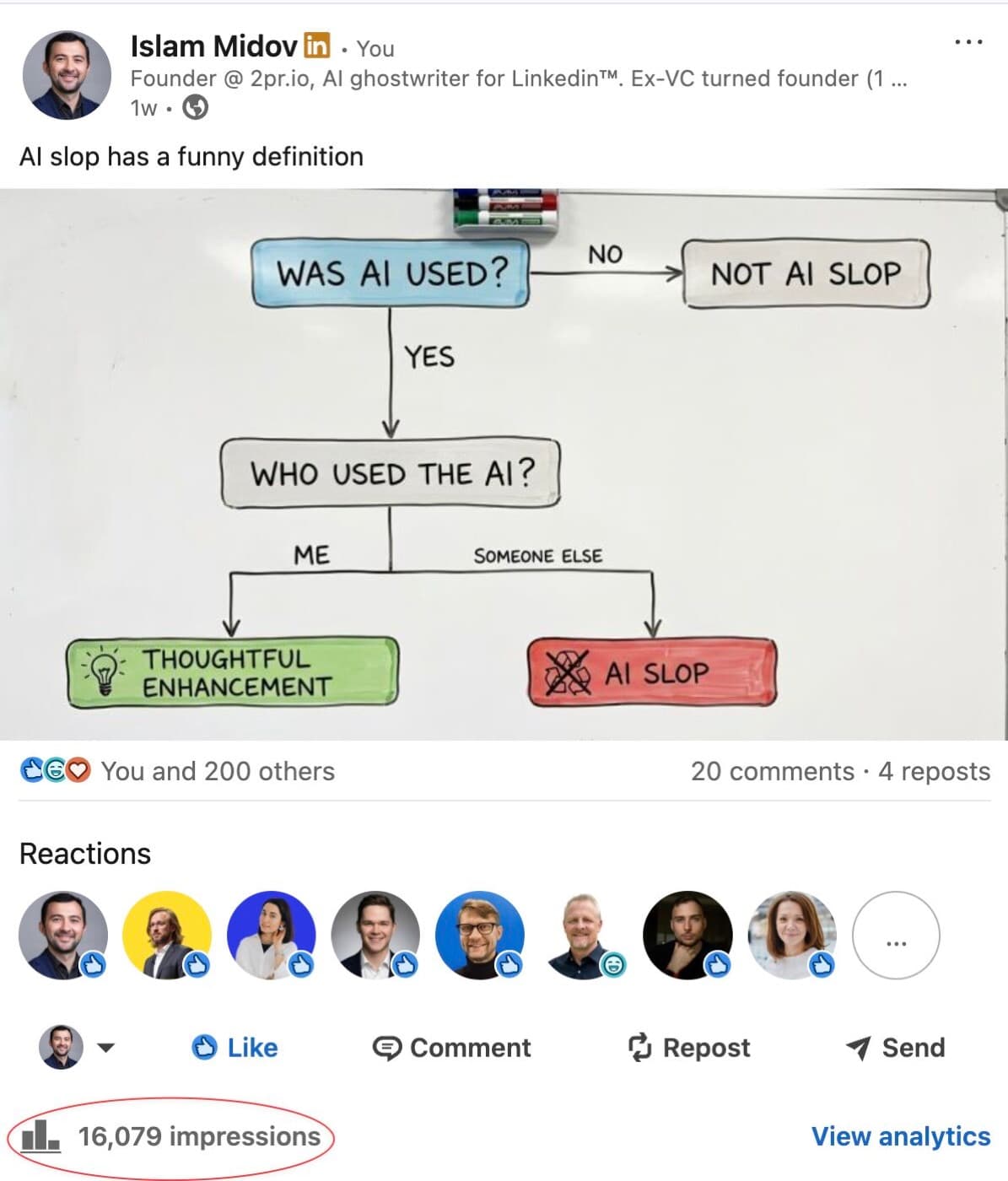
A concrete example: one of these "dead day" Sunday posts pulled more than 16,000 impressions. On the day the old playbook tells you to stay quiet.
Why you should not over-index on this
Two honest limits before you rewrite your whole calendar.
First, the sample is our users. These are people who post deliberately, often with help drafting and scheduling, so the population is not a random cross-section of LinkedIn. Your own audience may behave differently, especially if they are in a timezone or industry with unusual rhythms.
Second, a +8% day with a forgettable post still loses to a -15% day with a great one. Timing is a tiebreaker, not a strategy. The single biggest lever on your reach is whether the post is worth reading, which is why a small share of posts drive most of the results. We covered that pattern in why 5% of your posts drive 95% of your reach. Day-of-week optimization only matters once the writing is already good.
How to actually use this
So what do you do with it? Not "only post on Sundays." Here is the practical read.
- Stop avoiding the weekend. If you have been saving your best post for Tuesday because a 2023 guide told you to, try Sunday or Monday instead. The data says you are leaving reach on the table.
- Be skeptical of Wednesday. It is not cursed, but it is the most crowded slot, so the bar to stand out is higher. If you post midweek, make it your strongest piece, not your filler.
- Do not let timing override having something to say. The best day to post is the day you actually have something worth posting. A sharp idea on a Thursday beats a forced post on a "perfect" Sunday.
- Test it on your own account. General data is a starting point. Your audience is the real authority. Post across different days for a month and check your own profile analytics to see when your reach is highest.
This is also where frequency and timing meet. If you only post once a week, the day matters more, so lean toward the strong days. If you post several times a week, you will naturally cover the good slots anyway, so spend your energy on quality. We go deeper on cadence in how often you should post on LinkedIn.
Where a tool helps
Knowing the best day is easy. Consistently having something good to post on that day, and remembering to schedule it, is the hard part.
This is exactly what 2pr.io is built for. It drafts posts in your own voice, learned from a persona and short AI interviews, so you start from something instead of a blank page. Its content planner lets you schedule ahead and suggests posting times based on when your audience is actually active, so you are not guessing at the calendar each week. Its analytics then show you which days and topics are landing for your specific account, so you can adjust based on your own evidence rather than a general benchmark. And because it runs on the official LinkedIn API, your account stays safe from the bans that come with sketchy automation tools.
If you want to compare your options first, this rundown of AI tools for LinkedIn content is a fair place to start, and you can try a few free tools before committing to anything. Plans start at $24/month on annual billing, or $49 month to month, on the pricing page.
The bottom line
If you want a default: post on Sunday or Monday, treat Wednesday as the slot you have to earn, and stop assuming the weekend is dead. But hold all of that loosely. This is one company's recent data, not a universal law, and the calendar is the smallest variable in the equation. The day you post matters a little. Whether the post is worth reading matters far more. Get the writing right first, then use timing to squeeze out the extra few percent.
More LinkedIn guides
Founder-led marketing: the complete guide for B2B SaaS founders
Founder-led marketing for B2B SaaS means the founder becomes the main distribution channel for trust, demand, and narrative. Not just by posting on...
June 23, 2026When to use AI agents vs simple LLM workflows
If you're asking when to use AI agents vs workflows, here's the short answer: start with a single LLM call, move to a workflow when the task is multi-step...
September 18, 2026LinkedIn's Network tab: what the feed split means
LinkedIn split the feed into For You and Network tabs. Here is what the change does, why it happened, and what it means for creators.
Grow on LinkedIn with 2pr
Ideas, AI drafts in your voice, carousels, scheduling, and analytics: one tool. Start your free trial.
Start free trial