
Founder-led marketing: the complete guide for B2B SaaS founders
June 23, 2026
TL;DR
Founder-led marketing for B2B SaaS means the founder becomes the main distribution channel for trust, demand, and narrative. Not just by posting on LinkedIn, but by consistently publishing opinions, lessons, research, and stories that make buyers associate the company with a real person they trust. For most B2B SaaS founders, this works better than brand-first marketing because personal profiles get more reach, buyers trust people more than logos, and the sales cycle usually starts with credibility before it starts with product evaluation.
What founder-led marketing actually is
Most people reduce founder-led marketing to "post more on LinkedIn."
That is too shallow.
Founder-led marketing is when the founder becomes the media asset. Your expertise, judgment, taste, and point of view become the top of the funnel. People do not just discover your company. They discover how you think.
That matters because in B2B SaaS, the product is often hard to evaluate in one click. Buyers need to trust the people behind it before they book a demo, reply to a message, or take your category seriously.
So no, founder-led marketing is not random personal branding.
It is a repeatable system:
- Clear positioning on your profile
- Consistent publishing around 2-3 themes
- A recognizable voice and point of view
- Content that creates trust before a sales conversation
- Profile and content aligned with your sales model
If you do this well, your content does not just get attention. It compounds authority.
The 5-10x reach gap: personal vs company page
This is the most important starting point.
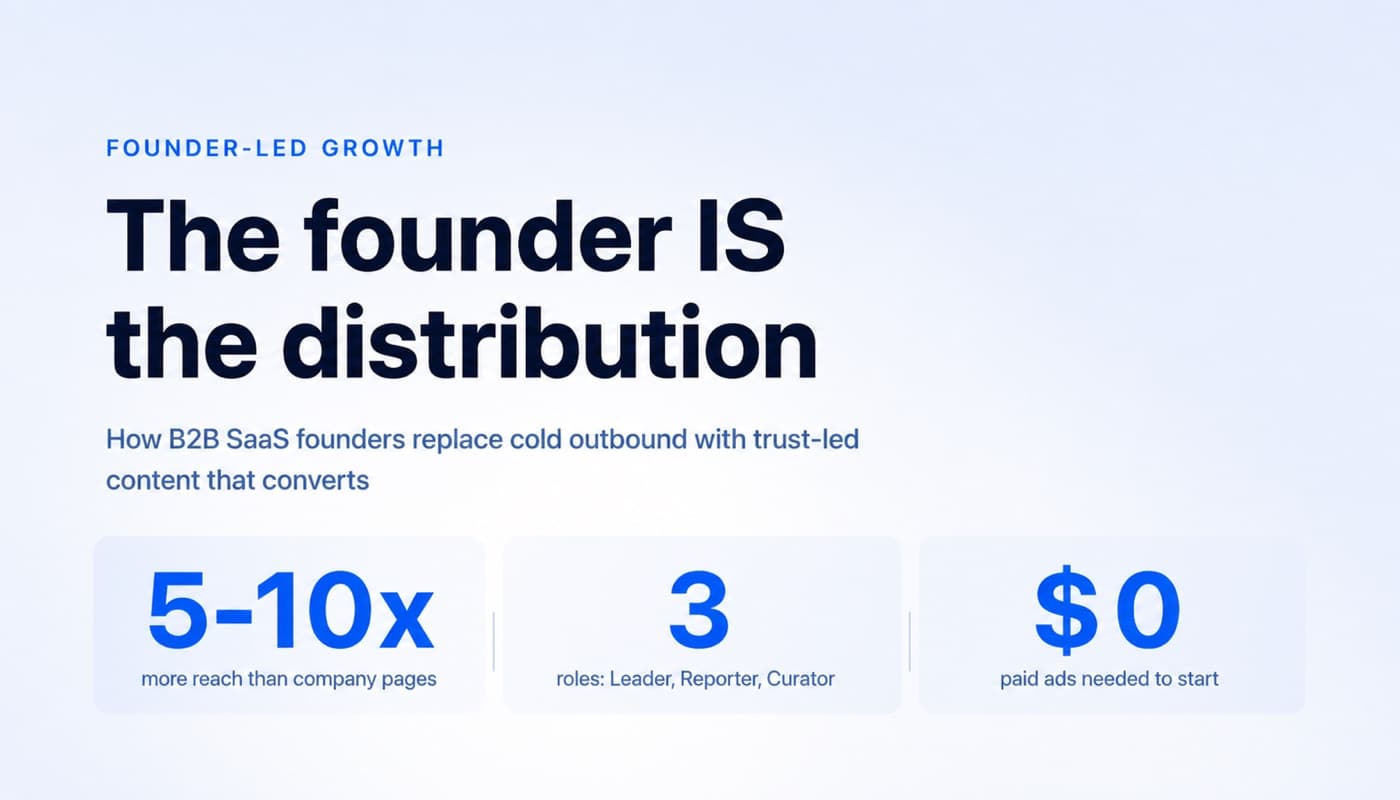
Personal profiles usually get 5-10x more reach than company pages. I have seen this in my own work, and it is consistent with what most operators already know from practice.
There are two reasons.
First, LinkedIn itself pushes personal content more aggressively than company content.
Second, users do not want to spend attention on company pages unless they already care. They are willing to spend attention on a person, especially one with a clear opinion, a useful framework, or a relevant story.
A company page speaks like a brand. A founder can speak like a human.
That difference is massive.
If you are an early-stage founder and you are investing your energy into a company page while your own profile is half-empty, you are usually putting your effort into the weaker asset.
Your personal profile is the real landing page.
That means:
- Your headline should show specialization, not just job title
- Your about section should show positioning, not résumé
- Your featured section should guide the next action
- Your visible content should make your expertise obvious in 10 seconds
Why B2B buyers buy from people
B2B buyers are rational later. First, they are human.
Before they compare features, they ask simpler questions:
- Do I trust this person?
- Do they understand my problem?
- Have they seen enough to have a useful opinion?
- If I get on a call, will I waste my time?
That is why founder-led marketing works.
Trust is transmitted through personality. Through specificity. Through repeated exposure. Through seeing the same person explain a market clearly over time.
A logo cannot do that as well.
A founder can say, "I have seen this pattern 30 times."
A founder can say, "Here is where most teams get this wrong."
A founder can say, "This worked for us, and here is where it failed."
That is not just content. That is trust mechanics.
In my view, this is the real edge. Not virality. Not vanity metrics. Trust at scale.
Self-serve vs DM/demo model: content strategy differs completely
A lot of bad advice comes from treating all SaaS models the same.
They are not.
If you sell self-serve or low-ticket, content does most of the work. If the reader likes the post, clicks the link, and can try the product instantly, the path is short. Content is the main conversion surface.
If you sell through DMs, calls, or demos, the path is different. The post creates interest, but the profile often decides whether the person reaches out. In that model, content and profile work as a pair.
I think of it like this:
- Self-serve or small ticket: content >> profile
- DM, demo, or large ticket: content ≈ profile
That changes what success looks like.
For self-serve, a strong post can create same-day clicks and signups.
For demo-led products, a strong post often creates profile visits, connection requests, and inbound DMs. The post opens the door. The profile closes the first layer of trust.
Founders miss this all the time. They get a post to perform, then wonder why nothing happened. Often the answer is simple: the profile did not convert the attention.
The Starter Story / HubSpot case
One of my favorite recent examples is Starter Story.
HubSpot acquired Starter Story, and the part I find most interesting is not just the business itself. It is the founder-led dynamic behind it.
Pat Walls posted that HubSpot should acquire Starter Story in September 2025.
Five months later, HubSpot did.
That single post reportedly got around 53,000 views. And apparently, one acquisition offer.
To me, this is founder-led marketing at its best.
Not because one post magically created an exit. That is the wrong lesson.
The real lesson is this:
- Build something worth buying
- Understand the timing
- Say it publicly and clearly
That is what public positioning does. It shapes perception. It makes buyers, partners, talent, and acquirers see the company through a specific frame.
A company brand rarely does this with the same force.
A founder can.
And when the founder has built enough credibility, one sentence can move through the market faster than a brand campaign.
That is why I keep saying social media is not just for engagement farming. Sometimes it becomes deal flow.
How to start without burning out
Most founders fail here for one of two reasons.
They either post randomly with no system, or they try to become a full-time creator overnight and burn out in two weeks.
Both are bad.
The sustainable version is much simpler.
- Pick 2-3 themes you can talk about for a year
- Choose your role: Leader, Reporter, Curator, or a hybrid
- Post 3-5 times per week if you can sustain it
- Write in your real voice, not template voice
- Spend time on comments too, not just posts
I usually tell people this: do not optimize the average post. Optimize for the breakout posts.
In my own data, roughly 5% of posts create 95% of reach. That distribution is normal. Super Pareto is the game.
So stop expecting every post to win.
Nobody can guarantee virality. But you can increase the odds with a system. I have been in social media for more than five years. It may look fast from the outside. It was not.
Consistency matters more than intensity.
The attribution problem: what to track instead
This is where many B2B teams get stuck.
They want founder-led marketing to behave like paid ads. Exact spend in, exact revenue out, clean dashboard, clean attribution.
That is usually an illusion of control.
Founder-led marketing influences demand earlier and more indirectly. A buyer may see ten posts over two months, visit your profile twice, ignore you, then respond to a cold email because now your name feels familiar.
Good luck attributing that cleanly.
So I track proxies that actually matter:
- Profile visits after strong posts
- Meaningful comments, not one-word comments
- Connection requests from ICPs
- Inbound DMs
- Lead quality on calls
- Mentions like "I have been seeing your posts"
I care far less about likes than most people do.
Likes are cheap. Saves are stronger. Thoughtful comments are stronger. Profile visits are stronger. Pipeline conversations are stronger.
If you obsess over perfect attribution, you will underinvest in the channel that builds trust before intent becomes visible.
The long game: 3-6 months, not 3 weeks
This is the part most people do not want to hear.
Founder-led marketing is a long game.
In most cases, you need 3-6 months of consistent work to see meaningful business results. Not one post. Not one month. Not one lucky spike.
Why?
Because the market needs repeated exposure. Your positioning needs repetition. Your voice needs to become familiar. The audience needs enough evidence to believe this is not random.
Most founders quit too early.
They post for three weeks, get average numbers, conclude it does not work, and go back to channels that feel more measurable.
That is a mistake.
The early stage is often quiet. Then one post breaks out. Then a few people start recognizing your name. Then your DMs change quality. Then calls get easier because trust is preloaded.
That is how it usually happens.
Slow, then sudden.
FAQ
What is founder-led marketing in B2B SaaS?
It is when the founder becomes the main trust and distribution channel for the company by publishing consistently under their own name. The goal is not just reach. The goal is credibility, attention from the right buyers, and a stronger pipeline because people trust a person faster than a brand.
Do I need to go viral for founder-led marketing to work?
No. Virality is not the goal. Business value is. Some viral posts bring zero pipeline if the topic has no connection to your ICP or product. I have seen posts get huge reach and create no business outcome. Relevance beats raw reach.
Should I focus on LinkedIn posts or on my profile first?
Both matter, but the balance depends on your sales model. If you sell self-serve, content carries more of the conversion load. If you sell through demos or DMs, your profile matters much more because people will check who you are before they contact you.
How often should a founder post?
3-5 times per week is a good target if you can sustain it for at least six months. The right pace is the pace you can maintain without hating the process. Consistency beats short bursts of motivation.
What should I measure if attribution is messy?
Track signals that show trust and buyer intent building: profile visits, meaningful comments, relevant connection requests, inbound DMs, lead quality, and direct customer feedback. Founder-led marketing usually works through compounding familiarity, not clean last-click attribution.
More LinkedIn guides
Should founders post about multiple topics on LinkedIn?
Yes, you can post about multiple topics on LinkedIn.
June 23, 2026The Best Day to Post on LinkedIn (2026 Data)
We ranked 10,000 recent LinkedIn posts by reach. Sunday and Monday win, Wednesday loses. Here is the day-by-day data and how to use it.
September 18, 2026LinkedIn's Network tab: what the feed split means
LinkedIn split the feed into For You and Network tabs. Here is what the change does, why it happened, and what it means for creators.
Grow on LinkedIn with 2pr
Ideas, AI drafts in your voice, carousels, scheduling, and analytics: one tool. Start your free trial.
Start free trial