
The LinkedIn attention hierarchy: why 99% of B2B content gets ignored
June 23, 2026
TL;DR
If your LinkedIn content gets no engagement, the answer is usually simple: your post sits too low in the attention hierarchy. Most B2B posts live at level 7, 8, or 9, where people feel nothing, risk nothing, and learn nothing urgent. LinkedIn does not reward content just because it is useful or accurate. It rewards content that wins attention first, then keeps it, then earns a save, a real comment, a profile visit, or a DM. If your post does none of that, it gets ignored.
Most founders think the problem is timing, hashtags, or the algorithm.
Usually it is not.
Usually the post is weak before the algorithm ever sees it.
Most B2B content starts at the bottom
I see this constantly. A smart founder writes a reasonable post about a product update, a hiring milestone, or a lesson like "be consistent and take responsibility." Then they wonder why it gets 12 likes and zero pipeline.
Because attention is not a meritocracy.
It is a hierarchy.
And most B2B marketers keep publishing from the bottom of it.
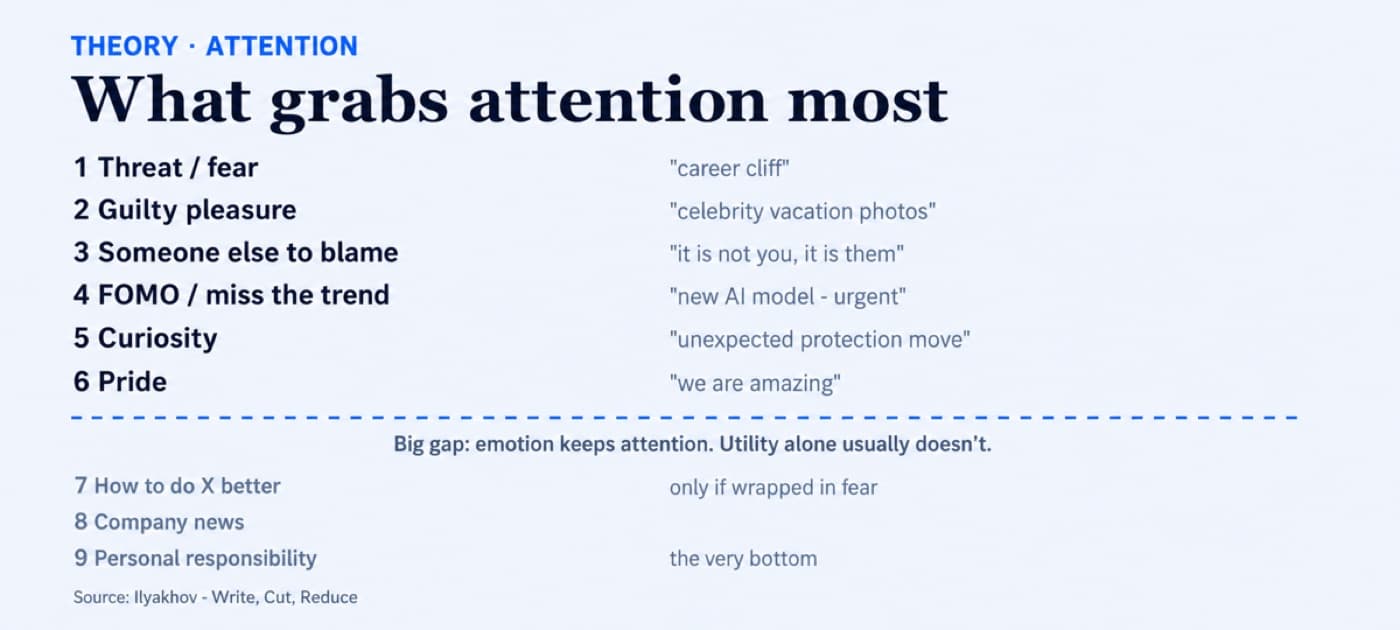
The strongest framework I use here comes from Maxim Ilyakhov. If you understand these nine levels, LinkedIn starts making a lot more sense.
The 9-level attention hierarchy
From strongest to weakest, here is how human attention usually works:
-
Threat, fear
Enemy at the gates. Something bad is coming. Something important is breaking. Something costly is being missed. -
Unbelievable pleasure
Extreme aspiration, fantasy, status, novelty, desire. -
Someone else’s fault
Relief. Friction gets externalized. "You are not failing because you are lazy. The system is built wrong." -
FOMO
A shift is happening. Others are moving. If you wait, you lose. -
Curiosity
A knowledge gap opens. You need to know what happens next. -
Pride
"We are great." "We built something cool." Better than nothing, but still self-oriented.
Then comes what I call 300 meters of empty space.
-
How to do X better
Useful, yes. Attention-grabbing, usually no. -
Company news
Funding, launches, hires, office photos, event recaps. -
Personal responsibility
"Work harder." "Take ownership." "Be disciplined." This is the bottom.
This is the uncomfortable truth: most B2B content sits at 7, 8, or 9.
And people scroll past it because it asks for attention without earning it.
Why how-to content usually fails on LinkedIn
A lot of people assume educational content should win by default.
It does not.
"How to write better outbound emails" is level 7. Useful. Rational. Forgettable.
To work on LinkedIn, how-to content usually needs to be wrapped in a stronger emotional frame.
Not fake drama. Real stakes.
For example:
- Weak: "How to use AI to write LinkedIn posts faster"
- Stronger: "Most AI LinkedIn posts are killing trust. Here’s how to use AI without sounding fake"
- Stronger: "If your LinkedIn posts sound like ChatGPT, Brew 360 will flatten them. Here’s the fix"
- Stronger: "Founders are wasting 6 months posting polished nonsense. Here’s what actually earns saves"
Same lesson.
Different level in the hierarchy.
The post does not just teach. It warns, creates FOMO, or opens a curiosity gap.
That is what gets the scroll to stop.
The 300 meters of empty space between level 6 and 7
This gap matters more than most people realize.
Level 6 is still emotion. Pride. Identity. Status. "We did something impressive."
Level 7 is utility without emotional voltage. "Here is a framework."
That drop is huge.
In practice, this means a decent how-to post can still lose badly to a mediocre opinion post with higher emotional charge.
You can feel this in your feed.
A founder saying, "Everyone is copying the wrong AI content playbook" will often outperform a clean carousel called "5 LinkedIn writing tips for founders."
Not because the second one is bad.
Because it starts too low.
If your post begins at level 7, you need a much stronger hook, angle, or format to survive.
If it begins at levels 1 to 5, attention comes easier.
That is why I tell people not to start with information. Start with tension.
The Laugh / Teach / Feel filter
There is a second filter I use before publishing anything.
Chris Cunningham from ClickUp put it simply: does this make people laugh, teach them something, or make them feel something?
If the answer is no to all three, do not publish it.
That rule sounds obvious. Yet 99% of B2B content fails it.
It is informative without being teachable. Personal without being moving. Polished without being funny. Corporate without being human.
ClickUp reportedly used this filter as part of the machine that helped them grow from around 30 million to 200 million plus impressions per month.
Why does this matter on LinkedIn specifically?
Because the platform is now much better at reading content quality semantically. The old playbook of stuffing hashtags, gaming posting time, and forcing empty comments matters less. The system reads posts more like an editor now. Flat, templated, fake-sounding content gets exposed faster.
So before I post, I ask:
- Does this make the reader laugh?
- Does this teach something specific enough to save?
- Does this create a real feeling like tension, relief, validation, ambition, or urgency?
If it does none of the three, I kill it.
How I think about LinkedIn-specific execution
On LinkedIn, reach is not the goal. Business is.
I have had posts with big reach and zero business value. That is not a win.
The metrics I care about are stronger signals:
- Saves
- Meaningful comments, not one-word bait
- Profile visits
- DMs and connection requests
- Leads and customers
This matters because a post can go viral in the wrong niche and still do nothing for your company.
I learned this the hard way. Numbers are not money.
The best LinkedIn content lives at a strong attention level and still connects back to your actual expertise, audience, and offer.
Audit your last 5 posts
Take your last five LinkedIn posts and score them brutally.
For each one, ask:
- What level of the hierarchy is this really on?
- Does it pass Laugh, Teach, or Feel?
- Would a stranger save it?
- Would the right buyer visit my profile after reading it?
- Is this aligned with my role: Leader, Reporter, or Curator?
Most people discover the same pattern fast.
Their content is too proud, too corporate, too instructional, or too self-referential.
A common distribution looks like this:
- Two level-8 company updates
- One level-9 personal responsibility post
- One level-7 how-to thread with no tension
- One level-6 "look what we built" post
Then they blame the algorithm.
No. The hierarchy beat them before distribution even started.
How to turn a weak level-8 post into a level 1-5 post
Let’s say your original post is this:
"We’re excited to announce our new LinkedIn analytics feature."
That is level 8. Company news. Almost nobody cares.
Here is how I’d reframe it:
-
Level 1, fear
"Most LinkedIn creators are reading the wrong metrics and killing posts that would have converted. Here’s the dashboard I wish they had earlier." -
Level 3, someone else’s fault
"If your LinkedIn content feels dead, it may not be your writing. Most dashboards train you to optimize for vanity metrics." -
Level 4, FOMO
"LinkedIn content teams are shifting from likes to saves and profile visits. If you still report impressions first, you are already behind." -
Level 5, curiosity
"I compared low-like posts that drove leads vs high-like posts that drove nothing. The difference was not what most people expect."
Same feature.
Different packaging.
Notice what changed. I did not start with us. I started with the reader’s pain, risk, gap, or missed opportunity.
That is the whole game.
The practical rule I use before posting
If a post starts with:
- "We’re excited to announce..."
- "I’ve been thinking about responsibility..."
- "Here are 5 tips..."
I assume it is weak until proven otherwise.
Then I rebuild it around one of these:
- What is the threat?
- What are they missing?
- What false belief should I break?
- What will make the right person save this?
- What emotion does this create in the first two lines?
That one shift is often the difference between being ignored and being remembered.
FAQ
Why does my LinkedIn content get no engagement even when it is useful?
Because usefulness alone is usually level 7. People do not reward utility until you first win attention. If the post does not trigger fear, FOMO, curiosity, relief, laughter, or a strong feeling, it blends into the feed. Useful content needs emotional packaging.
Are company updates always bad on LinkedIn?
No. But raw company news is usually level 8, so it underperforms unless you attach a broader tension or lesson. Do not post "we launched a feature." Post what mistake the feature corrects, what costly blind spot it exposes, or what market shift made it necessary.
Should I optimize for likes, comments, or impressions?
Not first. Those are weak signals unless they turn into something meaningful. I care much more about saves, strong comments, profile visits, DMs, and eventual revenue. A post with lower reach but higher buyer intent beats a vanity viral post every time.
Does the LinkedIn algorithm punish AI-written content?
It punishes flatness more than the tool itself. If the writing sounds templated, generic, or semantically empty, performance suffers. The real issue is not "AI text" as a category. It is fake voice, no point of view, and no match between your profile, expertise, and what you publish.
How often should I post to see results?
Three to five times per week is enough if you can sustain it for months. Consistency matters, but quality matters more. I would rather see one strong level-1-to-5 post than five level-8 updates. Most people need three to six months of systematic work before the compounding becomes obvious.
More LinkedIn guides
Why LinkedIn browser extensions put your account at risk
Yes, LinkedIn browser extension account ban risk is real. If a tool installs as a browser extension, reads your cookies, and performs actions on LinkedIn as...
June 23, 2026LinkedIn algorithm 2026: what Brew 360 actually changed
If you're searching for the LinkedIn algorithm 2026 changes, here's the short answer: LinkedIn stopped acting like a dumb engagement counter and started...
September 18, 2026LinkedIn's Network tab: what the feed split means
LinkedIn split the feed into For You and Network tabs. Here is what the change does, why it happened, and what it means for creators.
Grow on LinkedIn with 2pr
Ideas, AI drafts in your voice, carousels, scheduling, and analytics: one tool. Start your free trial.
Start free trial