
The taste gap, and why your first posts disappoint you
August 28, 2026
TL;DR
The taste gap is the distance between your ability to judge good work and your ability to make it. It feels worst at the start, because your taste is already sharp while your skill is not. That gap is not a signal to stop, it is proof your taste is working. You close it by making a lot of work, not by waiting to feel ready.
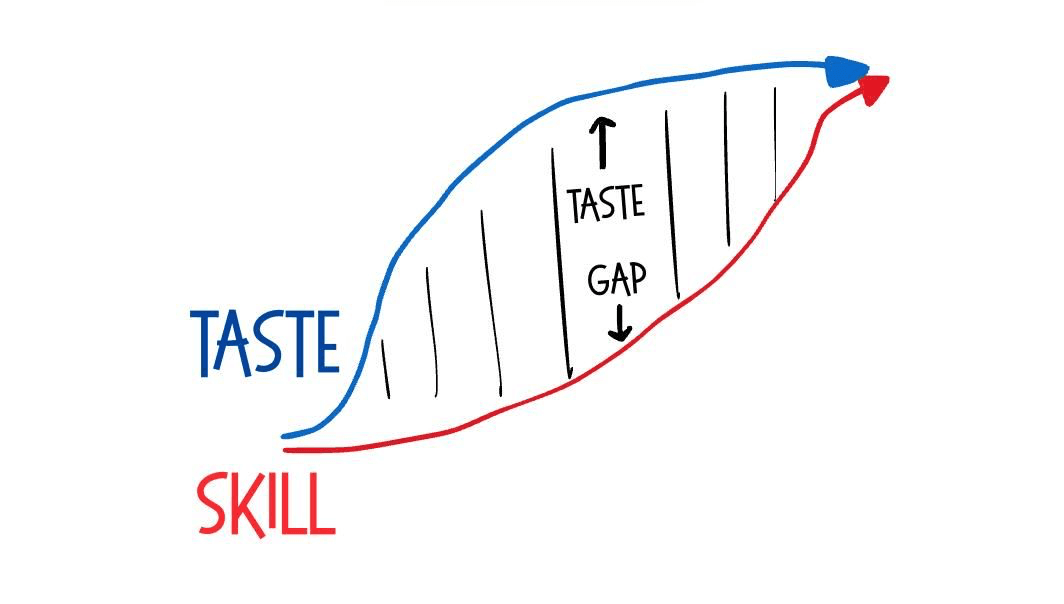
The taste gap is the distance between your ability to recognize good work and your ability to produce it. You can tell your first LinkedIn post is flat, your first video is stiff, your first draft is not as sharp on the page as it was in your head. That frustration is not a verdict on your potential. It is your taste running ahead of your skill, which is exactly what happens when you start something new.
Most people read that gap backwards. They see the distance between what they made and what they wanted, and they conclude they are not cut out for it. The opposite is closer to the truth. The fact that you can see what is wrong means your taste is already doing its job. The only real problem is expecting your output to match that taste before you have put in the reps.
What the taste gap actually is
The idea is usually credited to Ira Glass, who described it for anyone doing creative work: you get into it because you have good taste, but for the first years, what you make does not live up to that taste. Your judgment is good. Your ability is not there yet. The two live on different timelines.
That mismatch is uncomfortable precisely because your taste is the thing that got you started. You followed people whose work you admired, you noticed what made a post land or a video hold attention, and you built a standard in your head. Then you sat down to make your own, and the output fell short of the standard you had already set. Nothing is broken. You are just early.
A vivid, if imperfect, example: Stephen King hated an early draft of one manuscript so much that he threw it in the trash. His wife pulled it back out and pushed him to finish it. That book became his first major hit and sold more than four million copies. It is one story, not proof of a rule, but it captures the pattern. The person closest to the work, with the sharpest taste for it, is often the worst judge of whether it should exist. Their taste is screaming at a draft that is actually fine.
Why it feels worst at the very start
The gap is widest at the beginning, and that is by design. Your taste arrives fully formed, borrowed from everything you have consumed. Your skill starts at zero and climbs slowly. So the distance between the two is never larger than on day one, which is the exact moment most people quit.
This is why starting is so disproportionately hard. It is not that the first post is objectively terrible. It is that you are grading it against a standard built from the best work you have ever seen, while your own ability has had no time to catch up. The pain you feel is the size of the gap, not the size of your lack of talent.
Understanding this reframes the discomfort. When your first drafts disappoint you, the honest read is not "I am bad at this." It is "my taste is ahead of my skill, and that is normal." That single reframe is often the difference between someone who publishes a second post and someone who never gets past the first. If you are stuck at post zero, how to start posting on LinkedIn walks through the first ten posts and why their only job is to exist.
How the taste gap shows up in LinkedIn content
On LinkedIn the gap is loud because the feedback is public. You write a post, you can immediately feel the opening is weak, the structure is generic, the idea is duller on the page than it was in your head. Everyone scrolling past seems to have it figured out, and you do not.
A few specific ways it surfaces:
- The hook feels flat. You know a strong first line stops the scroll, but yours reads like a memo. Naming the problem is progress. If you want proven openers to study, these LinkedIn hook formulas give you patterns to reverse-engineer instead of staring at a blank first line.
- The writing sounds generic. You can hear that it does not sound like you, but you cannot yet make it sound like you on command. That is a skill that builds with reps, and it is also where the right tools help you get there faster.
- The idea feels thinner written down. In your head it was a sharp insight. On the page it is three obvious sentences. Closing that gap is mostly about learning to develop an idea, which only happens by writing a lot of them out.
None of these are signs to stop. They are the specific muscles the reps are training. The discomfort is the map of what to work on next.
How to actually close the gap
There is no shortcut around volume. Taste is closed by doing, not by planning to do. The people who get good are not the ones with more talent at the start, they are the ones who made the next draft, published the next post, recorded the next take, and kept going long enough for skill to catch up to taste.
A few things make the grind more bearable and more productive:
- Set a volume target, not a quality target. Aim for a number of posts, not a level of brilliance. Ten decent posts teach you more than one you polished for a month. Reps are the input; quality is the output that follows.
- Ship before it feels ready. The draft will never satisfy your taste at the start, so waiting for that feeling means never shipping. Publish at "good enough," then learn from the response.
- Use your taste as direction, not as a veto. The same taste that makes your drafts feel inadequate is the thing pointing you toward better. Let it tell you what to fix next, not whether to hit publish.
- Read the response, not just the like count. Which posts got real comments, what people actually said, which angle resonated. That feedback closes the gap faster than self-criticism, because it is real data instead of your internal critic.
The trap to avoid is letting sharp taste push you back to the consumption side, where you admire other people's work and never make your own. Taste is only useful if it is aimed at something you are actually building.
Where a tool helps, and where it does not
A writing tool cannot give you skill, but it can shrink the gap between your taste and your output while you build that skill. The failure mode is not "my post was not good enough," it is "I never published because it did not feel ready." Anything that gets you past that is doing the real work.
This is where 2pr.io earns its keep. It drafts posts in your own voice, learned from persona and AI interviews, so you start from something that already sounds like you instead of a blank page that feels beneath your standards. The analytics show you which posts actually landed, so you can aim your taste at real feedback rather than guessing. And it runs on the official LinkedIn API, so building the habit never puts your account at risk. Plans start at $24/month on annual billing, or $49 month to month, on the pricing page. Just remember the tool is a multiplier for your reps, not a replacement for them. Teaching AI to write like you still starts with you knowing what "like you" sounds like, and that only comes from doing it.
The bottom line
The taste gap is the distance between what you can recognize as good and what you can currently make. It feels worst at the start because your taste is already sharp while your skill is still at zero, and that specific pain drives most people to quit right before it would have started to close. Read it the other way. The frustration is proof your taste is working. You do not fix it by waiting to feel ready or by consuming more of other people's work. You fix it by making the next draft, publishing the next post, and letting your skill catch up to the standard your taste already set.
More LinkedIn guides
How to use humor and memes on LinkedIn
Humor and memes are a real funnel on LinkedIn: they get you noticed before anyone knows your expertise. Here is how to use them without looking unserious.
August 21, 2026X algorithm scoring weights, and what they teach you
X open-sourced its algorithm scoring weights. Here is what each weight means, why replies and reshares beat likes, and the lesson for LinkedIn creators.
October 2, 2026How to get more impressions on LinkedIn: 12 lessons
How to get more impressions on LinkedIn, from 2M impressions in a year: chase breakout posts, win the hook, pick a lane, and measure every post.
Grow on LinkedIn with 2pr
Ideas, AI drafts in your voice, carousels, scheduling, and analytics: one tool. Start your free trial.
Start free trial