
How to use humor and memes on LinkedIn
September 4, 2026
TL;DR
Irony and memes are a superpower for getting noticed in your niche, because they earn attention before anyone knows your expertise. Humor is the top of a simple funnel: a relatable, insider joke earns attention, educational and opinion posts prove you can solve the real problem, and commercial posts give that trust a next step. The catch is that good humor needs insider judgment, knowing what is painfully true, what is tired, and what your audience will instantly recognize.
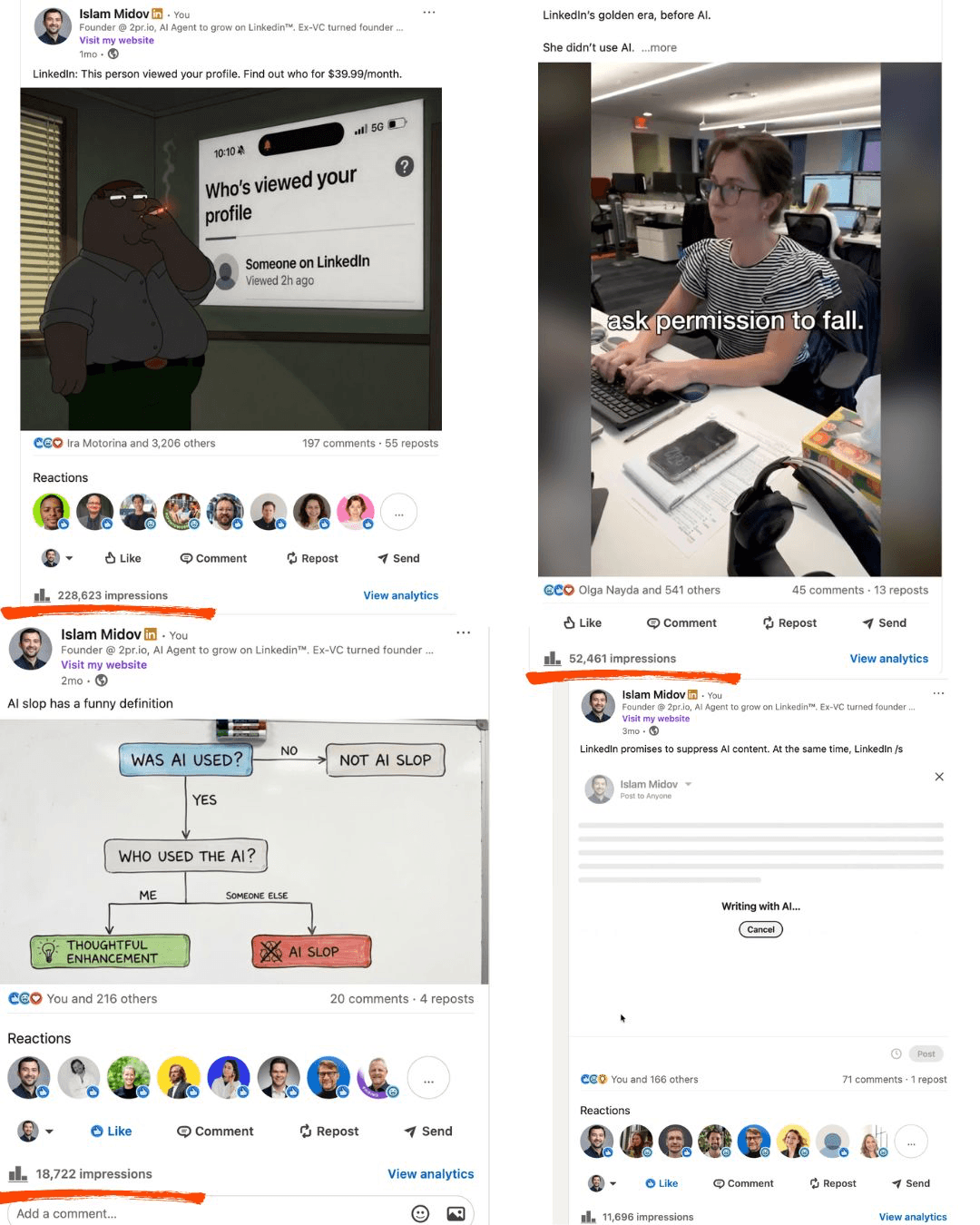
Irony and memes are a superpower for getting noticed in your niche, because they earn attention before anyone knows your expertise.
That is the part most professionals miss. They treat humor as a break from serious content, something you post when you have nothing useful to say. In reality, an insider joke is often the most efficient business asset you can publish, because it does something a case study cannot: it stops the scroll from a total stranger.
Why humor works before expertise does
Nobody on LinkedIn owes you attention. When a person who has never heard of you sees your post, they have no reason to read a framework, a lesson, or a pitch. They have not decided you are worth listening to yet.
A sharp, niche-specific joke changes that in one line. It says more than "I am funny." It says: I understand this world. I am an insider you may want to listen to.
Most of my audience cares to some level about LinkedIn. So when I post something full of irony about the nonsense on LinkedIn, the joke is a credential. It proves I live in the same reality they do, before I have made a single claim about what I know.
That is the difference between humor and information. Information asks for attention. Humor earns it, then makes people feel understood. And feeling understood is the fastest way a stranger decides you are one of them.
The funnel: attention, then trust, then the offer
Humor is not the whole strategy. It is the top of a funnel that has three clear stages, and each one does a different job.
Insider humor or a relatable niche observation earns attention and makes people feel understood. This is the meme, the ironic take, the "we have all seen this" observation. Its only job is to stop the scroll and signal that you get it.
Educational posts, opinions, and case studies prove you can solve the problem behind the joke. Once you have someone's attention, you have to back it up. If your meme mocks bad cold outreach, your next posts should show you actually understand outreach. This is where you turn attention into trust.
Commercial posts give that trust a next step. Only after the first two stages have done their work does a pitch land, because now you are not a stranger asking for a favor. You are someone who clearly understood the problem before offering the solution.
The order matters. Skip the first stage and your educational content dies in the feed with 12 likes, because it started too low in the attention hierarchy to earn a look. Skip the second and your humor gets reach but no respect. Skip the third and you build an audience that likes you and never buys.
This works in any niche
None of this is specific to LinkedIn creators or marketers. The mechanism is the same everywhere, because it is about human attention, not your industry.
A cybersecurity founder could call out some nonsense from big tech in a meme, share a practical security lesson next, then explain how they help teams fix it. A recruiter could joke about the state of job descriptions, then post a breakdown of what actually gets candidates to reply, then mention they are hiring for a client. A fractional CFO could mock a viral "just cut costs" take, then teach the real math, then offer a call.
The pattern is identical: earn attention with something painfully recognizable, prove your expertise, then give trust a next step. You are no longer a stranger asking for attention. You are someone who got the problem before explaining the solution.
Humor is not a substitute for a point of view
The funnel only works if the humor is real. A generic meme that could belong to anyone in any industry does nothing, because it does not prove you are an insider. It just proves you can repost.
Good humor needs insider judgment: knowing what is painfully true, what is tired, and what your audience will instantly recognize. That judgment is the whole thing. It is why humor is hard to fake and why it works as a credential when it lands. A joke that only a real insider could have made is worth more than a hundred polished, forgettable how-to posts.
This is also where humor and slop part ways. A tired meme, a recycled format, a joke that misses what actually hurts, that is noise. The bar is not "is this funny," it is "would the right person in my niche read this and think, finally, someone said it."
Where AI helps, and where it does not
AI can help find the raw material. Two out of four posts in a recent collage of mine started in the 2pr.io viral-post database, where you can see what formats and angles are already working in your space. That is a research step, the same way top creators reverse-engineer winning posts instead of starting from a blank page. Kevin Meyer used a similar approach to help generate 12 million impressions a year for salespeople.
But AI cannot supply the insider judgment. It does not know which observation is painfully true for your specific audience, or which format has been done to death in your niche this month. It can surface patterns and raw ideas. You supply the taste that turns a pattern into a joke only you could have made. If you let a model write the humor for you, you get exactly the generic, recognizable-by-nobody content that the funnel is designed to avoid, and increasingly the same content that gets flagged as AI slop.
How to actually run this
You do not need to be a comedian. You need a rhythm.
- Find the raw material. Look at what is already resonating in your niche, in your own feed and in a viral-post database. Note the observations that make you nod before you laugh. Those are the true ones.
- Write the insider take. Turn one of those observations into a short, specific post. Specific beats clever. The goal is recognition, not applause.
- Follow it with proof. Within a few days, post the educational or opinion piece that shows you can actually solve the problem the joke pointed at.
- Give it a next step. Occasionally, and only after the first two are doing their job, make the commercial ask. It will land differently.
You do not need every post to be funny. Humor is the hook at the top, not the entire diet. Most creators need a mix, and the funniest ones still lean on expertise and offers to convert the attention they win.
The bottom line
Humor gets you noticed. Expertise earns trust. The offer converts. That is the whole funnel, and it works in any niche because it runs on how attention actually moves, not on your industry.
The mistake is treating memes as unserious, or treating them as the whole strategy. Used with intent, an insider joke is the cheapest way to make a stranger feel understood, and feeling understood is what buys you the right to teach and, eventually, to sell. Just remember the judgment part: the joke has to be true, and it has to be one only a real insider could make.
If you want help finding the angles and formats already working in your niche, 2pr.io is a safe AI copilot for LinkedIn content, with a viral-post database to research from and analytics to see which of your posts actually earn saves and profile visits, not just likes. Plans start at $24/month on annual, or $49 month to month on the pricing page. LinkedIn is a place where it is nice to have fun.
More LinkedIn guides
Do LinkedIn bot farms work for lead generation?
No. LinkedIn bot farms are a negative-ROI lead-gen channel. Here is why fake profiles and bot DMs fail, and the three channels that actually book calls.
August 28, 2026The taste gap, and why your first posts disappoint you
The taste gap is why your writing feels worse than your standards. Here is what it is, why it hits creators hardest at the start, and how to close it.
October 2, 2026How to get more impressions on LinkedIn: 12 lessons
How to get more impressions on LinkedIn, from 2M impressions in a year: chase breakout posts, win the hook, pick a lane, and measure every post.
Grow on LinkedIn with 2pr
Ideas, AI drafts in your voice, carousels, scheduling, and analytics: one tool. Start your free trial.
Start free trial