
LinkedIn Inferred Credibility Scores: the new file in your data export
November 26, 2026
TL;DR
Since mid November 2026 the full LinkedIn data archive includes a file called Inferred Credibility Scores.csv. It rates your notability on 10 signals (0 to 5) rolled into a tier from 1 to 4, and your expertise on 122 topics (1 to 4), with history back to February 2026. For your strongest topics it splits expertise into role, tenure, content, education and validation. LinkedIn has not said this feeds feed ranking, but it is the first look at how LinkedIn labels you, and the content score is the one part you can move by posting.
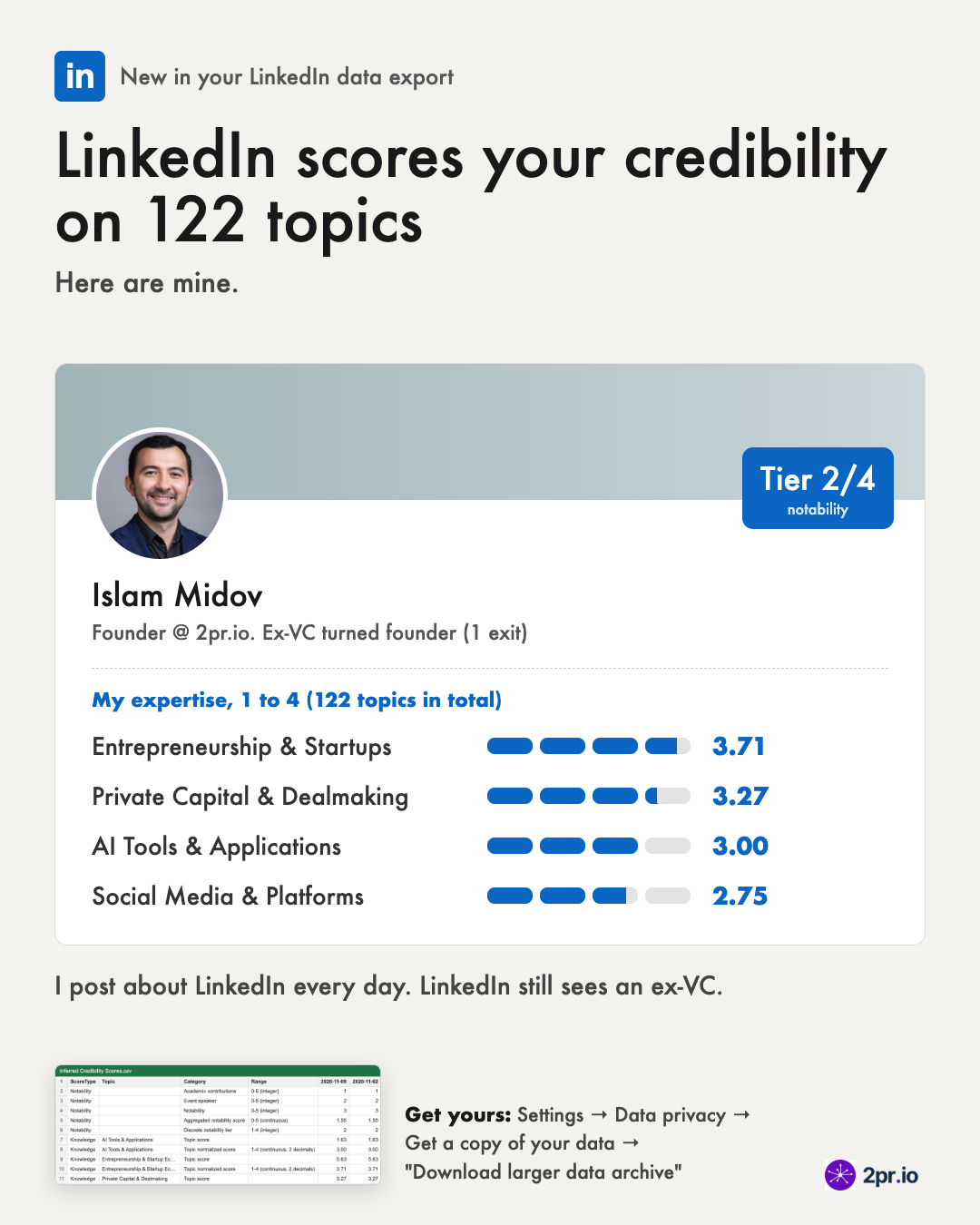
LinkedIn now puts a file called Inferred Credibility Scores in your data export. It rates how notable LinkedIn thinks you are and how much of an expert it thinks you are on 122 topics, with a history going back to February 2026. It appeared in my archive on November 18. The archive I pulled on November 10 did not have it.
Below: how to get the file, what each column means, my own numbers as a worked example, and what you can actually change.
How to get your Inferred Credibility Scores
- On LinkedIn, open Settings, then Data privacy, then Get a copy of your data.
- Pick Download larger data archive (the full one, not a single category) and request it.
- LinkedIn emails you when it is ready. That can take up to 24 hours.
- Unzip it and open Inferred Credibility Scores.csv. It opens fine in Excel or Google Sheets.
If the file is not there, request a new archive. Older archives do not have it.
What is in the file
Every row has a score type, a topic, a category, a range, and then one column per date LinkedIn recalculated it. My file has 57 dates between February 6 and November 12, 2026, though most rows only change every few weeks.
There are two score types.
Notability: how known you are
Twelve rows, not tied to any topic:
Swipe sideways to compare
| Signal | Range |
|---|---|
| Thought leadership, Visibility, Public reach, Media recognition, Honors, Event speaker, Academic contributions, Institutional credibility, Organizational influence, Notability | 0 to 5 each |
| Aggregated notability score | 0 to 5, continuous |
| Discrete notability tier | 1 to 4 |
Most of these come from your profile and from what the web says about you (press, awards, talks, the companies you worked at), not from your posts.
Knowledge: what you are an expert in
For each of 122 topics you get a raw topic score (it can be negative) and a topic normalized score from 1 to 4. The topics are broad: "Entrepreneurship & Startup Ecosystems", "AI Tools & Applications", "Clinical Specialties & Treatment".
For about five topics, the ones LinkedIn is most sure about, it adds five sub-scores from 1 to 4:
Swipe sideways to compare
| Sub-score | What it likely reads |
|---|---|
| Role and scope | Your titles and how senior they are |
| Tenure and experience | Years spent in the field |
| Content and output | What you post and write about the topic |
| Education and credentials | Degrees and certifications |
| Validation and influence | How others engage with and endorse your work |
A worked example: my scores
I am the founder of 2pr.io and spent years in venture capital before that. Here is what LinkedIn made of that.
Notability: tier 2 of 4, aggregated score 1.55 (it was 1.73 in February). Thought leadership, visibility, honors and institutional credibility are 3 out of 5. Public reach, media and speaking are 2. Organizational influence dropped from 4 to 3 in July.
Top expertise topics (1 to 4):
Swipe sideways to compare
| Topic | Now | August |
|---|---|---|
| Entrepreneurship & Startup Ecosystems | 3.71 | 3.48 |
| Sales, Growth & Business Strategy | 3.40 | 3.39 |
| Private Capital & Dealmaking | 3.27 | 3.08 |
| Corporate News, Leadership & M&A | 3.11 | 3.06 |
| AI Tools & Applications | 3.00 | 2.88 |
| Social Media & Platforms | 2.75 | 2.52 |
The weak spot: I write about AI and LinkedIn almost every day, yet "Generative AI Product Development" gets a 2 for tenure and a 2 for credentials. Its content score dropped from 4 to 3 in October. My Venture Capital and Startup Leadership topics, meanwhile, are mostly 4s. LinkedIn still reads me as an ex-VC first.
Does this file affect your reach?
LinkedIn has not said so. The file is labelled "inferred", it sits in the export next to other things LinkedIn infers about you, and nothing in it mentions the feed.
A per-member expertise score on 122 topics would be a natural input for matching posts to readers, so it is a reasonable guess. It is still a guess. For what LinkedIn has actually said on the record about ranking, see the LinkedIn algorithm according to LinkedIn.
Which scores you can move
Most of the file reflects your career: titles, tenure, degrees, press. You cannot post your way to a new degree.
One sub-score is different. Content and output tracks what you publish. It is the only part that moved for me in a way I can tie to my own behavior: my Corporate Finance content score fell from 4 to 3 in July, months after I stopped writing about finance, and the AI one fell in October.
So the practical takeaways:
- Pick the two or three topics you want to be known for and check where they sit today.
- Post about them consistently. A topic you stop writing about drifts down.
- Make your profile agree with your posts. Role and scope reads your headline and titles. If your headline says one thing and your posts say another, you split the signal.
- Re-export every month or two and compare. The dated columns make it easy to see what moved.
Point 2 is where most people stall: writing on the same topic every week, in your own voice, is real work. That is what 2pr.io is for. It drafts LinkedIn posts in your voice from your ideas, notes and links, so staying on topic does not depend on finding a free hour. It runs on the official LinkedIn API, and plans start at $24/month on annual billing, on the pricing page.
The bottom line
The Inferred Credibility Scores file is the first time LinkedIn shows you, in numbers, who it thinks you are: how notable, and an expert in what. Whether or not it feeds ranking today, it is worth ten minutes. Download your archive, find your top topics, and check that they match the ones you want to be known for. If they do not, the content score is the lever you control.
More LinkedIn guides
How to Export LinkedIn Connections (December 2026 Change)
How to export your LinkedIn connections to a CSV, what the file contains, and why the December 2026 export drops companies and job titles.
November 25, 2026Is it safe to connect your LinkedIn to 2pr.io?
Will connecting LinkedIn to 2pr.io get your account banned? No. It runs on LinkedIn's official API, with no password and no extension. Here is how to check that yourself.
November 19, 2026The LinkedIn algorithm, according to LinkedIn
Every statement LinkedIn has published about how its feed ranks posts, newest first, from 2026 back to 2015. Quoted from LinkedIn's own engineering blog, its official blog and its named product leads, with a screenshot and a link for each one.
Grow on LinkedIn with 2pr
Ideas, AI drafts in your voice, carousels, scheduling, and analytics: one tool. Start your free trial.
Start free trial