
The LinkedIn algorithm, according to LinkedIn
November 19, 2026
TL;DR
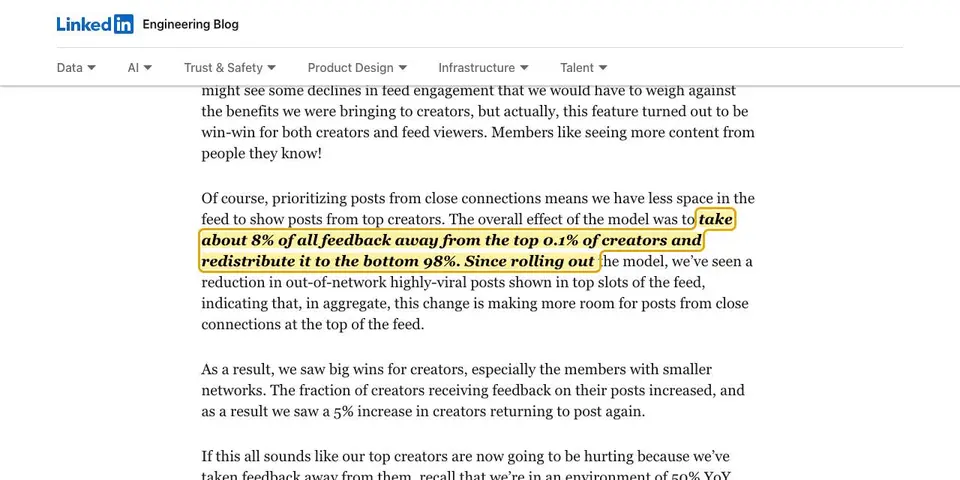
Almost every "LinkedIn algorithm" guide quotes the same few lines, usually without a source. This is the opposite: only what LinkedIn itself has said, on the record, with the receipt attached. Since July 2025 LinkedIn's Sr. Director of Product Management has been answering the myths by name on his own profile: scheduling does not affect distribution, posting from a third-party tool does not affect reach, links do not carry a penalty when the post stands on its own, hashtags are "a nice to have, not a need to have", and "LinkedIn is not designed for virality". Behind that sits a decade of engineering posts: clicks in 2015, virality treated as a problem in 2017, 8% of all feedback deliberately moved from the top 0.1% of creators to the bottom 98% in 2018, dwell time replacing clicks in 2020, and a feed rebuilt on LLMs in 2026.
Search "LinkedIn algorithm" and you get a hundred articles quoting the same handful of lines. Trace those lines back and a surprising number end nowhere. The most repeated sentence in the entire genre, about the feed showing you "people you know, talking about things you care about", is usually sourced to a blog post quoting another blog post.
So here is the other version. Every claim below comes from LinkedIn: its engineering blog, its official blog, or a named LinkedIn employee speaking on the record. Each one has a date, a link, and a screenshot of the page it came from. Nothing here is our opinion, and nothing here comes from a third-party study.
It runs newest first, because what LinkedIn said this year matters more than what it said in 2015. The old material is still here, at the bottom, and it is worth the scroll: the feed's objective has been rewritten twice.
What is on this page
- The myths, answered by LinkedIn's own product leads
- 2026: what LinkedIn is doing about AI slop and automation
- 2026: the feed was rebuilt on LLMs
- 2025: hundreds of signals, audited before launch
- 2022: the official line
- 2020: time replaced clicks
- 2018: LinkedIn took reach from big accounts and gave it to small ones
- 2017: virality became a problem to manage
- 2015 to 2016: the feed predicted whether you would click
- Two things the internet gets wrong
- What LinkedIn has never said
- The rule this page follows
The myths, answered by LinkedIn's own product leads
This is the part nobody collects, and it is the most useful part.
Since July 2025, Rishi Jobanputra, Sr. Director of Product Management at LinkedIn, has been answering feed questions in public posts on his own profile, by name, one myth at a time. He asked for them openly: "Do you have a question you want answered about the LinkedIn Feed or LinkedIn posting myths you've heard that you want me to fact check?"
Here are his answers, newest first, in his words.
Does scheduling a post reduce its reach?
No.
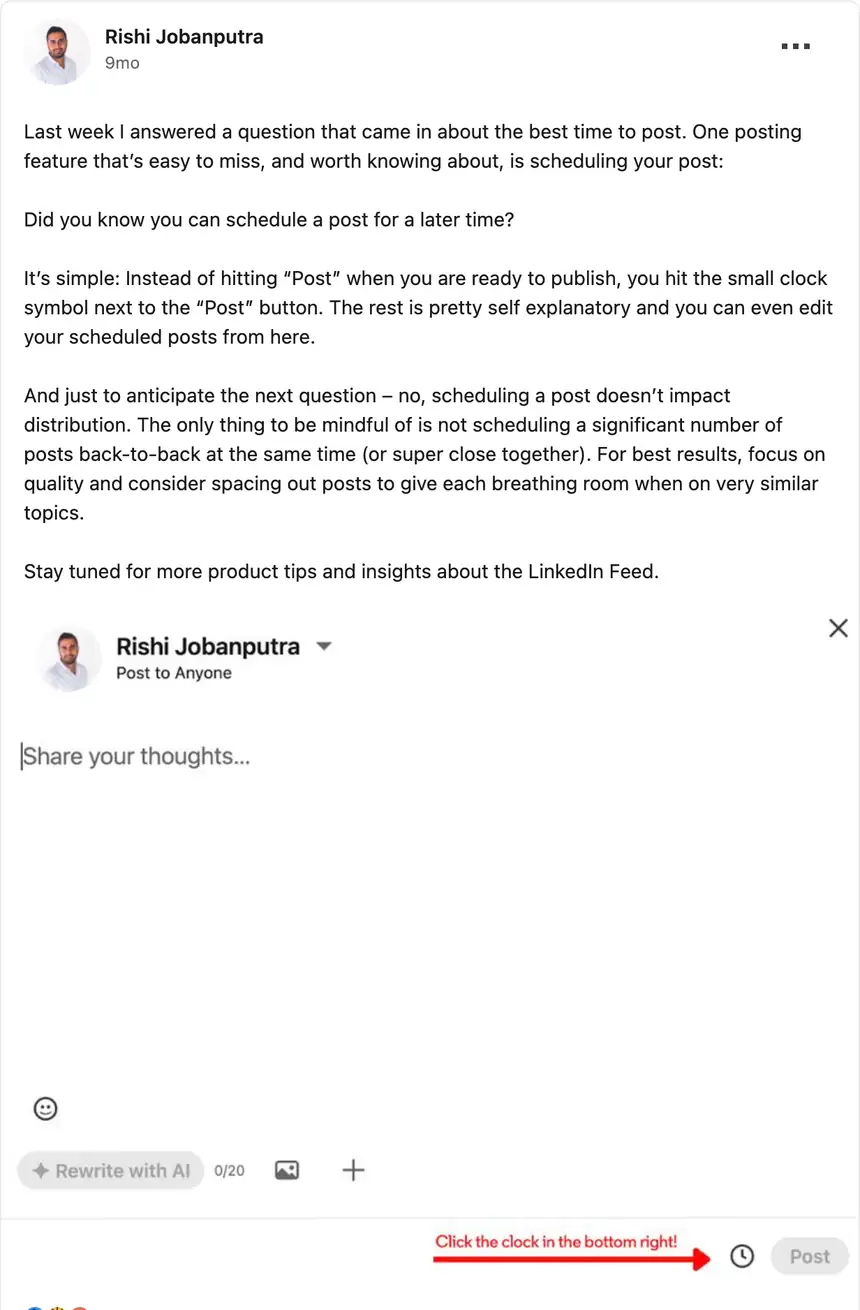
"no, scheduling a post doesn't impact distribution."
9 February 2026. He adds one caveat in the same post, which is about volume rather than scheduling:
"The only thing to be mindful of is not scheduling a significant number of posts back-to-back at the same time (or super close together). For best results, focus on quality and consider spacing out posts to give each breathing room when on very similar topics."
Is there a best time to post?
This one has an answer, and it is softer than the hour-by-hour charts suggest.
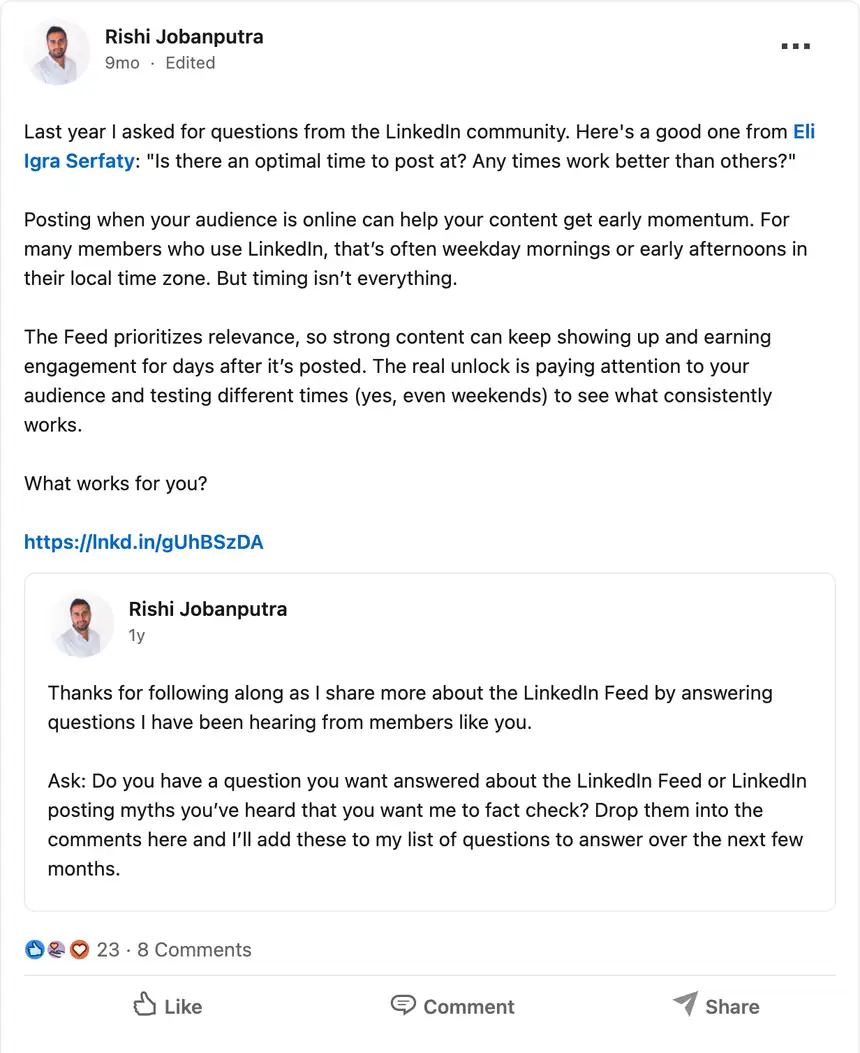
"Posting when your audience is online can help your content get early momentum. For many members who use LinkedIn, that's often weekday mornings or early afternoons in their local time zone. But timing isn't everything."
26 January 2026. The same post undercuts the premise of timing advice altogether:
"The Feed prioritizes relevance, so strong content can keep showing up and earning engagement for days after it's posted."
Does posting from a third-party tool reduce your reach?
No, and he demonstrated it rather than just asserting it.
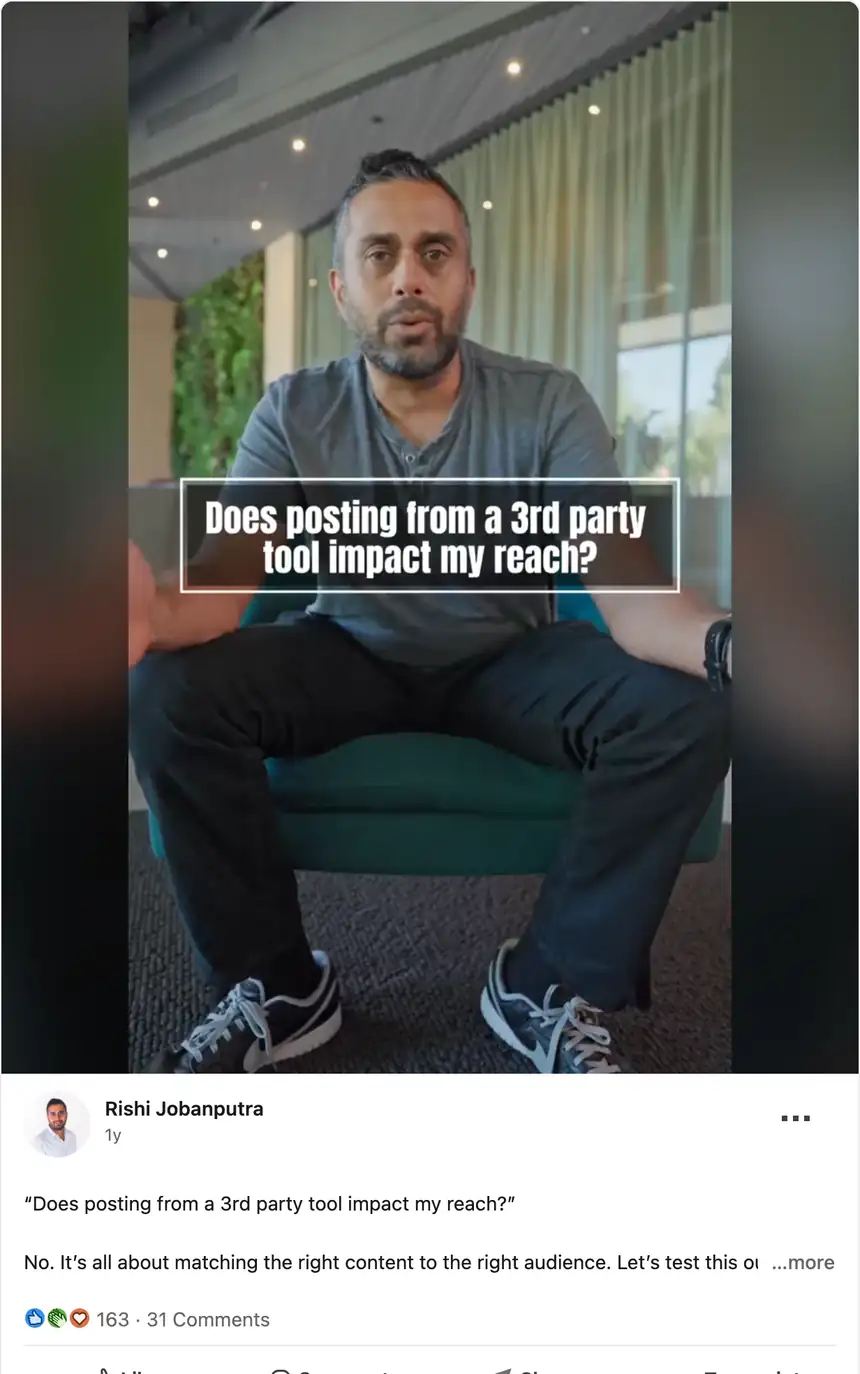
"'Does posting from a 3rd party tool impact my reach?' No. It's all about matching the right content to the right audience. Let's test this out from CapCut."
2 October 2025. He published that post from CapCut, a third-party tool, which is the point.
Do engagement pods work?
They are against the rules, and LinkedIn says it has acted on them by name.
Gyanda Sachdeva, VP of Product Management, 6 November 2025:
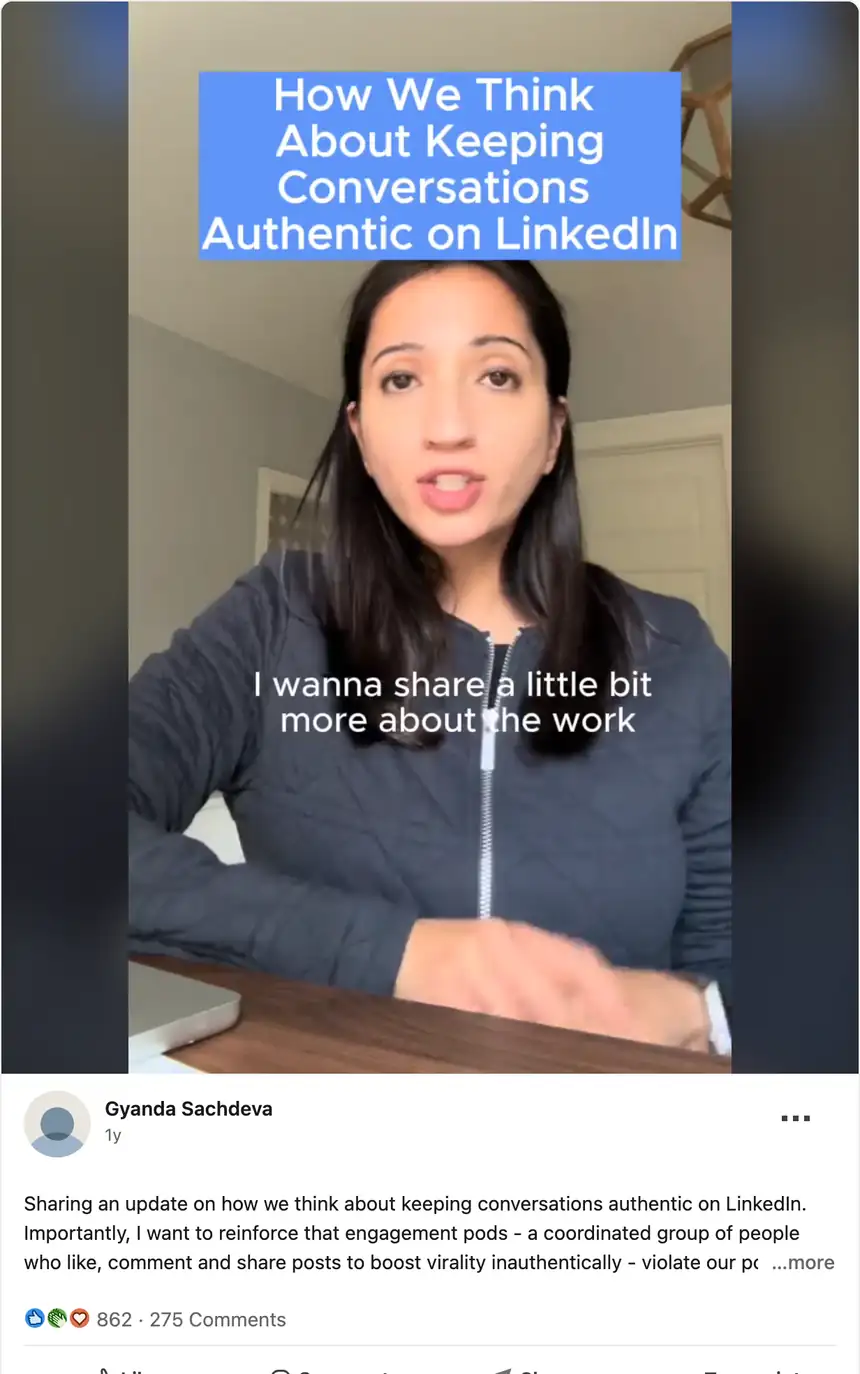
"engagement pods - a coordinated group of people who like, comment and share posts to boost virality inauthentically - violate our policies on LinkedIn. Our goal is to make engagement pods ineffective."
Oscar Rodriguez, VP Product, 18 December 2025, on what that meant in practice:
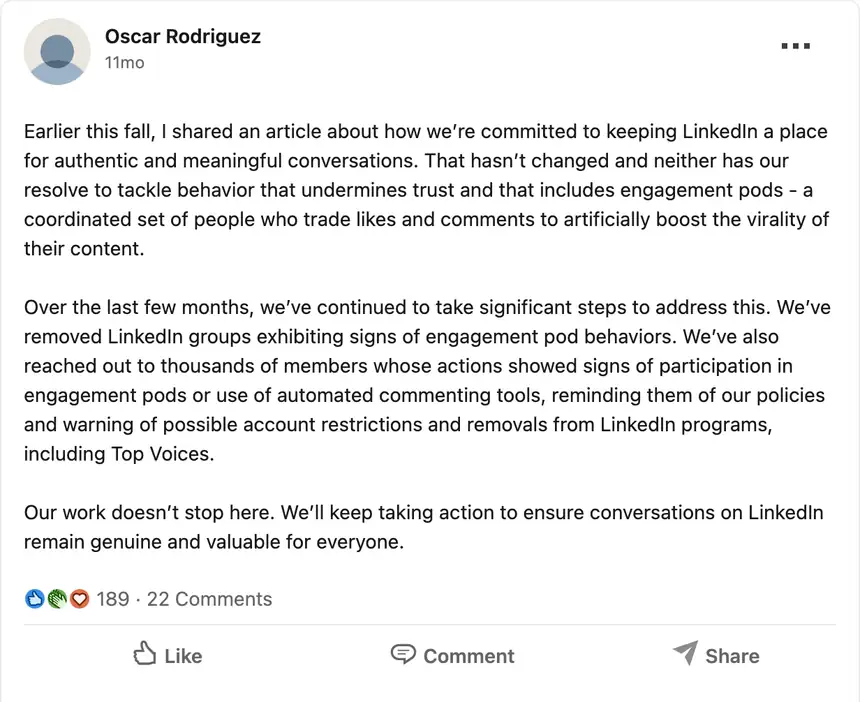
"We've removed LinkedIn groups exhibiting signs of engagement pod behaviors. We've also reached out to thousands of members whose actions showed signs of participation in engagement pods or use of automated commenting tools, reminding them of our policies and warning of possible account restrictions and removals from LinkedIn programs, including Top Voices."
Does commenting "CFBR" help someone's post?
No.
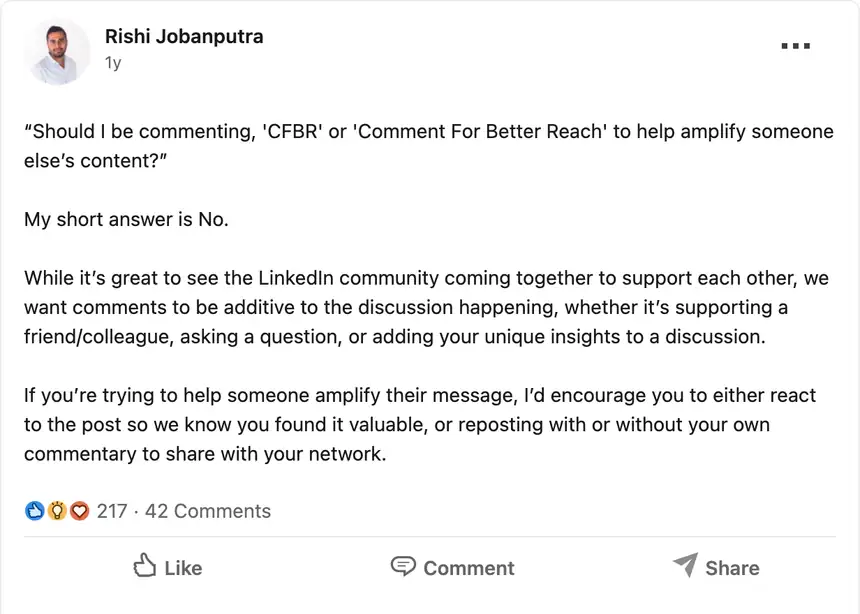
"'Should I be commenting, "CFBR" or "Comment For Better Reach" to help amplify someone else's content?' My short answer is No."
4 September 2025. What he suggests instead is a reaction or a repost, because a comment is supposed to add to the discussion.
Do links in a post get penalised?
Not as a rule. The condition is whether the post works without the link.
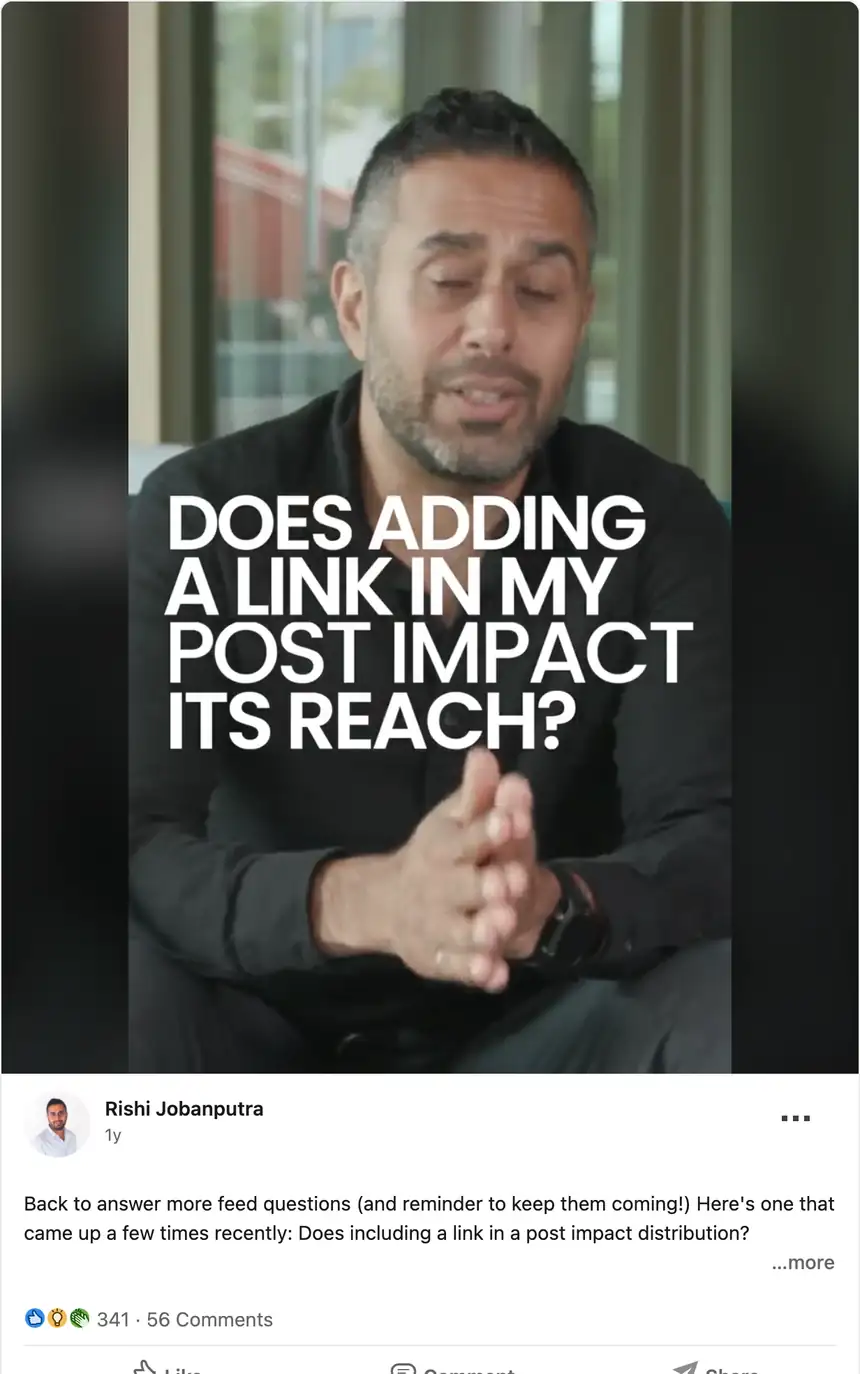
"Does including a link in a post impact distribution? The key takeaway - make sure your post gives enough context that it could stand alone without the link."
14 August 2025. Note what is absent: no percentage, no penalty, no instruction to put the link in the first comment. Every specific number you have read about the cost of links came from somewhere other than LinkedIn.
Is LinkedIn trying to make posts go viral?
It says the opposite, and this line explains most of the rest of the page.
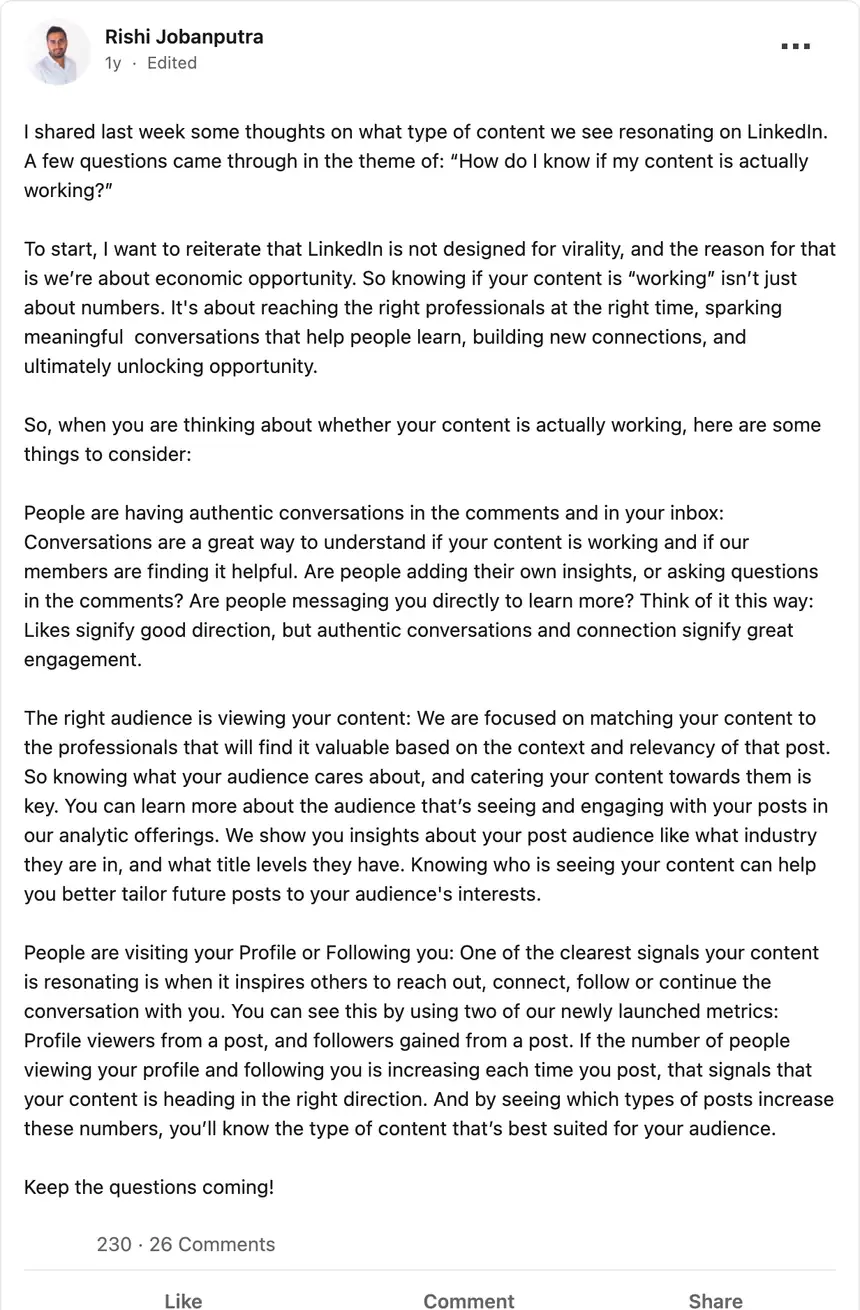
"I want to reiterate that LinkedIn is not designed for virality, and the reason for that is we're about economic opportunity."
6 August 2025.
Will everyone who follows you see your post?
No, and he is unusually direct about it.
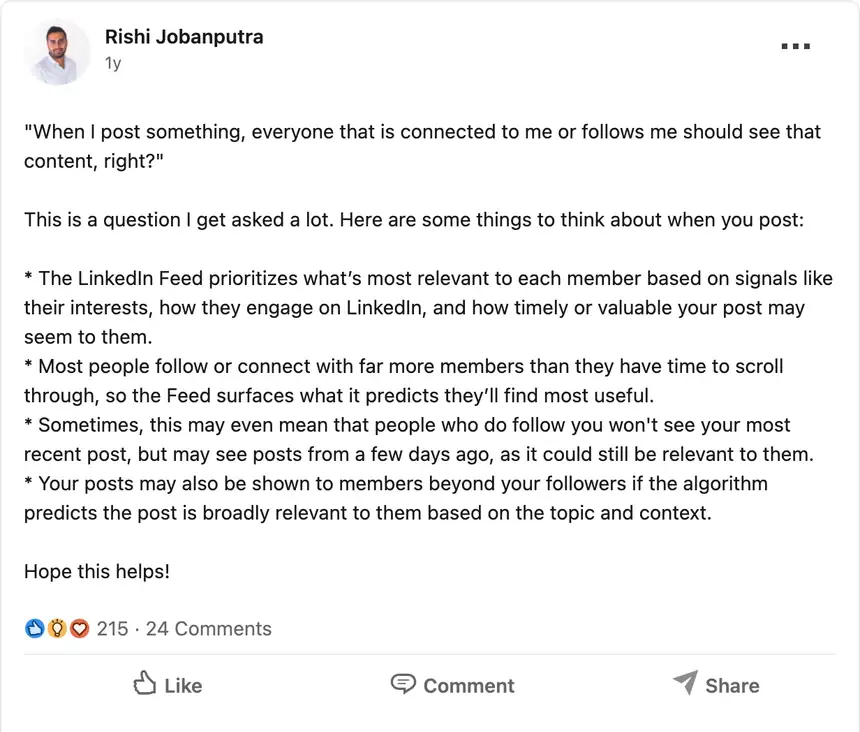
"Sometimes, this may even mean that people who do follow you won't see your most recent post, but may see posts from a few days ago, as it could still be relevant to them."
22 July 2025. The same post confirms the reverse, that reach is not capped at your followers:
"Your posts may also be shown to members beyond your followers if the algorithm predicts the post is broadly relevant to them based on the topic and context."
Do hashtags matter?
Barely.
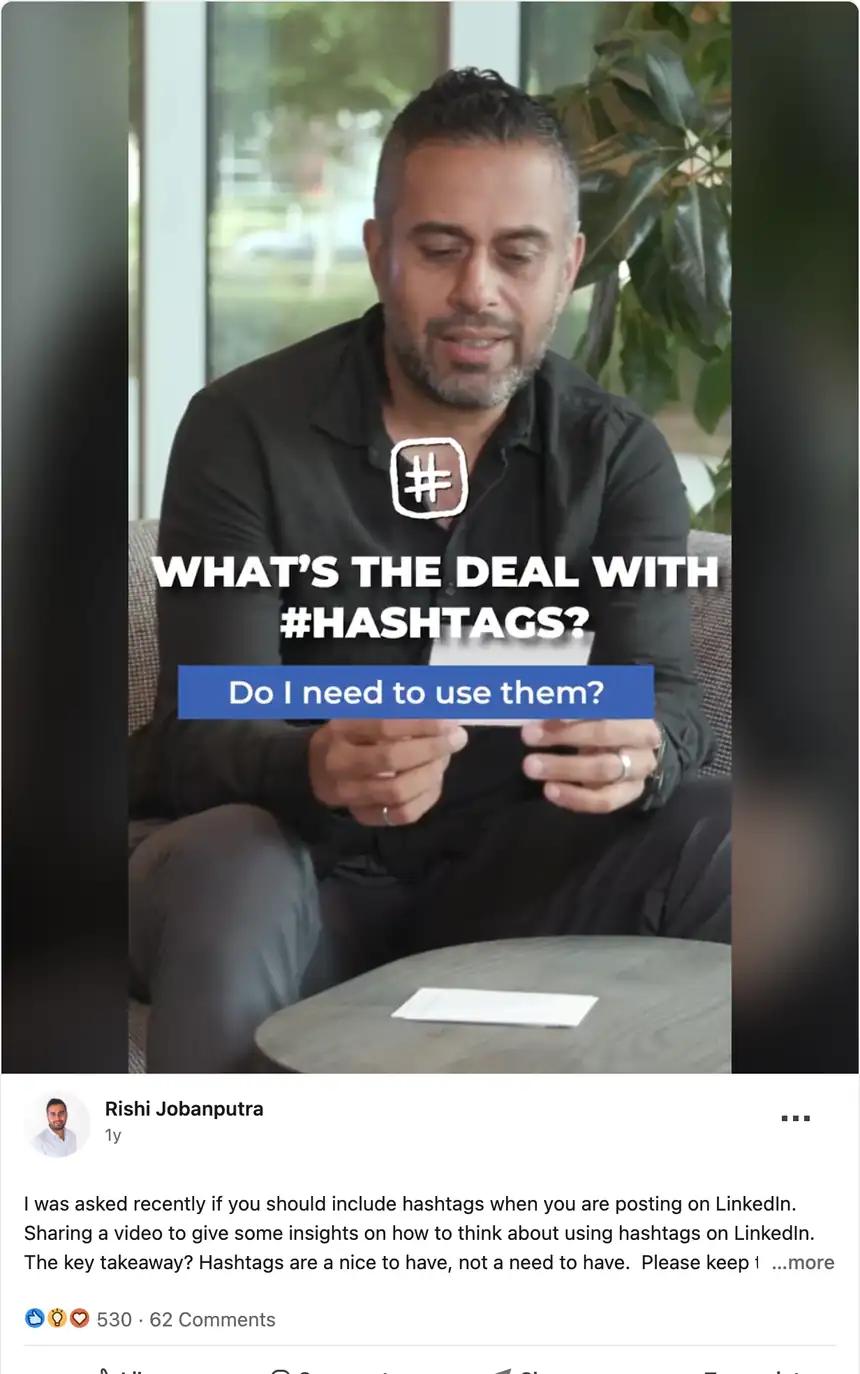
"The key takeaway? Hashtags are a nice to have, not a need to have."
17 July 2025.
2026: what LinkedIn is doing about AI slop and automation
This is the most commercially relevant section if you use any tool to post or comment, and LinkedIn has been specific.
Hari Srinivasan, Chief Product Officer, LinkedIn Ecosystem, 30 July 2026, with the only enforcement numbers LinkedIn has published:
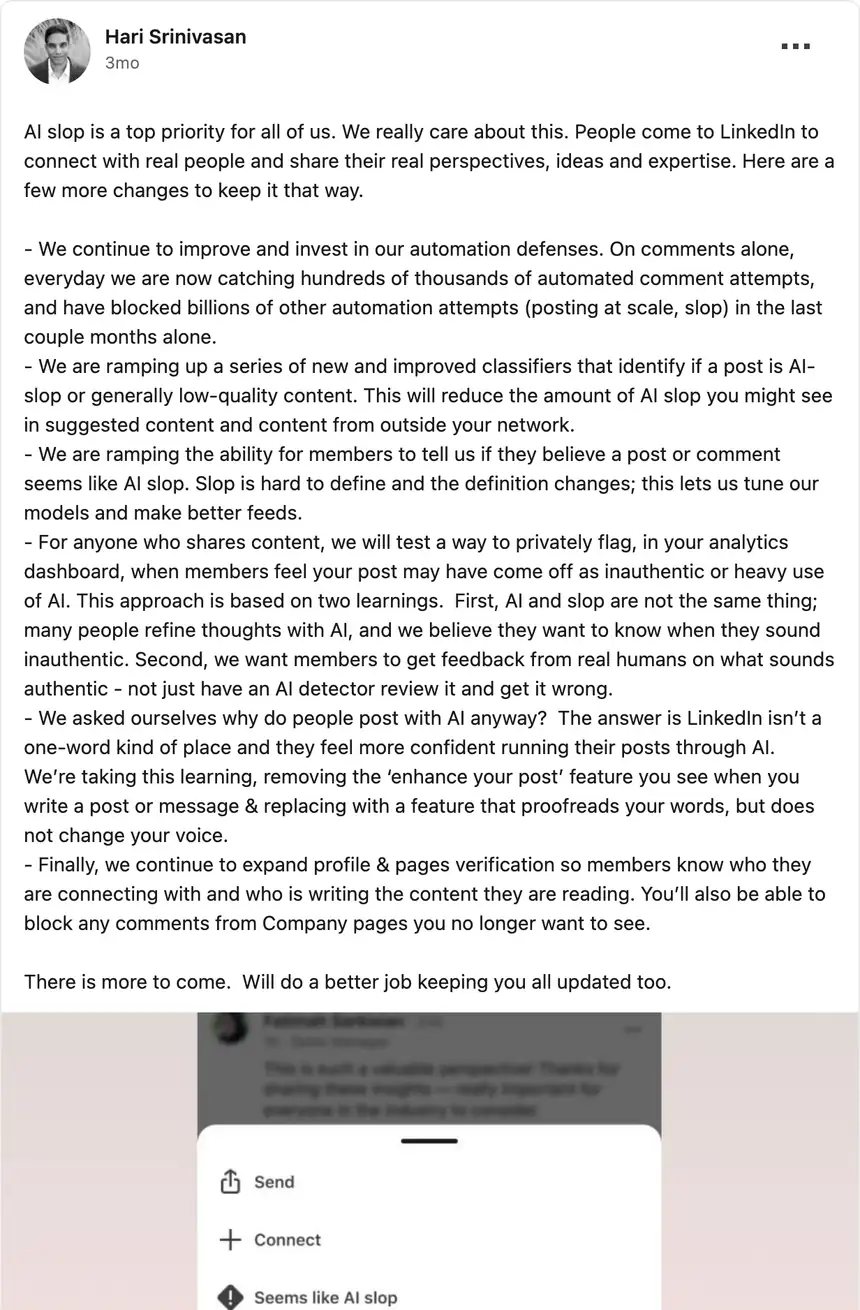
"On comments alone, everyday we are now catching hundreds of thousands of automated comment attempts, and have blocked billions of other automation attempts (posting at scale, slop) in the last couple months alone."
The same post describes what is coming: classifiers that identify a post as AI slop or low quality and cut its distribution in suggested content, a way for members to report slop, and a private flag in your own analytics when readers found your post inauthentic. It also draws the distinction that matters:
"AI and slop are not the same thing; many people refine thoughts with AI, and we believe they want to know when they sound inauthentic."
LinkedIn even removed its own AI writing feature over this:
"We're taking this learning, removing the 'enhance your post' feature you see when you write a post or message & replacing with a feature that proofreads your words, but does not change your voice."
In August 2026, Tim Jurka, VP of Engineering, went further on automated comments on Software Engineering Daily. The full transcript is public.
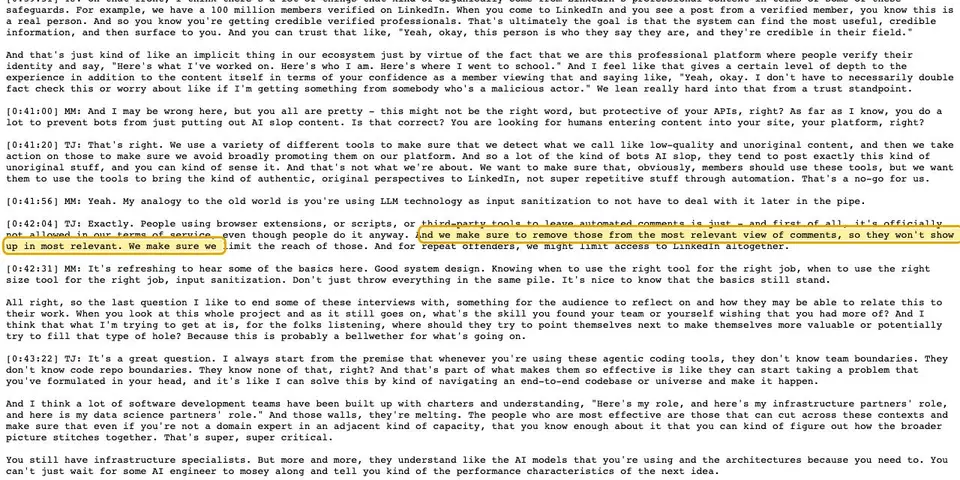
"We make sure to remove those from the most relevant view of comments, so they won't show up in most relevant."
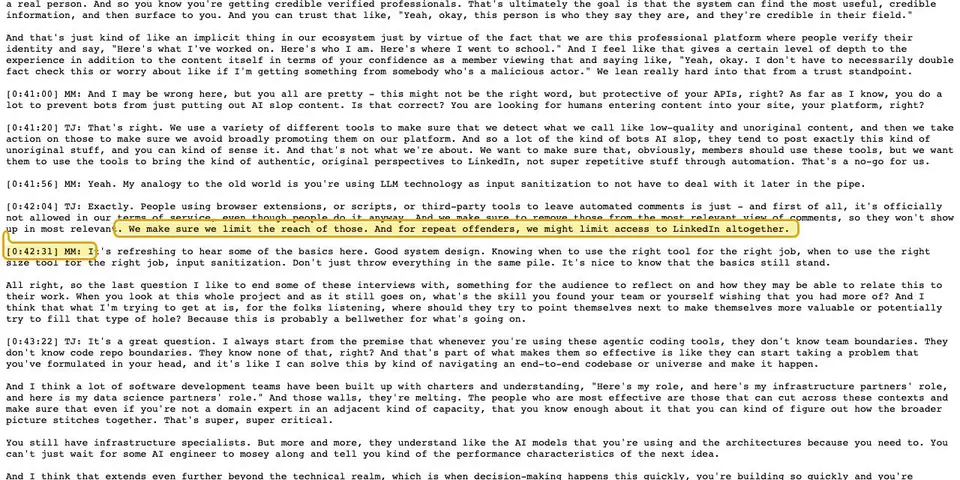
"We make sure we limit the reach of those. And for repeat offenders, we might limit access to LinkedIn altogether."
He is specific that this is about comments left through browser extensions, scripts and third-party tools, and says it is already against LinkedIn's terms of service. In the same answer, he is equally specific that using AI is not the problem:
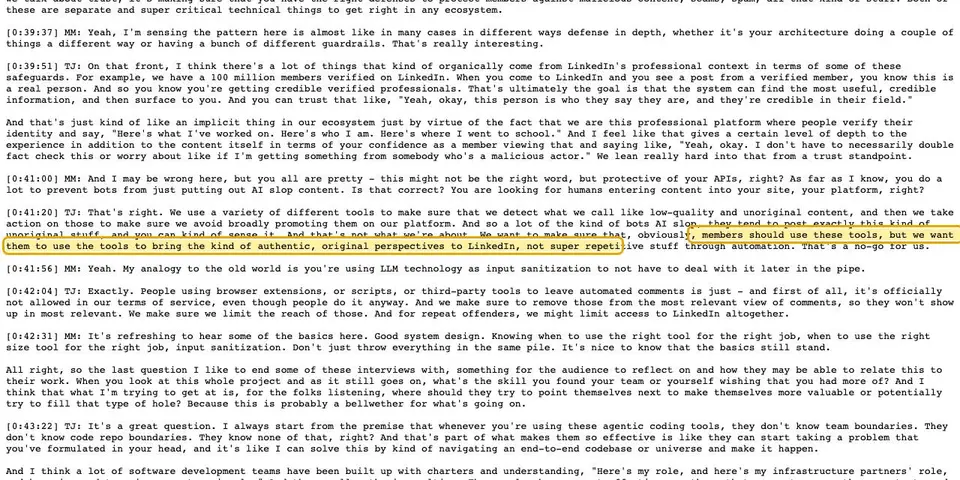
"members should use these tools, but we want them to use the tools to bring the kind of authentic, original perspectives to LinkedIn"
Put the two together and LinkedIn's position is consistent: write your own post with whatever tools you like, and schedule it with whatever tool you like. Point a bot at other people's posts and you are the target.
2026: the feed was rebuilt on LLMs
In March 2026 LinkedIn published the architecture of the current feed. The ranking model is new, and so is the unit it reasons about.
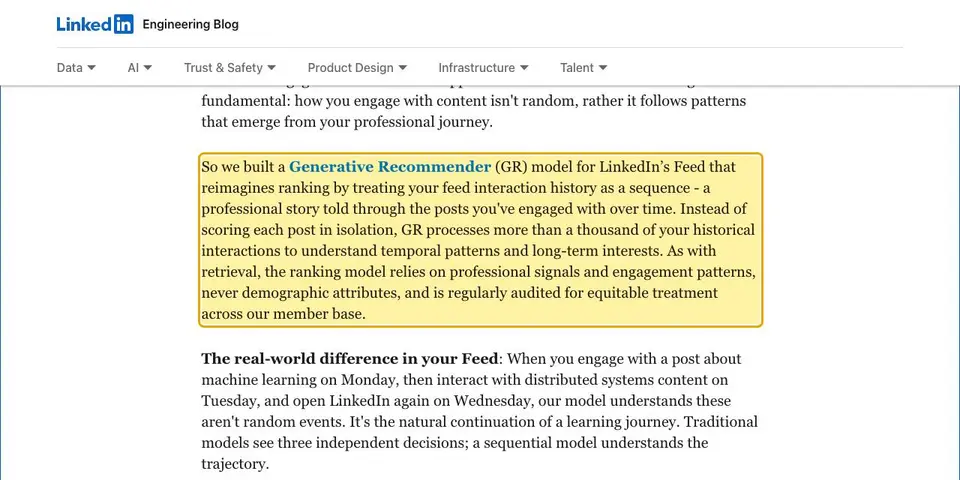
"we built a Generative Recommender (GR) model for LinkedIn's Feed"
Instead of judging each post on its own, it reads your history as a sequence:
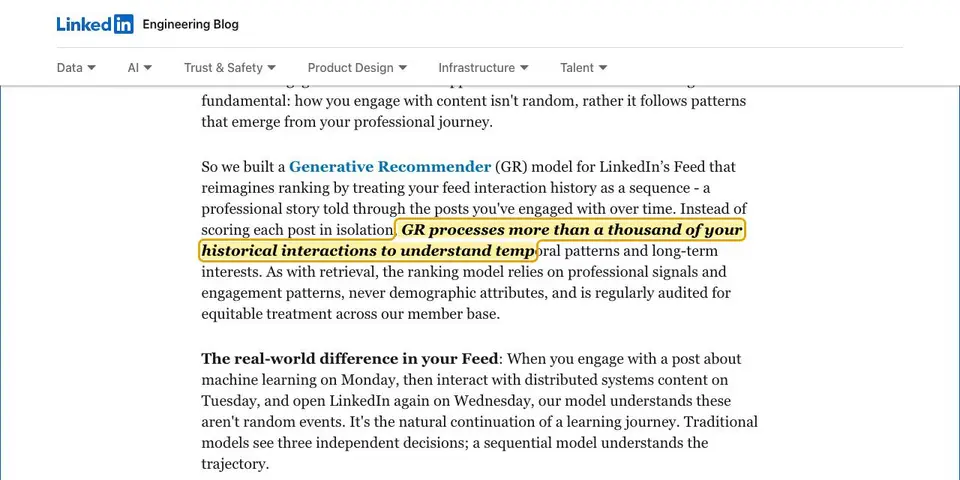
"GR processes more than a thousand of your historical interactions"
The post also reports that it deliberately broke the link between how popular a post is and how relevant the system thinks it is, measuring a near zero correlation of -0.004 between popularity counts and relevance scores, and a 15% improvement in recall@10 after the change. In other words, raw popularity was removed as a shortcut for relevance.
That is the engineering counterpart to what Rishi Jobanputra keeps saying in plain language: this is not a virality machine.
2025: hundreds of signals, audited before launch
The November 2025 engineering post is mostly about fairness, and it is the source of the number people cite loosely:
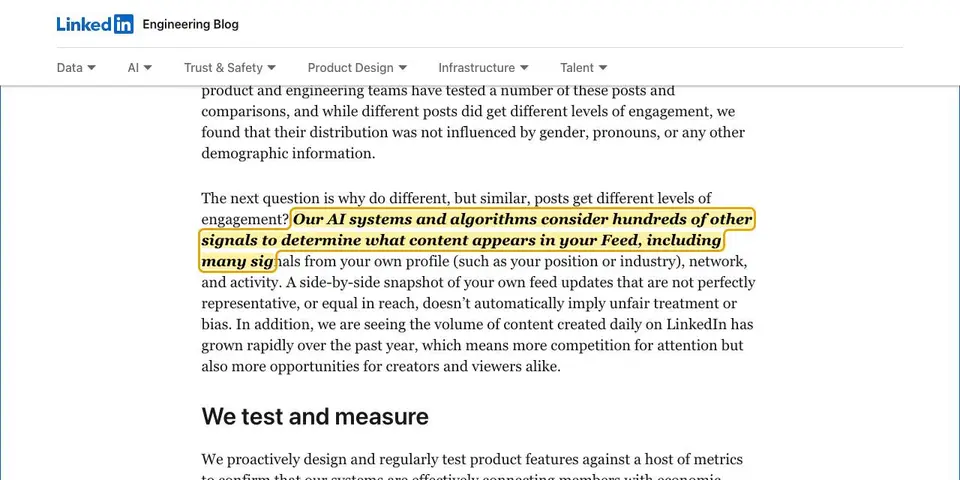
"Our AI systems and algorithms consider hundreds of other signals to determine what content appears in your Feed"
The same post says LinkedIn tests, before each major model launch, whether creators from any one group are systematically ranked lower than others given similar engagement and quality.
2022: the official line
In 2022 LinkedIn ran a three-part series called "Mythbusting the Feed" on its main blog, aimed at members rather than engineers. It is lighter on specifics, but it does name a category of content that gets held back:
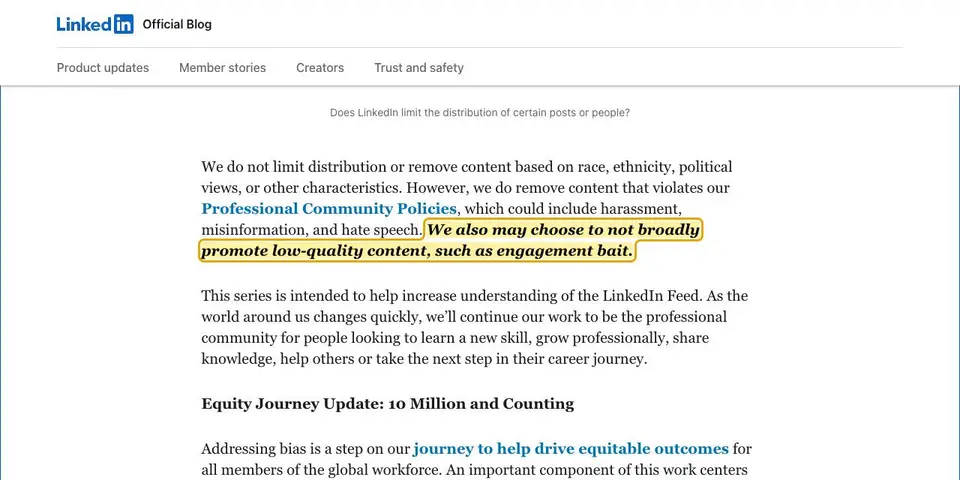
"We also may choose to not broadly promote low-quality content, such as engagement bait."
2020: time replaced clicks
The dwell time post is where the 2015 objective gets dismantled by its own authors. Clicks, it says, are noisy. What replaced them is more demanding, because not reading is now a cost:
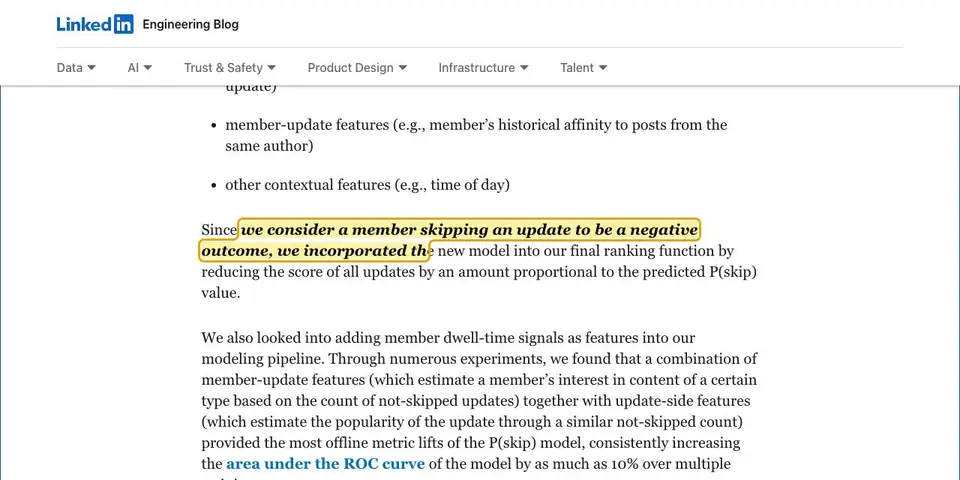
"we consider a member skipping an update to be a negative outcome"
The post explains that scores are reduced in proportion to how likely a skip is. Then it states the philosophy in one line:
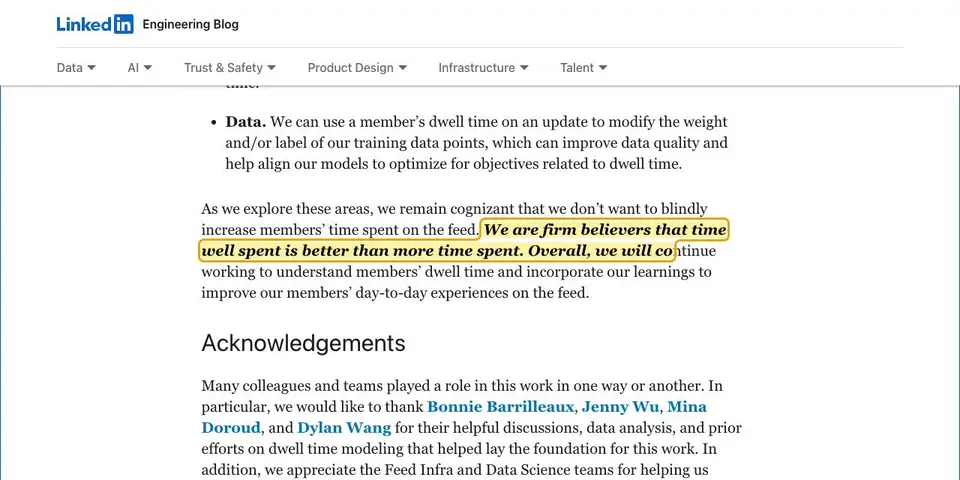
"We are firm believers that time well spent is better than more time spent."
2018: LinkedIn took reach from big accounts and gave it to small ones
This is the post that should be famous and is not. LinkedIn's data science team wrote up "creator-side optimization" and said out loud what it did to the distribution of attention:
"take about 8% of all feedback away from the top 0.1% of creators and redistribute it to the bottom 98%"
The reasoning is stated just as directly:
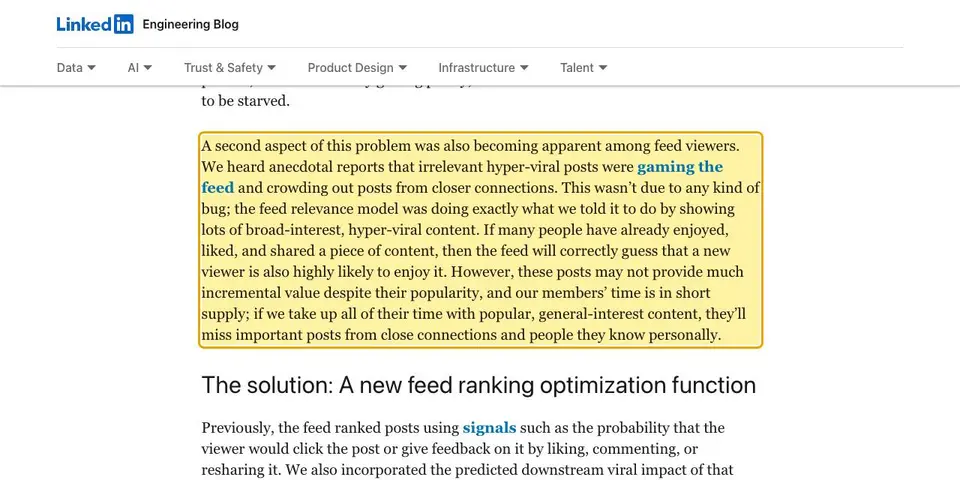
"irrelevant hyper-viral posts were gaming the feed and crowding out posts from closer connections"
And the reason they cared, which is the most quotable statistic in the whole archive for anyone deciding whether to keep posting:
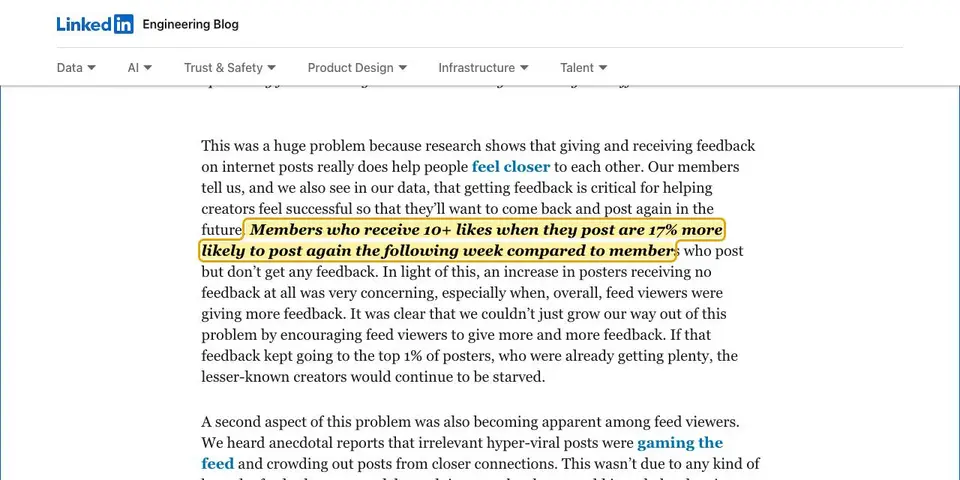
"Members who receive 10+ likes when they post are 17% more likely to post again the following week"
Read those three together and the incentive is clear. LinkedIn wants more people posting, so it spends some of the biggest accounts' reach to get smaller accounts their first ten reactions.
2017: virality became a problem to manage
By 2017 the framing had changed. Reach was no longer only something to maximise, it was something that could go wrong. The post is explicit that a small number of low-quality posts travelling far is a failure state, and it reports what the fix did:
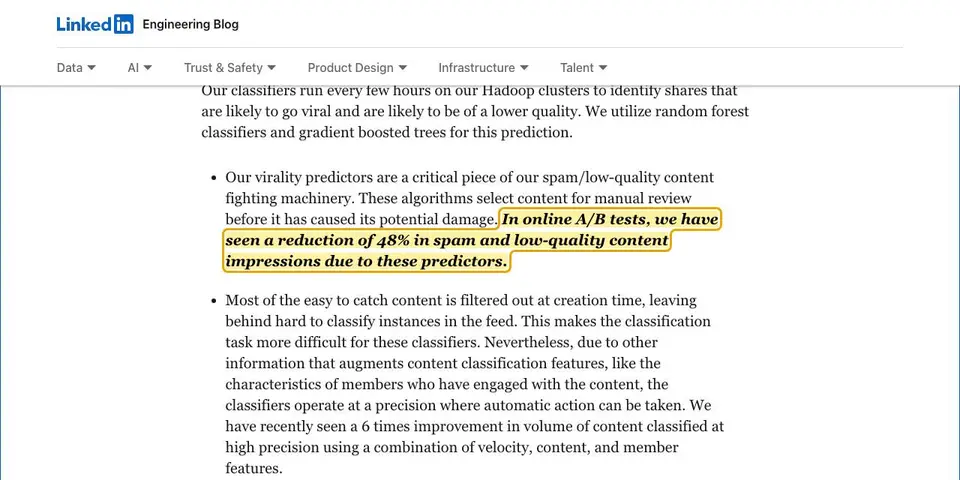
"In online A/B tests, we have seen a reduction of 48% in spam and low-quality content impressions due to these predictors."
2015 to 2016: the feed predicted whether you would click
The earliest detailed account of feed ranking is Guy Lebanon's two-part series. It is blunt in a way LinkedIn no longer is.
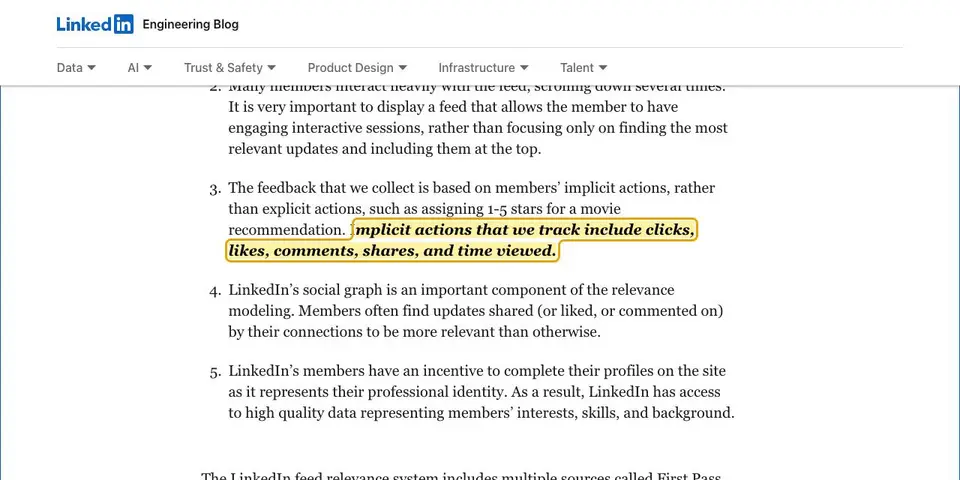
"Implicit actions that we track include clicks, likes, comments, shares, and time viewed."
The model's job was stated just as plainly. Part two says the relevance model is trained to predict the interaction rate between a viewer and an update, then adds a line that tells you exactly what was being optimised:
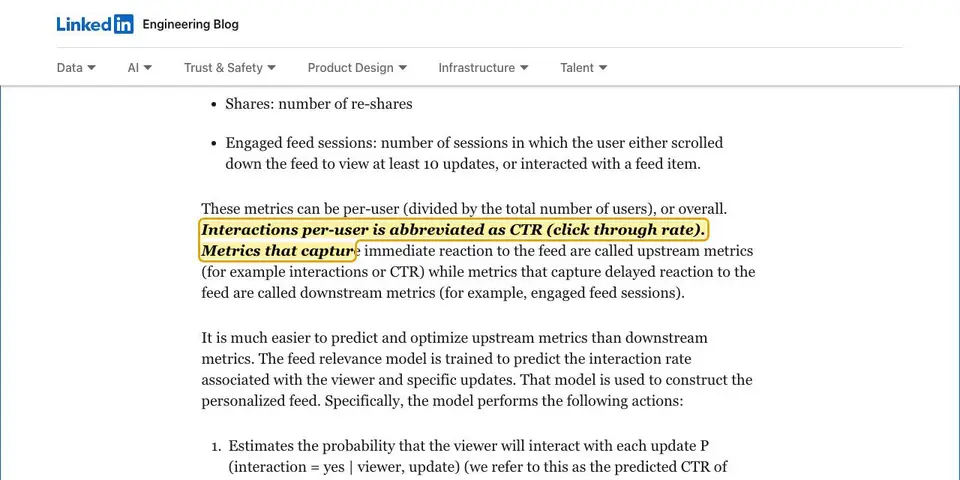
"Interactions per-user is abbreviated as CTR (click through rate)."
Part one also gives a number nobody quotes, about how much of your feed comes from your own network:
"That source contains over 50% of the updates in the LinkedIn feed."
Read that next to the 2026 rebuild and you can see the whole arc: a model trained to predict clicks became a model that treats a skip as a cost, then a model told not to use popularity as a proxy for relevance at all.
Two things the internet gets wrong
While assembling this we found two errors repeated across many sites.
The first part of "Mythbusting the Feed" is dated 25 May 2022 on the page itself. A lot of articles say 23 May.
The March 2026 engineering post names no base model. It does not mention 360Brew, and it does not mention LLaMA, although plenty of coverage says it does. It names a Generative Recommender, fine-tuned LLMs used for retrieval, and a mixture-of-experts ranking head.
What LinkedIn has never said
Worth noting, because the absence is itself information. In everything we read, LinkedIn has never published a posting frequency, never said that editing a post hurts reach, and never given a number for how much external links cost you. Every confident claim you have read about those comes from somewhere other than LinkedIn.
The rule this page follows
A statement qualifies if LinkedIn published it, or if a named LinkedIn employee said it on the record. That is the whole filter. It excludes every agency study, every reverse-engineering experiment, and our own data too. Not because those are worthless, but because the moment you mix them in, you are back to a blog post quoting a blog post.
Every quote here was located in the live page text before it was captured, so each one is confirmed to exist word for word on the page it is attributed to. Where LinkedIn has said nothing, this page says so rather than filling the gap with someone's guess.
Free, one email
Read the full research
Every statement LinkedIn has published about how its feed ranks posts, 2015 to 2026, with the quote, the date, a link and a screenshot of the page it came from. We send the occasional LinkedIn research like this one too.
No spam, unsubscribe anytime.
More LinkedIn guides
How a General Counsel who started with 200 connections got 970,000 LinkedIn views in 6 months
A real LinkedIn case study. Andrei Bodilovskii is a General Counsel in IT, FinTech and AI. He started in May with about 200 connections and now has about 1,400 followers. His 20 posts since then reached roughly 970,000 views, and 4 of them passed 100,000. His method is simple. He finds formats that are already working in neighbouring niches and repurposes them for his audience of lawyers, with Claude and the 2pr.io MCP doing the legwork.
November 3, 2026How to read your LinkedIn analytics (2026 guide)
How to read LinkedIn analytics in the new Dashboard: what each metric means, what's normal across 42,544 posts, and what to do with the numbers.
October 21, 202621 students, 5 paying customers: why a small trusted group beats a big audience
A real affiliate case study. Joachim Lépine trains professional translators to get clients on LinkedIn. He recommended 2pr.io to a beta group of 21 people, and 5 became paying customers, most on annual plans. That is roughly 1 in 4, and $350 in commission in seven weeks, from a group smaller than most LinkedIn posts' comment sections.
Grow on LinkedIn with 2pr
Ideas, AI drafts in your voice, carousels, scheduling, and analytics: one tool. Start your free trial.
Start free trial