
How Nikita Benkovich 32x'd his LinkedIn reach in three steps
July 17, 2026
TL;DR
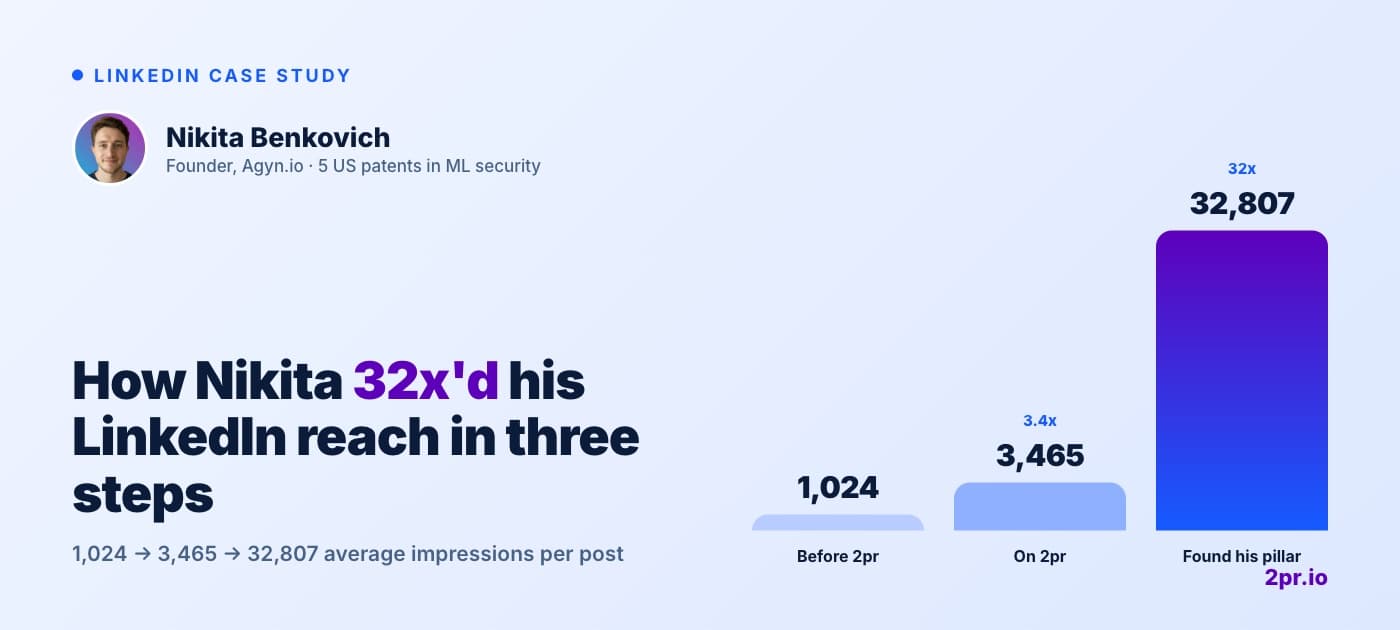
Nikita Benkovich is a security researcher and founder (5 US patents in ML security, founder of Agyn). His average LinkedIn post used to reach about 1,024 people. After he started using 2pr.io, that tripled to 3,465. Then he found his real content pillar, original cybersecurity research on the AI coding tools everyone uses, and his average jumped to 32,807. Two jumps, and they are not the same kind. A tool multiplied his reach about 3x through consistency and packaging. Having something only he could say multiplied it again, by roughly 9x more. The run added up to 429,606 impressions, 363 new followers, and 10 investor meetings. Expertise is the moat. Distribution just makes it visible.
Nikita Benkovich is a friend of mine, and one of the sharpest security researchers I know. That is the only reason I can write this with the real numbers instead of the polished ones.
Here is the short version of who he is. Nikita is the founder of Agyn, an open-source control plane for AI agents in the enterprise. He is a co-inventor on 5 US patents in ML-based cybersecurity from his years at Kaspersky, he won first place at the NeurIPS 2022 Trojan Detection Challenge, and he previously founded Hautech.ai, a generative AI company that reached $1M ARR and 13,700 customers. Agyn's own research hit 72.2% on SWE-bench Verified, the top result among GPT-5-based systems at release.
None of that is content. It is the reason his content works.
The numbers, in three periods
The clearest way to see what happened is to line up his average impressions per post across three stretches of time.
Swipe sideways to compare
| Period | Posts | Avg impressions per post |
|---|---|---|
| Before 2pr | 87 | 1,024 |
| First months on 2pr | 32 | 3,465 |
| After the cybersecurity pillar | 7 | 32,807 |
Two jumps, and they are not the same kind of jump.
Jump one: 1,024 to 3,465. This is what changed when he started using 2pr. Same person, same expertise, same follower base. What changed was the packaging and the cadence. His ideas started landing as finished posts, consistently, instead of once in a while. That alone more than tripled his average reach. For context, his 2025 baseline was around the same 1,000, so this is not an old-history artifact. It is a real step up.
Jump two: 3,465 to 32,807. This is what changed when he stopped posting about AI in general and started publishing original security research on the AI coding tools everyone uses. He red-teamed Claude Code, Codex, OpenCode, and Grok CLI, and showed exactly what breaks, reproducibly. That is a roughly 9x jump on top of the first one, and 32x versus where he started.
The lesson is right there in the two numbers. A good tool multiplied his reach a few times over. Having something only he could say multiplied it again, by a lot more.
Then the followers followed
Reach is nice. Followers are the compounding asset, and they moved even harder than impressions.
- Before 2pr: 48 new followers across 87 posts. About one every two posts.
- First months on 2pr: 69 followers across 32 posts. About two per post.
- After the cybersecurity pillar: 247 followers across just 7 posts. About 35 per post.
His single best post, the Claude Code backdoor writeup, added 104 followers on its own, more than his previous 87 posts combined. When you say something worth following, people follow.
The reach was not even the point
It is easy to look at 429,606 total impressions and stop there. Nikita did not.
The audience his security research attracts is technical, security-aware, and investor-adjacent. It is exactly the audience Agyn needs. So the reach did not stay in the feed. Across the run it turned into 239,913 people reached, 1,410 profile clicks, a spot in the top 10% of Y Combinator applications, and 10 investor meetings.
Every post also doubled as a live demo of the company's thesis. Agyn secures AI agents. Nikita's posts are, quite literally, him finding the ways AI agents get compromised. The content and the company were the same argument.
Three posts from his pillar
Real examples from his feed, impressions from our analytics:
- "I found a critical vulnerability in Claude Code." He walked through how a compromised weather tool talked Claude Code into installing software on his laptop, step by step, no confirmation dialog. 95,444 impressions, 60,960 people reached, 104 new followers from one post.
- "OpenAI's Codex is destroying SSDs." He took a story the community was already arguing about and added the measured numbers and the root cause. 52,915 impressions, 33,201 reached.
- "xAI's Grok CLI exfiltrates your entire repo silently." A simple test, a clear result, and a question that made people stop. 29,363 impressions, 18,629 reached.
Notice what those three have in common. They are newsworthy (named products that millions of people use), they are in his lane (security), and every claim is something he can defend in the comments. That last part matters more than the hook. It is why the posts kept spreading instead of dying after the first wave.
The lesson
Most LinkedIn advice is about the wrapper. The hook, the line breaks, the posting time, the streak. All of that is real, and it is worth roughly a 3x. That is the first jump, and a tool handles most of it for you.
But the second jump, the 9x on top, did not come from the wrapper. It came from the payload. When Nikita posted something only he could credibly say, about something the world happened to care about that week, the reach took care of itself.
So the order of operations is this. Find the thing you know better than almost anyone. Point it at something people already care about right now. Then make it easy to keep doing. Only the last step is a tool.
Expertise is the moat. Distribution just makes it visible. Cases like Nikita's are the main reason we build 2pr.io: so a clear idea becomes a finished, well-targeted post in minutes, and you actually keep publishing long enough to win.
FAQ
Did 2pr write his viral posts?
No. The research, the findings, and the point of view are entirely Nikita's. 2pr is how he shapes them into finished posts and ships them consistently. He uses it for all of his posts.
Was it the tool or the content that drove the results?
Both, in sequence, and you can see them separately. The tool drove the first jump, from 1,024 to 3,465 average impressions, through consistency and packaging. His content pillar drove the second and much larger jump, from 3,465 to 32,807. Either change alone would have underperformed.
Is this repeatable, or did he get lucky?
The cybersecurity posts are repeatable because they come from a durable advantage. He keeps doing real security research, so he keeps having real things to say. The 3x from consistency is repeatable for anyone. The 9x from expertise is repeatable for anyone with genuine depth in a topic people care about.
I do not have 5 patents. Does this still apply to me?
Yes. You do not need patents. You need one topic you understand better than your audience, and the discipline to post about it consistently. Nikita's edge is deep, but the mechanism is the same at any level.
What is the single takeaway?
Have something only you can say. Then say it sharply, and say it often.
More LinkedIn guides
Best LinkedIn MCP Server in 2026: Honest Comparison
Best LinkedIn MCP server in 2026. Compare 2pr.io, Taplio, ViralBrain, scrapers, and data platforms on media, safety, and setup.
June 24, 2026How Kevin Meyer does 12M LinkedIn impressions a year, repeatedly
A real LinkedIn case study. Kevin Meyer consistently does around 1M impressions a month, 12M a year, with 60k followers. Not one viral fluke, a repeatable system: reverse-engineering winning posts, using memes as a business weapon, and a cadence that compounds. Here is how it works.
October 2, 2026How to get more impressions on LinkedIn: 12 lessons
How to get more impressions on LinkedIn, from 2M impressions in a year: chase breakout posts, win the hook, pick a lane, and measure every post.
Grow on LinkedIn with 2pr
Ideas, AI drafts in your voice, carousels, scheduling, and analytics: one tool. Start your free trial.
Start free trial